





Harness Cable Assemblies for Distributors: Stock and Packaging
- Building a Distributor Inventory Model for Preassembled Cable Sets
- Separate fast-moving configurations from engineered variants
- Use demand segmentation and service-level targets
- Control component availability and obsolescence
- Packaging Engineering for Reliable Warehouse and Transit Performance
- Protect connectors, cable geometry, and termination areas
- Manage moisture, contamination, and electrostatic risks
- Standardize carton information and export documentation
- Supplier Qualification for Industrial Connector Distribution
- Evaluate manufacturing control and application coverage
- Confirm electrical, mechanical, and environmental evidence
- Measure total cost rather than purchase price alone
- How WEIPU Supports Distributor Stock and Packaging Programs
- Broad product coverage and scalable production
- Quality systems for demanding end markets
- Flexible OEM, ODM, and replenishment support
- Frequently Asked Questions
For distributors, a harness cable assembly program is not simply a matter of purchasing finished cable sets and placing them on a shelf. Stock decisions affect working capital, order fulfillment, product compatibility, field reliability, and the cost of returns. Packaging decisions are equally important because industrial connectors can be damaged by moisture, impact, contamination, electrostatic discharge, incorrect bending, or mixed-lot identification before installation. A reliable distribution strategy therefore combines demand forecasting, connector and cable standardization, batch traceability, protection against transport conditions, and clear customer-facing documentation. The most effective suppliers support this process with configurable circular connectors, heavy-duty connector systems, industrial connector families, sample approval, and repeatable production controls.
Building a Distributor Inventory Model for Preassembled Cable Sets
Separate fast-moving configurations from engineered variants
Distributors should classify products according to sales velocity, application criticality, configuration stability, and replenishment lead time. High-volume combinations with stable pin counts, contact arrangements, cable lengths, jacket materials, and termination methods are suitable for finished-goods stock. Less predictable variants should be managed as modular kits or made-to-order items. This distinction prevents capital from being tied up in slow-moving assemblies while preserving quick response for standard customer requirements.
A useful stock-keeping unit structure records more than connector family and cable length. The product code should identify contact count, gender, keying or coding, conductor size, shielding, jacket type, termination process, environmental rating, and revision level. If a distributor stores visually similar products under vague descriptions, picking errors become likely. A controlled configuration record also helps customers reorder the correct item when equipment is serviced months or years after the original installation.
Use demand segmentation and service-level targets
Stock levels should reflect the commercial consequences of a shortage. A cable set for a noncritical control panel may tolerate a longer lead time, while a replacement part for a production line, medical device, rail vehicle, or renewable-energy converter may require immediate availability. ABC analysis can rank items by annual consumption value, while an additional criticality category can identify products that require higher service levels regardless of sales volume.
Reorder points should account for average demand during supplier lead time, demand variability, receiving inspection, and a defined safety stock. A simple planning formula is reorder point equal to expected lead-time demand plus safety stock. The formula is only useful when sales history, open orders, supplier performance, and engineering revisions are maintained accurately. Distributors should review the result periodically rather than relying on a permanent minimum quantity established during a single project.
Control component availability and obsolescence
Finished assemblies often contain multiple risk points: connector bodies, contacts, backshells, seals, cable, labels, protective caps, and specialized tooling. A shortage of one low-cost component can stop shipment of the complete product. Supplier agreements should therefore define approved alternates, end-of-life notification, minimum order quantities, and the process for approving a material or design change.
Stock rotation is particularly important for rubber seals, adhesives, heat-shrink materials, plated contacts, and cables with shelf-life or storage-temperature limits. FIFO or FEFO practices, depending on the material, reduce degradation and prevent old inventory from remaining hidden behind newer receipts. Any substitute must be validated for electrical performance, mechanical fit, environmental sealing, and regulatory requirements before release.
Packaging Engineering for Reliable Warehouse and Transit PerformanceProtect connectors, cable geometry, and termination areas
Packaging should prevent the connector interface from becoming the weakest point in the logistics chain. Protective caps or covers can shield contacts and threaded or bayonet coupling surfaces from dust, impact, and accidental deformation. Cable exits should not be forced into a sharp radius, compressed beneath heavy cartons, or tied so tightly that insulation and strain relief are damaged. The manufacturer’s minimum bend radius and the assembly’s approved routing geometry should guide the pack-out design.
Small assemblies may be placed in individual bags or compartments, while larger harnesses often require formed trays, partitions, reels, or custom corrugated inserts. The objective is not merely attractive presentation. The package must keep each assembly identifiable, prevent tangling, stop connector-to-connector contact, and allow warehouse personnel to remove one unit without disturbing the rest of the lot.
Manage moisture, contamination, and electrostatic risks
Industrial distribution channels may expose products to high humidity, condensation, salt air, dust, vibration, and repeated temperature changes. Packaging specifications should define whether a moisture-barrier bag, desiccant, humidity indicator, corrosion inhibitor, or sealed inner liner is required. The correct method depends on the materials, storage duration, shipping route, and customer environment. Packaging must not introduce fibers, oils, or residues that could contaminate contacts or optical and medical equipment.
Electrostatic-sensitive components require packaging that is compatible with the product’s ESD control plan. Where appropriate, static-dissipative or shielding materials, grounded handling procedures, and clear ESD labels should be used. The ISO 9001 quality management principles support documented processes, controlled identification, and continual improvement, but the packaging specification must still be tailored to the assembly’s actual electrical and environmental risks.
Standardize carton information and export documentation
Every inner pack and master carton should provide enough information for receiving, storage, and customer installation. Recommended data includes supplier name, part number, customer part number when applicable, revision, quantity, lot or batch number, production date, barcode, country of origin, handling symbols, and any storage limitation. For mixed cartons, each individual package should remain separately identifiable; mixed-lot packaging without clear segregation creates avoidable traceability problems.
Packaging dimensions and gross weight should be recorded in the distributor’s enterprise resource planning system. Accurate data improves freight quotation, warehouse slotting, export documentation, and replenishment planning. For international shipments, the commercial invoice, packing list, product description, and tariff classification should be consistent. Buyers should also verify applicable regional requirements rather than assuming that a generic label meets every market’s rules.
| Distribution approach | Best use | Inventory advantage | Primary risk | Recommended control |
|---|---|---|---|---|
| Finished standard assemblies | Stable, high-volume configurations | Fast shipment and simple order processing | Obsolescence or excess stock | ABC review, revision control, and defined reorder points |
| Component kit with final assembly | Moderate demand with several cable-length options | Lower finished-goods variety | Assembly capacity or tooling bottlenecks | Approved work instructions and reserved components |
| Make-to-order production | Low-volume or application-specific designs | Minimal inventory exposure | Longer customer lead time | Configured drawings, sample approval, and supplier SLA |
| Bulk or mixed packaging | Low-cost, noncritical items with simple handling | Lower packaging cost | Tangling, picking errors, and interface damage | Partitions, individual labels, and quantity verification |
| Individual protective packaging | Critical, sensitive, or high-value assemblies | Better traceability and protection | Higher material and handling cost | Pack-out validation and documented inspection |
Packaging should be validated rather than selected only by appearance or unit cost. A practical qualification plan can include compression assessment, vibration and drop testing appropriate to the shipping mode, humidity exposure, seal and label checks, and a post-test electrical and visual inspection. The ISO 780 handling-mark standard provides internationally recognized symbols for packaging instructions. Distributors should also align transport testing with the carrier, carton size, pallet pattern, and expected distribution route.
Supplier Qualification for Industrial Connector Distribution
Evaluate manufacturing control and application coverage
A supplier should demonstrate control over connector molding, metal stamping or machining, plating, cable preparation, crimping, soldering, overmolding where applicable, testing, and final packing. Vertical process control reduces variation between batches and makes corrective action more direct. Buyers should request process flow documentation, inspection criteria, sample reports, and change-notification procedures rather than evaluating a catalog page alone.
Application coverage matters because a distributor may serve several sectors with different requirements. Circular connector products may support compact control systems and sensor interfaces; heavy-duty connector products may be needed for machinery, power distribution, or harsh industrial environments; and broader industrial connector families may serve automation, rail, renewable energy, and factory equipment. The ISO 12944 corrosion-protection framework illustrates why environmental exposure should be considered systematically rather than described only as indoor or outdoor.
Confirm electrical, mechanical, and environmental evidence
Qualification should cover rated voltage and current, contact resistance, insulation resistance, dielectric withstand, mating durability, cable retention, strain relief, sealing, temperature range, and resistance to vibration or chemicals where relevant. The exact test method should match the product family and end-use specification. For medical applications, sterilization cycles and material compatibility require special review; for rail and automotive projects, sector-specific quality systems and validation records may be contract requirements.
Buyers should distinguish between an ingress-protection claim for a connector system and the performance of the completed cable set after termination, mating, routing, and exposure. The IEC IP Code framework is widely used to describe protection against solids and water, but the declared rating must be supported by the complete product configuration and applicable test conditions. Technical files should identify which connector, backshell, seal, cable, and assembly process were included in validation.
Measure total cost rather than purchase price alone
Distributor profitability depends on landed cost, inspection labor, warehouse space, packaging consumption, picking time, failure rates, warranty exposure, and customer support. A lower unit price can become expensive if labels are inaccurate, carton quantities vary, or a supplier frequently changes materials without notification. Supplier scorecards should include on-time delivery, lot acceptance, response time, corrective-action closure, documentation accuracy, and packaging damage rate.
Digital ordering and structured product data can further reduce friction. Distributors benefit when drawings, 3D models, certificates, test reports, packing specifications, and revision histories are available through controlled channels. Clear data also improves search visibility for customers comparing cable harnesses, circular connector options, sealed industrial interfaces, and heavy-duty connection systems.
How WEIPU Supports Distributor Stock and Packaging Programs
Broad product coverage and scalable production
WEIPU has operated since 1996 and is a global supplier of high-reliability industrial connectors. As a principal drafter of the GB/T 11918-2014 national standard, our technical foundation is aligned with demanding industrial connection requirements. Our 2025 facility expansion has increased the production site to 80,000 square meters and supports annual capacity of 55 million units.
Our portfolio includes more than 70,000 specifications across circular connector, industrial connector, heavy-duty connector, CEE, and related product families. This breadth allows distributors to consolidate sourcing for multiple applications while preserving the configuration detail required for accurate inventory coding. We serve more than 30,000 customers in 130 countries, giving our team experience with international documentation, packaging coordination, and multi-market product requirements.
Quality systems for demanding end markets
WEIPU supports quality-sensitive programs with IRIS certification for rail transit and IATF 16949 certification for automotive applications. These systems reinforce process discipline, traceability, corrective action, and continuous improvement. Our engineering and manufacturing teams can work with distributors to define connector selection, contact configuration, cable specifications, labeling, packing quantities, and inspection requirements before regular production begins.
Our independently developed technologies include solutions designed for IP69K protection, high-current applications up to 800A, and medical environments requiring resistance to autoclave conditions up to 134°C. These capabilities are relevant when a distributor must stock products for washdown machinery, energy systems, medical equipment, transportation, or smart manufacturing. The final rating and suitability remain dependent on the selected model, complete assembly, installation method, and verified application conditions.
Flexible OEM, ODM, and replenishment support
Our vertically integrated production system enables a one-stop approach from technical clarification and prototype development to production, inspection, and shipment. WEIPU offers OEM and ODM services, a 24-hour rapid-response channel, and prototype delivery in 7–15 days for suitable projects. These services can help distributors test a new configuration, validate a private-label opportunity, or reduce the risk of committing to large quantities before customer demand is confirmed.
A practical distributor project should provide WEIPU with forecast ranges, target stock levels, preferred pack quantities, shipping destinations, labeling rules, product drawings, and service-level expectations. Our team can then help distinguish standard items from engineered variants, establish a repeatable pack-out, and define the documentation package needed for receiving and downstream customers. This approach supports faster replenishment without sacrificing configuration control.
For technical background, buyers may review the WEIPU industrial connector portfolio and compare product families according to current, sealing, mating, environmental, and installation requirements. A qualified supplier relationship should ultimately produce measurable results: fewer picking errors, less transit damage, more dependable lead times, lower inventory exposure, and stronger customer confidence.
Frequently Asked Questions
Should distributors stock finished cable assemblies or connector components?
Stable, high-volume configurations are suitable for finished-goods stock, while lower-volume or frequently customized variants are better managed as component kits or make-to-order products. The decision should consider demand, criticality, lead time, revision risk, and working capital.
What information should appear on packaging for industrial cable assemblies?
Packaging should identify the supplier, part number, customer part number where applicable, revision, quantity, lot or batch number, production date, barcode, country of origin, handling symbols, and storage limitations. Mixed cartons should keep each item individually identifiable.
How can distributors prevent damage during shipment?
Use protective caps or covers for connector interfaces, maintain the approved cable bend radius, prevent tangling and compression, separate assemblies with trays or partitions, and select moisture-barrier or ESD packaging when the application requires it. Pack-out testing should reflect the actual transport route.
What supplier documents should buyers request?
Buyers should request technical drawings, configuration records, process-flow information, inspection criteria, sample or validation reports, certificates, material information, packaging specifications, and change-notification procedures. These documents support traceability and reduce the risk of undocumented substitutions.
What should be checked when selecting a circular or heavy-duty connector supplier?
The evaluation should cover electrical ratings, contact resistance, insulation performance, mating durability, sealing, temperature range, cable retention, environmental resistance, manufacturing controls, certifications, delivery performance, and the supplier’s ability to support standard, OEM, and application-specific configurations.
Can WEIPU provide customized connector and cable solutions?
Yes. WEIPU provides OEM and ODM services, independent R&D, prototype delivery in 7–15 days for suitable projects, and a 24-hour rapid-response channel. The engineering process can address connector selection, cable configuration, labeling, packaging, and production requirements.
Wiring Diagrams and Layouts for Distribution Boxes
Avoiding Connector Delays: Specs, Inspection, and Shipping Risks
Choosing Wire Tap Connectors by Wire Gauge, Voltage, and Application
Explosion-Proof Distribution Boxes for Hazardous Areas

SY1110/P SY1110/S Cable connector IP67
Mate with SP1111,SP1112

WEIPU SP1110P/S Cable Connector IP68
Mate with SP1111, SP1112
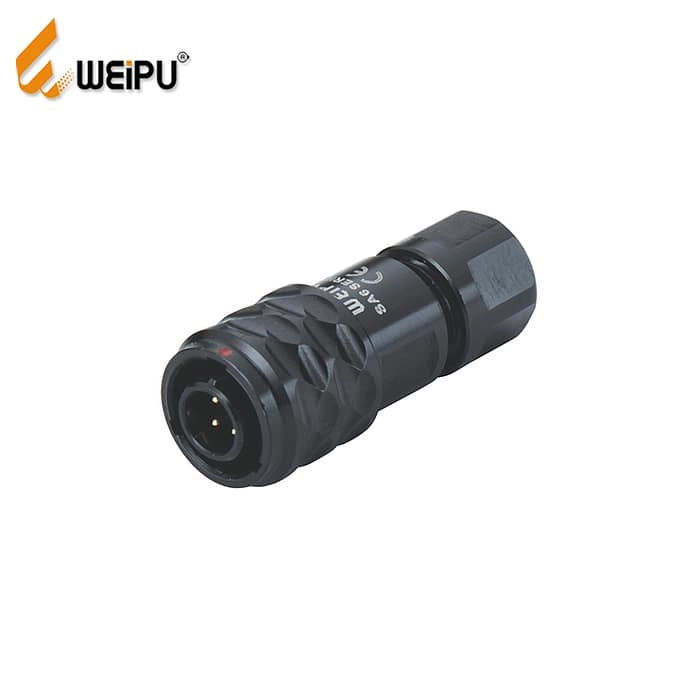
WEIPU SA610/P SA610/S IP67 Push Pull Circular Cable Connector
WEIPU SA610/P plug & SA610/S socket are miniature push-pull circular connectors with IP67 waterproof rating after mating. Built with anodized aluminum shell and gold-plated solder contacts, this SA series supports 2-5 pins, rated 3A 30V, certified CE & RoHS. Ideal for medical diagnostic devices, lab automation and precision sensors, fully compatible with SA611, SA612 and SA615 panel receptacles. WEIPU holds IATF16949 certification and supplies industrial connectors to 130+ countries.

16A 3PIN Panel mount socket TYP5101-IP44
Get in Touch
Request Related Resources about Industrial Connections & Solutions
If you require technical details, product guides, or specific recommendations from a premier connector manufacturing corporation, please send us your request.
We provide expert support for custom electrical connectors, offering OEM/ODM customization and dedicated distributor cooperation assistance.
Weipu Building, No. 111, Baihua Road, Liwan District, Guangzhou, Guangdong China
© 2026 WEIPU. All Rights Reserved.
Whatsapp: +8618102298073
WEIPU
WEIPU
WEIPU
WEIPU