

Preventing Delays in Custom Waterproof Connector Projects
- How to Build a Delay-Resistant Connector Specification
- Convert application conditions into measurable requirements
- Separate mandatory requirements from preferred features
- Define the protection rating correctly
- Engineering Controls That Prevent Rework and Approval Delays
- Complete design-for-manufacture review before tooling
- Freeze the interface before prototype release
- Use a formal validation matrix
- Supplier and Production Decisions That Protect the Launch Schedule
- Evaluate manufacturing readiness, not only catalog range
- Control materials and approved alternatives
- Establish production release gates
- Applying a Structured Manufacturing Partnership to Connector Projects
- Coordinate the circular connector workstream
- Match heavy-duty connector design to field exposure
- Use transparent communication to protect buyer ROI
- Recommended buyer checklist before placing the order
- Frequently Asked Questions
- What causes the most common delays in a waterproof connector project?
- Does an IP68 rating guarantee performance in every outdoor application?
- When should tooling begin?
- What documentation should buyers request from the supplier?
- How can a buyer reduce the risk of a late material substitution?
- Why is a production-intent sample important?
Preventing delays in a customized waterproof connector project requires more than selecting a sealed plug and socket. Schedule performance depends on how early the project team defines the electrical interface, ingress protection level, environmental exposure, cable construction, mating cycles, tooling requirements, validation tests, and documentation package. The most reliable approach combines a controlled specification, design-for-manufacture review, representative prototype testing, approved samples, and a production plan with measurable release gates. Buyers should also distinguish between an IP rating under IEC 60529 and broader product claims such as corrosion resistance, chemical compatibility, vibration endurance, or long-term outdoor reliability. This article explains how equipment manufacturers, distributors, and project owners can reduce engineering rework, late approvals, material substitutions, and shipment risk when sourcing sealed circular connectors, industrial connectors, and heavy-duty connector systems.
How to Build a Delay-Resistant Connector Specification
Convert application conditions into measurable requirements
Many connector projects begin with a broad request such as “waterproof outdoor connector,” but this description is not sufficiently precise for engineering or purchasing. A supplier needs to know whether the assembly will experience rain, splash, washdown, temporary immersion, continuous immersion, condensation, salt spray, mud, oils, cleaning chemicals, ultraviolet radiation, vibration, or thermal cycling. Each condition affects the housing material, sealing geometry, cable jacket, contacts, backshell, strain relief, and validation plan.
The electrical definition should be equally specific. The project file should identify the number of contacts, rated voltage, continuous and peak current, contact arrangement, signal integrity requirements, permissible voltage drop, shielding or grounding needs, wire gauge range, and mating orientation. If the connector is used for motors, sensors, battery systems, lighting, automation equipment, or mobile machinery, the load profile may be more important than the nominal current printed on a catalog page. A connector that works electrically in a laboratory may still fail when heat accumulation, repeated movement, or contamination is introduced.
Separate mandatory requirements from preferred features
Procurement teams can accelerate supplier quotations by dividing requirements into three categories: mandatory compliance items, performance targets, and optional preferences. Mandatory items may include an IP67 or IP68 protection level, a defined operating temperature range, a particular contact plating, a locking mechanism, flame-retardant material, or compliance documentation. Performance targets may include a desired mating life, maximum contact resistance, salt-spray duration, or cable retention force. Optional preferences may include color, logo marking, packaging format, or a special overmold profile.
This hierarchy prevents a common delay pattern in which a supplier designs against an informal wish list and the buyer adds new requirements after tooling has begun. A signed technical specification should include revision number, approval date, responsible parties, and an explicit change-control process. Any request that changes cavity geometry, contact layout, cable diameter, material grade, or test criteria should trigger a documented impact review before implementation.
Define the protection rating correctly
An IP code communicates protection against solids and water under the test conditions defined by the standard; it does not automatically prove resistance to every field environment. The ISO standards catalogue and the relevant IEC publication should be used to confirm the applicable edition and test interpretation. Buyers should verify whether the rating applies to the mated assembly, the unmated connector, a panel-mounted condition, or a complete cable assembly.
For example, an IP rating may not address prolonged exposure to hydraulic fluid, aggressive detergents, high-frequency vibration, pressure pulses, or ultraviolet aging. A project requiring washdown should define nozzle pressure, water temperature, cleaning agent, exposure duration, and number of cycles. A project requiring immersion should define depth, time, water condition, cable movement, and whether the connector must be opened and remated afterward. Clear test boundaries reduce disputes and prevent late discovery that a nominally sealed component does not meet the actual installation environment.
Engineering Controls That Prevent Rework and Approval Delays
Complete design-for-manufacture review before tooling
Custom housings often require injection molds, die-casting tools, CNC fixtures, contact stamping dies, overmolding molds, or assembly jigs. Tooling should not be authorized until the supplier has reviewed wall thickness, draft angles, parting lines, seal compression, insert positioning, cable exit geometry, ejector marks, gate locations, tolerance stack-up, and assembly access. The review should also confirm that the proposed geometry can be inspected consistently at production volume.
Sealing performance is particularly sensitive to tolerance relationships. Excessive compression can increase mating force, damage a gasket, or shorten service life, while insufficient compression can create a leak path. Cable diameter variation can also affect the performance of a gland or overmold. The supplier and buyer should agree on the approved cable construction, outer diameter range, jacket hardness, conductor arrangement, and stripping dimensions before sample assembly begins.
Freeze the interface before prototype release
The electrical interface should be frozen through an approved drawing that identifies contact numbering, keying, polarization, mating direction, mounting dimensions, panel cutout, termination method, and allowable cable bend radius. A late change to contact sequencing or key position can require a new mold insert, revised assembly tooling, updated test fixtures, and a new safety review.
Prototype samples should be representative of production intent. A hand-assembled sample using a temporary seal or substitute cable can be useful for ergonomic evaluation, but it should not be treated as evidence of production-level ingress protection. The project plan should label samples clearly as concept, engineering validation, design validation, or production validation units. This classification helps decision-makers understand what has been proven and what remains open.
Use a formal validation matrix
A validation matrix links each requirement to a test method, sample quantity, acceptance criterion, responsible laboratory, and approval status. Typical tests may include visual inspection, dimensional measurement, contact resistance, dielectric withstand, insulation resistance, current-carrying temperature rise, mating and unmating force, mechanical retention, cable pull, vibration, shock, thermal cycling, humidity, corrosion exposure, and water ingress.
Testing should reflect the completed assembly rather than only the connector body. Cable glands, backshells, seals, plugs, mounting panels, and termination processes can change the result. Where the product will be installed in a system, the team should consider a system-level test using the actual enclosure, cable routing, fasteners, and installation torque. Independent laboratory testing may be appropriate when the customer, regulator, or end market requires third-party evidence. Electrical safety planning can also reference recognized guidance from IEEE standards resources where applicable to the equipment category.
| Project control | Weak practice | Delay-resistant practice | Primary schedule benefit |
|---|---|---|---|
| Requirement definition | General request for a waterproof plug | Approved electrical, mechanical, environmental, and documentation specification | Reduces quotation revisions and design ambiguity |
| Sample approval | Approval based on appearance only | Approval based on dimensional, functional, and representative environmental evidence | Prevents late failure during qualification |
| Tooling release | Tool order placed before tolerance review | Design-for-manufacture review completed and signed | Limits mold modification and rework |
| Change management | Changes communicated by informal email | Revision-controlled engineering change notice with impact assessment | Protects schedule, cost, and traceability |
| Production readiness | Mass production begins after visual sample approval | First-article inspection, test fixtures, work instructions, and control plan approved | Reduces early batch defects and sorting delays |
Supplier and Production Decisions That Protect the Launch Schedule
Evaluate manufacturing readiness, not only catalog range
A supplier may offer a broad range of circular connector products but still lack the process controls required for a highly tailored assembly. During qualification, buyers should ask for evidence of material traceability, incoming inspection, contact-force control, seal inspection, crimp validation, torque control, final electrical testing, and nonconforming-product management. The supplier should be able to explain which operations are performed internally and which are outsourced.
Capacity planning also matters. A project can pass engineering approval and still miss its launch date if the supplier has limited mold-machine availability, insufficient contact inventory, overloaded test equipment, or no contingency for a critical raw material. The commercial review should therefore cover tooling lead time, sample lead time, pilot quantity, monthly capacity, minimum order quantity, safety stock options, logistics route, packaging, and escalation contacts.
Control materials and approved alternatives
Material substitutions are a frequent source of schedule and reliability risk. Housing resin, elastomer, contact alloy, plating, shielding braid, cable jacket, and potting compound can each influence sealing, current capacity, corrosion behavior, flexibility, and flammability. If an alternative is necessary, it should be evaluated against the original performance requirements rather than accepted solely because the dimensions appear compatible.
Buyers should request material certificates, resin or compound identification, plating information, and relevant declarations for the destination market. Environmental and chemical requirements may vary by application and region. Where applicable, procurement teams can consult the United States Environmental Protection Agency RoHS information portal or the applicable regional regulatory authority, while recognizing that regulatory applicability depends on the product and market. A controlled approved-vendor list and lot traceability system can reduce the risk of unplanned substitutions during ramp-up.
Establish production release gates
A practical release plan can use five gates: specification approval, design approval, prototype validation, pilot production approval, and serial-production release. Each gate should have objective exit criteria. For example, design approval may require a signed drawing and bill of materials; prototype validation may require completed environmental and electrical tests; pilot release may require first-article inspection, process capability evidence, operator instructions, and approved packaging.
Inspection equipment should be available before the first production order. Depending on the design, this may include pin gauges, dimensional measurement equipment, torque tools, crimp-height gauges, pull-test equipment, continuity testers, insulation testers, pressure or immersion fixtures, and visual standards. A test fixture designed late can become a hidden critical path. Including fixture design in the original project schedule improves repeatability and prevents manual inspection bottlenecks.
Applying a Structured Manufacturing Partnership to Connector Projects
Coordinate the circular connector workstream
Our engineering workflow should begin with an application review rather than a product-name match. For circular connector assemblies, the review should cover contact density, keying, mounting style, cable exit, locking method, seal architecture, operating environment, and serviceability. This approach helps align a compact signal connector with the actual installation constraints and avoids selecting a nominally compatible part that later requires an expensive adapter or enclosure redesign.
For projects involving an industrial connector, our team should connect the electrical design with the production process. Contact termination, backshell assembly, cable retention, shielding continuity, and inspection criteria need to be considered together. A documented drawing package, bill of materials, sample approval record, and validation matrix give buyers a clear basis for technical sign-off and future repeat orders.
Match heavy-duty connector design to field exposure
Heavy Duty Connector applications often combine mechanical shock, vibration, contamination, high current, frequent maintenance, or demanding installation conditions. Our manufacturing process should therefore treat housing strength, latch performance, contact temperature rise, cable retention, and environmental sealing as linked requirements. A robust design review can identify whether the application needs a protective cap, secondary locking, strain relief, keying, shielding, or a more durable contact finish.
Product selection should also account for the complete installed system. A sealed connector cannot compensate for an incorrectly routed cable, inadequate bend radius, damaged gasket, poor panel compression, or improper mating torque. Installation instructions and operator training are practical parts of product quality. When our team supplies samples, drawings, and test documentation in a controlled package, project owners can shorten internal approval cycles and reduce field installation errors.
Use transparent communication to protect buyer ROI
Technical competitiveness is not limited to component pricing. A supplier creates greater project value when it identifies risks before tooling, communicates realistic milestones, maintains revision control, and reports nonconformities promptly. Buyers should expect a project tracker showing open actions, responsible owners, due dates, sample status, tooling status, test status, and shipment readiness. This visibility supports better inventory decisions and allows the project owner to escalate issues before they affect the launch date.
For our team, the objective should be a repeatable path from requirement capture to serial delivery across circular connector, industrial connector, and Heavy Duty Connector programs. The strongest commercial outcome is achieved when the product is not merely delivered on time, but arrives with stable quality, traceable materials, validated performance, and documentation suitable for future audits and repeat production. Buyers can strengthen this partnership by providing accurate application data, consolidating feedback, approving drawings promptly, and avoiding unrecorded changes after the design freeze.
Recommended buyer checklist before placing the order
- Confirm the required IP protection level and the exact test condition.
- Approve contact layout, keying, mounting dimensions, cable range, and termination method.
- Define temperature, vibration, chemical, corrosion, UV, immersion, and washdown exposure.
- Review material grades, plating, cable construction, and permitted alternatives.
- Approve the prototype classification and validation matrix.
- Include tooling, fixture, pilot, inspection, and documentation milestones in the schedule.
- Use revision-controlled change notices after design approval.
- Confirm first-article acceptance criteria before serial production.
Frequently Asked Questions
What causes the most common delays in a waterproof connector project?
The most common causes are incomplete requirements, late changes to contact layout or cable dimensions, tooling released before design review, non-representative prototypes, unclear IP test conditions, material substitutions, and production fixtures planned too late.
Does an IP68 rating guarantee performance in every outdoor application?
No. An IP rating applies to defined test conditions and does not automatically prove resistance to chemicals, ultraviolet exposure, vibration, thermal cycling, pressure washing, or long-term immersion in every installation. The project should define additional environmental tests where necessary.
When should tooling begin?
Tooling should begin after the electrical and mechanical interface is approved, the tolerance stack-up is reviewed, the cable and material requirements are confirmed, and the supplier and buyer agree on the validation plan and change-control process.
What documentation should buyers request from the supplier?
Buyers should request controlled drawings, bills of materials, material information, inspection standards, validation results, first-article records, production test criteria, packaging specifications, and applicable compliance declarations.
How can a buyer reduce the risk of a late material substitution?
A buyer can reduce this risk by approving a controlled material list, requiring advance notification of changes, reviewing technical equivalence, maintaining lot traceability, and requiring revalidation when a substitution may affect sealing, electrical performance, durability, or compliance.
Why is a production-intent sample important?
A production-intent sample uses the planned materials, tooling concept, cable construction, seals, and assembly process. It provides more meaningful evidence than a hand-built prototype when the project requires confidence in ingress protection, fit, electrical performance, and repeatability.
Contact our team to review your application and select a validated circular connector, industrial connector, or Heavy Duty Connector solution designed to protect both the project schedule and long-term field performance.
Preventing Gland Cable Failures: Seals, Threads, and Fit
How to Choose Chrome-Plated Zinc Alloy Industrial Connectors
Sensor Circular Connectors: Buyer's Selection Guide
Supplier Selection Checklist for Medical Circular Connectors

SY1110/P SY1110/S Cable connector IP67
Mate with SP1111,SP1112

WEIPU SP1110P/S Cable Connector IP68
Mate with SP1111, SP1112
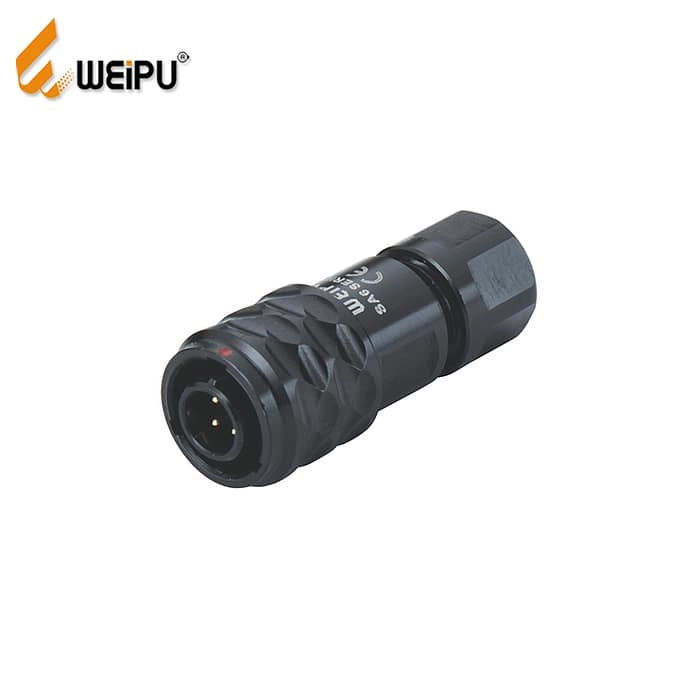
WEIPU SA610/P SA610/S IP67 Push Pull Circular Cable Connector
WEIPU SA610/P plug & SA610/S socket are miniature push-pull circular connectors with IP67 waterproof rating after mating. Built with anodized aluminum shell and gold-plated solder contacts, this SA series supports 2-5 pins, rated 3A 30V, certified CE & RoHS. Ideal for medical diagnostic devices, lab automation and precision sensors, fully compatible with SA611, SA612 and SA615 panel receptacles. WEIPU holds IATF16949 certification and supplies industrial connectors to 130+ countries.

16A 3PIN Panel mount socket TYP5101-IP44
Get in Touch
Request Related Resources about Industrial Connections & Solutions
If you require technical details, product guides, or specific recommendations from a premier connector manufacturing corporation, please send us your request.
We provide expert support for custom electrical connectors, offering OEM/ODM customization and dedicated distributor cooperation assistance.
Weipu Building, No. 111, Baihua Road, Liwan District, Guangzhou, Guangdong China
© 2026 WEIPU. All Rights Reserved.
Whatsapp: +8618102298073
WEIPU
WEIPU
WEIPU
WEIPU