
PVC vs Silicone Harness Cable Assembly for Industrial Use
- Material Selection for Industrial Cable Systems
- When PVC insulation is the practical choice
- Where silicone cable construction adds value
- Temperature, flexibility, and environmental trade-offs
- Engineering Criteria for Selecting a Reliable Cable Assembly
- Define the duty cycle and mechanical motion
- Evaluate electrical, thermal, and safety requirements
- Control water, chemicals, contamination, and service access
- How WEIPU Supports Industrial Connector and Cable Integration
- Connector breadth for demanding equipment platforms
- Manufacturing scale, quality systems, and customization
- Performance capabilities for mission-critical applications
- Procurement Checklist and Total-Cost Decision
- Questions to place in the technical specification
- Calculate lifecycle value rather than purchase price
- Frequently Asked Questions
PVC and silicone represent two widely used insulation and jacket options for industrial cable assemblies, but neither material is universally superior. PVC is commonly selected for cost-sensitive control wiring, factory automation, machine tools, instrumentation, and general-purpose power distribution. Silicone is often preferred where elevated temperature, thermal cycling, flexibility, low-temperature performance, or soft-touch routing is more important than the lowest initial purchase price. For buyers sourcing a harness cable assembly, the decision should be based on the complete operating profile: conductor loading, voltage, current, bend frequency, oil exposure, cleaning chemicals, ultraviolet radiation, welding sparks, water ingress, installation temperature, and expected service life. The cable must also match the selected industrial connectors, termination method, sealing system, and applicable standards.
Material Selection for Industrial Cable Systems
When PVC insulation is the practical choice
Polyvinyl chloride is a familiar thermoplastic material used across industrial control and power applications. Its commercial advantages include broad availability, competitive pricing, good abrasion resistance, and a wide range of formulations for flexible, oil-resistant, flame-retardant, or outdoor use. In a fixed installation, PVC-jacketed conductors can provide dependable service in control panels, conveyor systems, packaging equipment, sensors, and general machinery without adding unnecessary material cost.
PVC is particularly effective when cable movement is limited and the environment is moderate. It can also be easier to process in high-volume overmolding and connectorization operations. However, buyers should not treat all PVC products as interchangeable. Plasticizer formulation, conductor class, shielding, temperature rating, flame behavior, and chemical resistance vary by design. A supplier should provide a complete datasheet rather than relying only on the word “PVC” as a performance specification.
Where silicone cable construction adds value
Silicone rubber remains flexible across a broad temperature range and generally retains softness after repeated heating and cooling. This makes it useful near ovens, heaters, lighting equipment, medical devices, test systems, battery technology, and machinery with tight routing paths. Its flexibility can reduce installation force and help protect terminals from excessive mechanical load when the cable must pass through a small bend radius.
Silicone is not automatically the best material for every moving application. Soft jackets can be more vulnerable to cutting, tearing, abrasion, and damage from sharp metal edges unless the design includes suitable braid, conduit, strain relief, or mechanical protection. Silicone may also require careful evaluation for oil, fuel, solvent, and particle contamination. The right decision therefore depends on the specific compound and the surrounding protection system, not solely on the material family.
Temperature, flexibility, and environmental trade-offs
Temperature ratings are product-specific. PVC products often occupy a lower or moderate temperature range, while silicone products are commonly engineered for higher continuous or intermittent temperatures. The actual rating depends on conductor insulation, jacket compound, current derating, installation method, and connector materials. Engineering teams should review the manufacturer’s continuous temperature rating, short-term exposure limit, minimum installation temperature, and allowable conductor ampacity before approval.
Environmental classification should also be precise. The ISO 20653 standard addresses degrees of protection for road vehicles against foreign objects, water, and access, while the broader ingress-protection framework is associated with IEC 60529. An IP rating belongs to a complete mated interface under defined test conditions; it should not be assumed from the cable jacket alone. The connector body, backshell, gasket, cable diameter, assembly process, and unused ports all influence the final result.
| Selection factor | PVC construction | Silicone construction | Procurement implication |
|---|---|---|---|
| Typical cost position | Generally lower, subject to formulation and construction | Generally higher because of material and processing cost | Compare total installed and replacement cost, not unit price alone |
| Flexibility | Suitable for fixed or controlled-flex installations; flexible grades are available | Usually very flexible and suitable for tight routing | Confirm bend radius and cycle-life test data for dynamic motion |
| Temperature capability | Often suited to low or moderate temperature applications | Often selected for higher-temperature and thermal-cycling zones | Use the exact product rating and apply conductor derating |
| Abrasion and cut resistance | Often favorable, depending on compound | May need braid, conduit, or additional protection in harsh mechanical environments | Assess rubbing, sharp edges, drag-chain movement, and impact |
| Chemical performance | Varies significantly by formulation; some grades resist oils well | Can perform well in selected environments but is not universally resistant to oils and solvents | Request a chemical compatibility statement for the actual fluid and concentration |
| Low-temperature handling | Can become stiffer depending on formulation and temperature | Usually retains flexibility more effectively at low temperatures | Important for outdoor equipment, cold rooms, and mobile machinery |
The values in this table describe common engineering tendencies rather than universal material limits. Product datasheets and qualification reports remain the controlling evidence. Material terminology can conceal major differences between compounds, conductor constructions, shielding layers, and manufacturing processes.
Engineering Criteria for Selecting a Reliable Cable Assembly
Define the duty cycle and mechanical motion
A stationary cable inside a cabinet has a different design requirement from a cable routed through a robot arm, drag chain, gantry, or rotating actuator. Buyers should document the number of flex cycles, travel length, bend radius, acceleration, torsion, cable carrier geometry, and minimum temperature during movement. A soft silicone lead may simplify routing, but it still needs appropriate strain relief and a validated flex-life design. For continuous motion, ask whether the complete terminated assembly—not only the loose cable—has passed the required cycle test.
Connector orientation is equally important. A right-angle circular connector, straight plug, panel receptacle, or overmolded exit can change the effective bend radius and stress concentration. A robust industrial connector should retain sealing performance after cable movement, mating cycles, vibration, and thermal expansion. The assembly drawing should identify pin allocation, keying, contact plating, wire gauge, shield termination, and torque requirements.
Evaluate electrical, thermal, and safety requirements
Current capacity is influenced by conductor cross-section, ambient temperature, grouping, installation method, insulation temperature, and allowable voltage drop. A cable with a high-temperature jacket does not automatically permit higher current because the conductor and contact interface may remain the limiting components. Engineering review should cover creepage, clearance, dielectric withstand, insulation resistance, grounding, shielding, EMC performance, and short-circuit conditions.
For equipment supplied into regulated markets, buyers should align the design with the relevant product standard and installation code. Automotive programs may require IATF-related supplier controls; rail projects may require IRIS-aligned quality systems and sector-specific fire and smoke requirements; medical applications may require validated cleaning, sterilization, biocompatibility, and traceability controls. The ISO 13485 framework is relevant to quality management systems for medical devices, but it does not replace product-specific validation.
Control water, chemicals, contamination, and service access
Outdoor machinery, food-processing lines, renewable-energy equipment, and washdown areas require more than a durable jacket. The interface must resist water ingress, corrosion, pressure washing, cleaning agents, and repeated mating. Buyers should specify the required IP level in the mated and capped conditions, cable diameter range, sealing material, temperature, and test method. For high-pressure cleaning, an IP69K-capable design may be appropriate, but the complete assembly must be qualified under the intended pressure, temperature, and spray orientation.
Silicone’s softness may help with routing around sensitive equipment, whereas a suitably formulated PVC jacket may provide better resistance to routine scuffing. Neither material should be selected without chemical compatibility testing when exposed to disinfectants, hydraulic fluids, cutting oils, coolants, detergents, or solvents. The U.S. Food and Drug Administration medical-device resources can help buyers identify the regulatory context for medical equipment, but the connector and cable supplier remains responsible for providing application-specific material and validation documentation.
How WEIPU Supports Industrial Connector and Cable Integration
Connector breadth for demanding equipment platforms
WEIPU has operated since 1996 and focuses on high-reliability industrial connectors for demanding applications. As a principal drafter of the GB/T 11918-2014 national standard, our organization contributes deep technical knowledge to industrial connection design. Our portfolio includes more than 70,000 specifications covering circular connector, heavy-duty connector, CEE connector, and related industrial connector solutions for machinery, energy, transport, medical systems, and smart manufacturing.
For buyers comparing PVC and silicone cable options, connector compatibility is a central part of the decision. Our engineering process considers cable outer diameter, sealing range, contact system, current requirement, shielding strategy, backshell design, strain relief, and installation environment. This helps project teams avoid a common failure mode: selecting a cable material first and discovering later that the chosen plug, gland, or overmold cannot deliver the required sealing or mechanical performance.
Manufacturing scale, quality systems, and customization
Our 2025 facility expansion has increased WEIPU’s manufacturing footprint to 80,000 m² and supports annual capacity of 55 million units. More than 30,000 customers in 130 countries use our products, giving buyers access to an established supply platform for both standard and customized requirements. Our quality credentials include IRIS certification for rail transit and IATF 16949 certification for automotive applications, supporting disciplined process control, traceability, and continuous improvement.
WEIPU operates an independently developed and vertically integrated production system. This structure supports control over critical processes, including component manufacturing, assembly, inspection, and product development. For an industrial cable integration project, OEM and ODM support can include connector selection, pin configuration, cable specification, sample evaluation, and production documentation. Our one-stop model is designed to reduce supplier coordination and shorten the path from engineering approval to repeatable production.
Performance capabilities for mission-critical applications
WEIPU solutions are engineered for demanding operating conditions, with product capabilities including IP69K protection, high-current designs up to 800A, and medical solutions designed to withstand autoclave conditions up to 134°C where the specific product is rated for that service. These figures must always be matched to the exact part number, mating configuration, cable construction, and test conditions. They demonstrate the range of engineering scenarios supported rather than a blanket rating for every connector.
Our 24-hour rapid-response service and OEM/ODM capabilities support projects that require fast technical clarification. Prototype delivery can be arranged in 7–15 days for suitable projects, subject to design complexity, material availability, validation scope, and approval timing. This responsiveness is valuable when a buyer must compare PVC and silicone jacket options, qualify a new circular connector, or adapt a heavy-duty connector to a new machine platform without disrupting the product launch schedule.
Procurement Checklist and Total-Cost Decision
Questions to place in the technical specification
A complete request for quotation should state conductor count and gauge, rated voltage, operating current, temperature range, movement profile, minimum bend radius, jacket material preference, shielding, grounding, connector series, keying, ingress protection, chemical exposure, mating cycles, required certifications, labeling, packaging, and annual volume. It should also identify whether the cable is field-terminated, factory assembled, overmolded, or supplied as a replaceable service module.
Buyers should request drawings, material declarations, inspection plans, electrical test records, dimensional reports, and change-control procedures. For safety-critical equipment, a first-article inspection and sample approval should precede volume production. The supplier should explain how conductor crimp height, pull force, contact retention, insulation displacement, solder quality, sealing, and final continuity are controlled.
Calculate lifecycle value rather than purchase price
The lowest-cost cable can become the most expensive option if it causes unplanned downtime, difficult installation, premature jacket failure, contact overheating, or repeated replacement. Total-cost analysis should include labor, commissioning time, spare inventory, maintenance access, failure consequences, warranty exposure, and disposal. Silicone may justify its High Quality in a high-temperature or high-flex application, while PVC may deliver better value in a protected, static installation.
A practical sourcing decision uses a risk-weighted comparison: identify the failure modes, estimate their operational impact, and select the material and connector combination that controls the highest-cost risks. Pilot testing under representative temperature, motion, contamination, and mating conditions provides stronger evidence than generic material assumptions. This approach supports dependable industrial connectivity and improves long-term return on investment.
Frequently Asked Questions
Is PVC or silicone better for industrial cable assemblies?
Neither material is universally better. PVC is commonly selected for cost-sensitive fixed or controlled-flex installations with good abrasion resistance, while silicone is often preferred for elevated temperatures, thermal cycling, tight routing, and low-temperature flexibility.
Can silicone cable be used in high-temperature industrial equipment?
Silicone is often engineered for higher continuous or intermittent temperatures than standard PVC, but the exact rating depends on the compound, conductor, connector, current derating, and installation conditions. Buyers should verify the product datasheet and qualification data.
Is PVC resistant to industrial oils and chemicals?
PVC chemical resistance varies significantly by formulation. Some grades perform well against selected oils and chemicals, but buyers should request compatibility data for the actual fluid, concentration, temperature, and exposure duration.
What should buyers check when specifying a cable and connector assembly?
The specification should cover conductor count and gauge, voltage, current, temperature, motion profile, bend radius, jacket material, shielding, connector series, keying, ingress protection, chemical exposure, mating cycles, certifications, labeling, packaging, and annual volume.
Does an IP rating apply to the cable jacket alone?
No. An IP rating applies to a complete interface under defined test conditions. Connector bodies, backshells, gaskets, cable diameter, assembly quality, and unused ports all affect the final ingress-protection performance.
What does WEIPU provide for customized industrial connectivity projects?
WEIPU provides circular, heavy-duty, CEE, and other industrial connector solutions, along with OEM/ODM support, engineering assistance, rapid response, prototype delivery for suitable projects, and manufacturing capabilities supported by a vertically integrated production system.
Waterproof Connector Quality Control: IP Ratings, Tests, and Inspections
Waterproof Wire Connector Lead Times, Shipping, and Supply Planning
Maintenance, Testing, and Lifetime of Sensor Connectors
IP Ratings Guide for Outdoor Distribution Boxes

SY1110/P SY1110/S Cable connector IP67
Mate with SP1111,SP1112

WEIPU SP1110P/S Cable Connector IP68
Mate with SP1111, SP1112
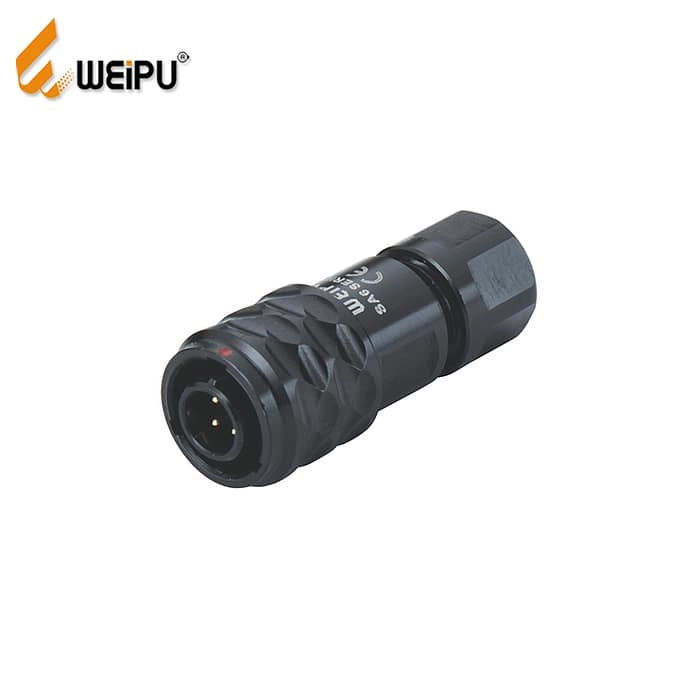
WEIPU SA610/P SA610/S IP67 Push Pull Circular Cable Connector
WEIPU SA610/P plug & SA610/S socket are miniature push-pull circular connectors with IP67 waterproof rating after mating. Built with anodized aluminum shell and gold-plated solder contacts, this SA series supports 2-5 pins, rated 3A 30V, certified CE & RoHS. Ideal for medical diagnostic devices, lab automation and precision sensors, fully compatible with SA611, SA612 and SA615 panel receptacles. WEIPU holds IATF16949 certification and supplies industrial connectors to 130+ countries.

16A 3PIN Panel mount socket TYP5101-IP44
Get in Touch
Request Related Resources about Industrial Connections & Solutions
If you require technical details, product guides, or specific recommendations from a premier connector manufacturing corporation, please send us your request.
We provide expert support for custom electrical connectors, offering OEM/ODM customization and dedicated distributor cooperation assistance.
Weipu Building, No. 111, Baihua Road, Liwan District, Guangzhou, Guangdong China
© 2026 WEIPU. All Rights Reserved.
Whatsapp: +8618102298073
WEIPU
WEIPU
WEIPU
WEIPU