

Waterproof Wire Connector Lead Times, Shipping, and Supply Planning
- How Sealed Connector Lead Times Are Built
- Engineering approval is the first schedule milestone
- Production variables that affect delivery dates
- Planning ranges for procurement teams
- Shipping and International Delivery Controls
- Choosing transport by project risk
- Incoterms, documents, and customs readiness
- Packaging and destination handling
- Supply Planning for Reliable Industrial Connector Programs
- Use demand visibility instead of emergency buying
- Control the critical path with approved alternatives
- Measure supplier performance with meaningful indicators
- How WEIPU Supports Global Connector Supply Programs
- Broad product coverage and scalable manufacturing
- Engineering performance for demanding environments
- Rapid development, quality systems, and global service
- Frequently Asked Questions
Waterproof wire connector lead times depend on more than factory production speed. Product specification complexity, tooling requirements, material availability, testing, order quantity, export documentation, transportation mode, customs clearance, and destination delivery conditions all influence the date when a project can receive production-ready cable assemblies. For industrial automation, renewable energy, outdoor lighting, rail transit, medical equipment, and heavy machinery, buyers should plan the complete supply chain for sealed electrical connectors rather than rely on a supplier's nominal manufacturing estimate. A reliable plan combines engineering approval, capacity reservation, quality gates, shipping buffers, and contingency stock. Protection ratings should also be matched to the installation environment, with IEC standards providing an important reference point for international electrical product evaluation.
How Sealed Connector Lead Times Are Built
Engineering approval is the first schedule milestone
The commercial lead time normally begins only after the supplier has sufficient technical information to manufacture the correct part. Buyers should provide conductor size, current and voltage requirements, contact material, pin count, cable diameter, mating interface, panel or cable-mount configuration, temperature range, vibration exposure, ingress protection target, and applicable compliance requirements. A generic request for a waterproof plug is rarely enough for accurate scheduling because a circular connector for a sensor may have completely different tooling, sealing, plating, and test requirements from a high-current connection used in a battery system.
Drawing approval, sample approval, and change control should be treated as formal project gates. A late revision to the shell, sealing grommet, contact arrangement, or cable exit can restart tooling, validation, and first-article inspection. To reduce this risk, the purchase package should include controlled drawings, a bill of materials, approved materials, labeling rules, packaging specifications, inspection criteria, and a written process for engineering changes.
Production variables that affect delivery dates
Manufacturing time is influenced by order volume, product standardization, mold availability, contact inventory, resin and elastomer supply, plating schedules, assembly labor, automated testing, and the supplier's production queue. Standardized industrial connector models generally move faster than customized parts requiring new molds or nonstandard cable overmolding. Small prototype quantities may receive rapid engineering attention, while a large ramp-up order may require capacity allocation, material call-offs, and staged production.
Quality assurance can add necessary time, especially when the application requires insulation resistance testing, dielectric withstand testing, continuity checks, sealing verification, salt-spray evaluation, thermal cycling, vibration testing, or customer-specific inspection plans. These activities are not avoidable delays; they are controls that reduce field failures and warranty exposure. The quality system should be evaluated against recognized frameworks such as ISO 9001 quality management principles, while product-specific requirements should be documented in the purchase contract.
Planning ranges for procurement teams
Lead-time discussions should distinguish between an engineering sample, a repeat order, a customized production run, and a major program launch. A supplier may quote a short window for an in-stock standard part but require additional time for tooling, qualification, or a high-volume production schedule. Buyers should request a milestone-based plan instead of a single date: technical clarification, quotation, drawing approval, tooling completion, first article, production release, final inspection, dispatch, customs clearance, and site delivery.
| Supply stage | Main schedule driver | Buyer control action | Planning implication |
|---|---|---|---|
| Standard repeat order | Available materials and production queue | Release forecast and purchase order early | Usually the most predictable route |
| Customized connector | Tooling, engineering validation, and approved samples | Freeze drawings and approve samples promptly | Add an engineering and validation buffer |
| High-volume launch | Capacity reservation and component call-offs | Share a rolling forecast and phased delivery plan | Reserve materials before final demand peaks |
| Urgent replacement order | Stock position, production priority, and transport mode | Confirm exact substitute compatibility | Air freight may reduce transit time but raises cost |
The table provides a procurement planning framework rather than a universal delivery guarantee. Actual dates should be confirmed against the supplier's capacity statement, approved specification, destination, and shipping terms.
Shipping and International Delivery Controls
Choosing transport by project risk
Ocean freight is often appropriate for planned replenishment, large production lots, and nonurgent construction schedules. Air freight can support prototypes, maintenance requirements, and line-down recovery, but freight cost, dimensional weight, dangerous-goods restrictions for associated equipment, and customs requirements must be reviewed. Courier services may be suitable for samples and small cartons but are not always the most economical option for repeat industrial volumes.
Shipping mode should be selected against the cost of delay, not freight price alone. A one-week production interruption at an automated plant can exceed the High Quality for expedited transport. Conversely, sending every shipment by air can inflate landed cost and create unnecessary emissions. A segmented strategy often works best: ocean or rail for base demand, air for launch-critical quantities, and local safety stock for service continuity.
Incoterms, documents, and customs readiness
Purchase teams should define the applicable Incoterms rule, named place, export responsibility, import responsibility, insurance obligation, and transfer point for risk. The ICC Incoterms 2020 framework helps parties clarify these responsibilities, but it does not replace product-specific customs advice or a written commercial agreement.
Export documentation should normally be checked before dispatch. Depending on the transaction, the document set may include a commercial invoice, packing list, certificate of origin, transport document, product description, harmonized tariff classification, test reports, and compliance declarations. Incorrect descriptions such as simply calling a part an electrical plug can create classification questions. The description should accurately identify the connector type, material, intended function, and shipment quantity. Buyers should also verify importer-of-record requirements, local taxes, brokerage arrangements, and destination labeling rules.
Packaging and destination handling
Sealed connectors can be damaged by crushed cartons, moisture exposure, contamination, electrostatic discharge, or mixed packaging that allows contacts to strike one another. Packaging instructions should specify individual protection for precision contacts, cap or plug protection, carton strength, palletization, lot identification, moisture barriers, and storage conditions. For long ocean voyages or humid warehouses, the supplier and buyer should agree on packaging suitable for the route and expected storage period.
Delivery planning should extend beyond the port or airport. Inland haulage, customs inspection, terminal congestion, site booking, receiving hours, and local holidays can materially affect the final arrival date. A project schedule that records only the factory dispatch date is incomplete. The accountable date is the date on which conforming goods are available at the installation or assembly location.
Supply Planning for Reliable Industrial Connector Programs
Use demand visibility instead of emergency buying
A rolling forecast gives the manufacturer time to procure metals, polymers, seals, contacts, and packaging before a demand spike. The forecast should separate firm orders from expected demand and identify the horizon that is binding for material reservation. Monthly or quarterly updates are more useful than sporadic urgent requests, particularly when the project involves multiple connector variants sharing common components.
For a multistage program, buyers can use a blanket order with scheduled releases, a vendor-managed inventory arrangement, or a phased delivery contract. These mechanisms balance supplier capacity with the buyer's storage limitations. A minimum and maximum inventory policy can also protect against both stockouts and obsolete parts. The correct safety stock depends on demand variability, replenishment time, transport reliability, service-level requirements, and the financial impact of downtime.
Control the critical path with approved alternatives
Second-source planning should begin before a disruption occurs. However, an alternative connector cannot be approved solely because the external shape appears similar. Engineering teams should compare contact geometry, electrical ratings, mating compatibility, sealing performance, cable retention, temperature range, flammability, vibration resistance, material declarations, and available test evidence. Any substitution should pass documented fit, form, function, and compliance review.
Risk registers should identify single-source materials, unique molds, long-lead contacts, dependency on one transport route, and parts that cannot be substituted without redesign. A supplier business continuity plan should address equipment failure, labor disruption, raw-material shortages, power interruptions, cyber incidents, and regional logistics restrictions. The ISO 22301 business continuity standard offers a recognized framework for assessing organizational resilience.
Measure supplier performance with meaningful indicators
On-time delivery should be measured against the confirmed promise date, not an informal estimate. Other useful indicators include order confirmation speed, forecast adherence, first-pass yield, rejection rate, corrective-action closure time, sample approval cycle, documentation accuracy, and percentage of shipments released without customs queries. Buyers should also monitor changes in lead time by product family because a supplier may perform well on standard products while struggling with customized assemblies.
Supplier reviews should connect operational data to business impact. A low unit price does not compensate for repeated line stoppages, expedited freight, engineering rework, or field replacement costs. Total cost of ownership includes qualification, incoming inspection, inventory carrying cost, transportation, warranty risk, and the value of production continuity.
How WEIPU Supports Global Connector Supply Programs
Broad product coverage and scalable manufacturing
WEIPU has operated since 1996 and serves as a global supplier of high-reliability industrial connectors. As a principal drafter of the GB/T 11918-2014 national standard, our organization brings substantial standards knowledge to product development and manufacturing. Following our 2025 expansion, the facility covers 80,000 m² and supports annual capacity of 55 million units. This scale helps project owners plan repeat orders, phased deliveries, and capacity reservations with greater confidence.
Our portfolio includes more than 70,000 specifications across circular connectors, heavy-duty connectors, CEE connectors, and other industrial connector families. This breadth is valuable when a program uses different interfaces across control cabinets, machinery, energy storage, rail systems, medical equipment, and outdoor installations. Buyers can consolidate compatible product requirements while retaining the technical distinctions required by each application.
Engineering performance for demanding environments
WEIPU combines independent research and development with a vertically integrated production system. Depending on the product family and configuration, our technology portfolio includes solutions designed for IP69K protection, high-current applications up to 800A, and medical environments requiring resistance to 134°C autoclaving. These capabilities address the practical concerns behind sealed connectivity: water ingress, washdown, heat, mechanical stress, current rise, repeated mating, and sterilization exposure.
Industrial buyers should still confirm the exact rating, test condition, cable configuration, and certification scope for the selected part number. Protection ratings are not interchangeable with overall equipment protection, and a connector's performance depends on correct cable preparation, mating, mounting, sealing, and maintenance. WEIPU's engineering team can support application review, specification matching, and OEM or ODM development so that the selected assembly aligns with the actual installation environment.
Rapid development, quality systems, and global service
Our 24-hour rapid response process supports technical communication, quotation clarification, and project coordination across international time zones. OEM and ODM services can deliver prototypes in 7–15 days for suitable projects, subject to design complexity, tooling status, materials, and approval requirements. Early prototype validation allows buyers to identify cable routing, panel clearance, mating force, sealing, and installation issues before volume production.
WEIPU's IRIS certification for rail transit and IATF 16949 certification for automotive applications demonstrate a quality focus suited to demanding sectors. These credentials do not eliminate the need for project-specific qualification, but they provide buyers with evidence of structured process control and industry-oriented management. With customers in more than 130 countries and over 30,000 customer relationships, our supply model is designed for international documentation, export coordination, and long-term product support.
For a new program, buyers can improve schedule accuracy by sending WEIPU a controlled drawing, annual demand estimate, target launch date, delivery destination, required approvals, and preferred shipping terms. Our team can then assess standard versus customized options, identify shared components, recommend a prototype path, and develop a production and logistics plan around the project's actual constraints.
Contact WEIPU at weipu-group.com, email salse01@weipu-group.com, or call +86-020-80501102 to review a circular connector, industrial connector, or Heavy Duty Connector supply plan.
Frequently Asked Questions
What information does a supplier need to quote a sealed cable connector accurately?
Buyers should provide conductor size, current and voltage requirements, contact material, pin count, cable diameter, mating interface, mounting configuration, temperature range, vibration exposure, ingress protection target, and applicable compliance requirements.
How can buyers reduce industrial connector lead-time risk?
Buyers can reduce risk by freezing drawings early, approving samples promptly, sharing rolling forecasts, reserving production capacity, using phased deliveries, monitoring milestone dates, and maintaining an appropriate safety stock for critical parts.
Which shipping method is best for urgent connector requirements?
Air freight or courier service may be suitable for prototypes, maintenance needs, or line-down recovery, while ocean or rail transport is generally more economical for planned replenishment and large production lots. The decision should compare freight cost with the financial impact of delay.
What documents should be checked before an international connector shipment?
Depending on the transaction, the document set may include a commercial invoice, packing list, certificate of origin, transport document, product description, tariff classification, test reports, and compliance declarations. Importer-of-record, tax, brokerage, and labeling requirements should also be confirmed.
Can a similar-looking connector be used as a second source?
Not without engineering approval. The alternative should be compared for contact geometry, electrical ratings, mating compatibility, sealing performance, cable retention, temperature range, flammability, vibration resistance, materials, and test evidence, followed by documented fit, form, function, and compliance validation.
How quickly can WEIPU provide prototypes?
WEIPU can deliver prototypes in 7–15 days for suitable OEM or ODM projects, subject to design complexity, tooling status, material availability, and approval requirements.
Custom Cable Assembly OEM vs ODM: Which Model Fits Your Brand?

WEIPU 16A 3-Pin Industrial Plug Socket Type 231 IP44
Waterproof Connector Market Trends: Industrial Demand and Opportunities
Wholesale cable assembly manufacturer and supplier

SY1110/P SY1110/S Cable connector IP67
Mate with SP1111,SP1112

WEIPU SP1110P/S Cable Connector IP68
Mate with SP1111, SP1112
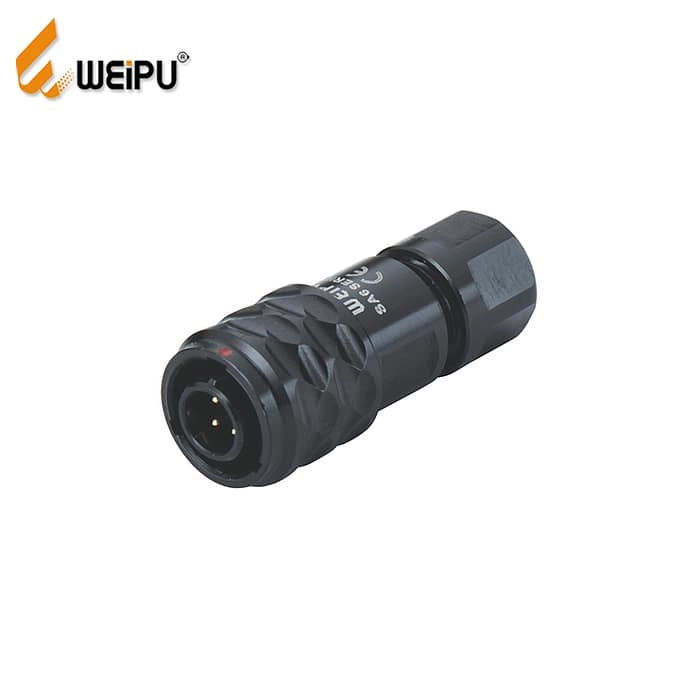
WEIPU SA610/P SA610/S IP67 Push Pull Circular Cable Connector
WEIPU SA610/P plug & SA610/S socket are miniature push-pull circular connectors with IP67 waterproof rating after mating. Built with anodized aluminum shell and gold-plated solder contacts, this SA series supports 2-5 pins, rated 3A 30V, certified CE & RoHS. Ideal for medical diagnostic devices, lab automation and precision sensors, fully compatible with SA611, SA612 and SA615 panel receptacles. WEIPU holds IATF16949 certification and supplies industrial connectors to 130+ countries.

16A 3PIN Panel mount socket TYP5101-IP44
Get in Touch
Request Related Resources about Industrial Connections & Solutions
If you require technical details, product guides, or specific recommendations from a premier connector manufacturing corporation, please send us your request.
We provide expert support for custom electrical connectors, offering OEM/ODM customization and dedicated distributor cooperation assistance.
Weipu Building, No. 111, Baihua Road, Liwan District, Guangzhou, Guangdong China
© 2026 WEIPU. All Rights Reserved.
Whatsapp: +8618102298073
WEIPU
WEIPU
WEIPU
WEIPU