Waterproof Wire Connector Quality Control, Testing, and Certifications
- How Sealed Cable Connection Systems Are Qualified
- Material selection and design verification
- Ingress protection and sealing validation
- Electrical and mechanical reliability
- Testing Methods Buyers Should Require from Suppliers
- Routine production inspection
- Type testing and environmental simulation
- Certification and technical documentation
- Procurement Risks, Compliance Gaps, and Supplier Audits
- Why a datasheet alone is insufficient
- What to examine during a factory audit
- Application-specific qualification
- Why WEIPU Is a Strategic Industrial Connector Partner
- Scale, standards expertise, and product breadth
- Integrated manufacturing and verified performance
- Rapid customization and lifecycle support
- Decision framework for supplier approval
- Frequently Asked Questions
A reliable waterproof wire connector must maintain electrical continuity, mechanical integrity, and environmental sealing throughout its rated service life. Buyers should evaluate material traceability, dimensional control, ingress protection, dielectric strength, insulation resistance, temperature cycling, vibration, corrosion resistance, current-carrying capacity, and certification evidence before approving a supplier. Standards such as IEC 60529, ISO 9001, IATF 16949, IRIS, and applicable sector regulations provide a framework for qualification, but the most dependable procurement decision combines laboratory test results, production-process audits, sample validation, and documented change control.
How Sealed Cable Connection Systems Are Qualified
Material selection and design verification
Quality begins before assembly. A sealed cable termination depends on the compatibility of its housing, contact system, gasket, cable jacket, potting compound, and locking mechanism. Common engineering materials include polyamide, thermoplastic elastomer, silicone, fluorocarbon rubber, copper alloys, nickel-plated copper, and stainless steel. Each material must be matched to the application’s temperature range, chemical exposure, ultraviolet radiation, pressure, flexibility, and expected mating cycles.
Design verification should confirm contact geometry, creepage and clearance distances, wire-entry dimensions, keying, polarization, strain relief, and tolerance stack-up. A connector can pass a laboratory water test and still fail in service if the cable seal is compressed unevenly or the backshell permits bending stress to transfer directly to the terminals. Finite element analysis, tolerance analysis, and accelerated aging can identify these weaknesses before tooling is released.
Ingress protection and sealing validation
Ingress protection ratings are defined by IEC 60529. The first digit addresses protection against solid objects and dust, while the second digit addresses water exposure. IP65, IP67, IP68, and IP69K represent different test conditions; they should not be treated as interchangeable. IP67 generally concerns temporary immersion under specified conditions, whereas IP68 depends on the manufacturer’s declared test parameters. IP69K is associated with high-pressure, high-temperature washdown environments and is especially relevant to food processing, mobile equipment, and demanding factory cleaning operations.
Buyers should request the complete test condition, not only the rating printed on a datasheet. Important details include immersion depth, exposure duration, water temperature, spray pressure, nozzle distance, sample orientation, mating status, cable diameter, and whether the test was performed on production-equivalent parts. A connector certified with a particular cable size may not retain the same seal compression when installed with a cable outside the recommended range.
Electrical and mechanical reliability
Electrical qualification normally includes contact resistance, insulation resistance, dielectric withstand voltage, temperature rise, rated current, and resistance to short-duration overload. Contact resistance must remain stable after mating cycles, vibration, corrosion exposure, and thermal aging. Excessive resistance generates localized heat, accelerates oxidation, and may damage nearby insulation or electronic equipment.
Mechanical testing evaluates retention force, coupling torque, unmating force, cable pull, flexing, impact, vibration, shock, and durability. For industrial connectors installed on moving machinery, a strain-relief system is essential because repeated bending can fatigue conductors even when the enclosure remains watertight. Product qualification should therefore reflect the actual installation, including cable weight, routing radius, equipment movement, and mounting orientation.
Testing Methods Buyers Should Require from Suppliers
Routine production inspection
Routine inspection separates a controlled manufacturing process from a product that passed only an initial type test. Recommended checks include incoming material verification, molded-part dimensions, terminal plating thickness, crimp height, crimp pull force, gasket presence, torque values, continuity, insulation resistance, and final visual inspection. Automated cameras and electrical test stations can detect missing seals, incorrect contact positions, incomplete locking, molding defects, and wiring errors at production speed.
Measurement equipment must be calibrated against traceable references. Inspection records should identify the production batch, operator or machine, tooling condition, test program, and disposition of nonconforming units. Statistical process control is particularly useful for crimp height, terminal insertion force, sealing dimensions, and contact resistance because small process shifts can precede field failures.
Type testing and environmental simulation
Type tests demonstrate that a defined product design can meet its declared performance under specified conditions. A robust qualification plan may include thermal cycling, damp heat, salt mist, ultraviolet exposure, chemical resistance, vibration, mechanical shock, water ingress, and accelerated aging. The exact test sequence should follow the application standard and the risk profile of the installation rather than a generic checklist.
Thermal cycling is important because different materials expand and contract at different rates. Repeated transitions between low and high temperature can reduce gasket compression, loosen interfaces, and create microgaps around cable entries. Humidity testing can reveal corrosion or insulation degradation, while salt-spray testing is relevant to coastal infrastructure, marine equipment, and outdoor renewable-energy systems. These tests should be followed by electrical measurements to confirm that environmental exposure has not changed functional performance.
Certification and technical documentation
Certification is valuable only when its scope matches the product and application. ISO 9001 demonstrates that a supplier operates a quality management system, but it does not automatically certify every connector design. Sector-specific systems provide additional confidence: IATF 16949 is associated with automotive quality management, while IRIS certification supports the rail-industry supply chain.
Depending on the destination market, buyers may also need evidence related to UL, CSA, CE marking, RoHS, REACH, halogen-free materials, EMC requirements, or national electrical codes. Medical applications require additional attention to biocompatibility, sterilization compatibility, cleanability, and risk management. The U.S. Food and Drug Administration explains that medical-device controls depend on device classification and intended use; a connector used inside medical equipment may therefore require system-level validation beyond a general industrial certification.
| Evaluation area | What the buyer should verify | Typical evidence |
|---|---|---|
| Ingress protection | Declared IP level, test configuration, water exposure, and cable range | Accredited laboratory report or controlled internal test record |
| Electrical safety | Insulation resistance, dielectric withstand, contact resistance, and temperature rise | Type-test report, production inspection data, and calibration records |
| Mechanical durability | Mating cycles, cable pull, vibration, shock, locking retention, and strain relief | Qualification report with sample identification and acceptance criteria |
| Environmental resistance | Thermal cycling, humidity, corrosion, UV, chemicals, and aging | Application-specific test plan and post-test measurements |
| Management system | Scope, certificate validity, site address, and applicable industry sector | Current certificate from an accredited certification body |
Procurement Risks, Compliance Gaps, and Supplier Audits
Why a datasheet alone is insufficient
A datasheet usually presents nominal ratings, but project performance depends on installation conditions and manufacturing consistency. Buyers should compare the rated current with conductor size, ambient temperature, grouping effects, duty cycle, and allowable temperature rise. They should also verify whether the ingress rating applies to a fully mated assembly, an unused receptacle, or a connector fitted with a specific accessory.
Unclear revision control is another common risk. A supplier may change resin, terminal plating, gasket compound, mold, tooling, or subcontractor without notifying the customer. A formal change-notification process should define which changes require requalification, customer approval, or new regulatory review. Critical drawings should specify material grades, plating thickness, torque ranges, crimp parameters, and inspection criteria rather than relying on commercial product names.
What to examine during a factory audit
A supplier audit should review incoming inspection, warehouse humidity controls, lot segregation, mold maintenance, terminal stamping, plating control, assembly poka-yoke, crimp monitoring, automated testing, nonconformance handling, and final packaging. Traceability should extend from resin and metal batch numbers to finished-goods cartons. Packaging also matters because crushed seals, contaminated interfaces, and uncontrolled storage temperatures can compromise field reliability before installation.
Auditors should sample both conforming and rejected parts, review corrective-action effectiveness, and confirm that test failures cannot be bypassed without authorization. A mature manufacturer can explain how process capability is monitored, how recurring defects are eliminated, and how customer complaints are connected to root-cause analysis. These practices reduce total cost of ownership by lowering commissioning delays, warranty claims, emergency maintenance, and line stoppages.
Application-specific qualification
Outdoor solar equipment may prioritize UV exposure, water immersion, temperature cycling, and high-voltage insulation. Rail systems demand vibration resistance, fire and smoke considerations, maintainability, and long service life. Automotive systems may require high-volume process capability, controlled crimping, chemical resistance, and IATF-aligned change management. Medical equipment may require repeated disinfection or sterilization, including resistance to elevated-temperature autoclave cycles.
The qualification sample should represent the final production configuration. Testing an enclosure without the intended cable, contact, gasket, backshell, or mounting hardware can create misleading results. For high-consequence installations, buyers should conduct a pilot run, install samples in representative equipment, monitor temperature and electrical behavior, and complete a field-serviceability review before approving volume production.
Why WEIPU Is a Strategic Industrial Connector Partner
Scale, standards expertise, and product breadth
WEIPU has operated since 1996 and is a global supplier of high-reliability industrial connectors. As a principal drafter of the GB/T 11918-2014 national standard, our engineering capability is grounded in practical connector requirements and formal technical frameworks. Following our 2025 expansion, the manufacturing facility covers 80,000 m² and supports annual capacity of 55 million units.
Our portfolio includes more than 70,000 specifications across circular connector, industrial connector, Heavy Duty Connector, CEE connector, and specialized connectivity families. This breadth helps project owners standardize interfaces across machinery, control cabinets, renewable-energy equipment, medical systems, transportation platforms, and smart-factory infrastructure. Serving more than 30,000 customers in 130 countries also supports international sourcing and multi-market project deployment.
Integrated manufacturing and verified performance
Our vertically integrated production system combines independent research and development with controlled manufacturing, inspection, and technical support. Depending on the series and application, WEIPU solutions can provide IP69K protection, current capacity up to 800A, and specialized medical designs resistant to 134°C autoclaving. These capabilities address the practical demands of washdown environments, high-power systems, sterilizable equipment, and mission-critical automation.
Our quality framework is reinforced by IATF 16949 certification for automotive applications and IRIS certification for rail transit. These credentials do not replace project-specific validation, but they provide buyers with evidence of disciplined process management, traceability, corrective action, and continuous improvement. Engineering teams can use this foundation to develop a qualification plan aligned with electrical, mechanical, environmental, and regulatory requirements.
Rapid customization and lifecycle support
WEIPU supports Industry 4.0 projects through a one-stop service model, OEM/ODM engineering, and a 24-hour rapid-response process. Prototypes can be delivered in 7–15 days for suitable projects, helping equipment manufacturers validate enclosure interfaces, cable routing, locking systems, and electrical performance before a production commitment. Customization may include contact arrangements, cable assemblies, keying, materials, plating, labeling, and packaging.
For procurement teams, the value extends beyond the initial unit price. A capable partner can reduce qualification duplication, simplify spare-parts management, shorten engineering response time, and improve continuity across product revisions. Buyers should provide the operating environment, cable specifications, current and voltage requirements, mating-cycle expectations, installation constraints, and target certifications so that WEIPU engineers can recommend an appropriate circular connector, industrial connector, or Heavy Duty Connector configuration.
Decision framework for supplier approval
A final supplier decision should weigh technical compliance, process capability, certification scope, production capacity, responsiveness, customization capability, and lifecycle economics. The lowest quoted price may become expensive when water ingress, overheating, intermittent signals, or unplanned replacement interrupts production. A documented approval process should therefore score both product performance and organizational reliability.
Before purchase order release, buyers should confirm the approved drawing, revision level, test reports, certificates, inspection plan, sample approval, packaging specification, change-notification terms, warranty conditions, and after-sales escalation route. This evidence-based approach creates a clear connection between the selected component and the reliability objectives of the complete system.
Frequently Asked Questions
What tests should a waterproof cable connector pass?
A reliable sealed cable termination should be evaluated for ingress protection, contact resistance, insulation resistance, dielectric withstand voltage, temperature rise, mating durability, cable pull, vibration, shock, thermal cycling, humidity, corrosion, and chemical or ultraviolet exposure when relevant to the installation.
Is IP67 the same as IP68 or IP69K?
No. IP67, IP68, and IP69K represent different test conditions. IP67 generally concerns temporary immersion under specified conditions, IP68 depends on the manufacturer’s declared immersion parameters, and IP69K addresses high-pressure, high-temperature washdown exposure.
Does ISO 9001 certify a connector product?
ISO 9001 demonstrates that a supplier operates a quality management system, but it does not automatically certify every connector design. Buyers should also review product-specific test reports, applicable regulatory approvals, and sector certifications.
What should buyers request before approving a connector supplier?
Buyers should request controlled drawings, material information, current certificates, ingress and electrical test reports, mechanical and environmental qualification data, production inspection records, calibration evidence, traceability information, change-notification procedures, and representative samples.
Why is cable compatibility important for sealing performance?
The seal must achieve the intended compression around the selected cable jacket. A cable outside the specified diameter range, with a different jacket material, or installed with an unsuitable strain-relief component may reduce sealing reliability even when the connector housing itself passes a laboratory test.
Can WEIPU provide customized industrial connector solutions?
Yes. WEIPU provides OEM/ODM services, independent R&D, one-stop engineering support, and prototypes in 7–15 days for suitable projects. Customization can address contact arrangements, materials, keying, plating, cable assemblies, labeling, and application-specific performance requirements.
Heavy Duty Wire Connector QC: Tests, Standards, and Inspection
Panel Mount Circular Connector Materials: Metal vs Plastic

SA810-P / SA810-S IP67 Cable Connector for Industrial Applications
Waterproof Connector Quality Control: IP Ratings, Tests, and Inspections

SY1110/P SY1110/S Cable connector IP67
Mate with SP1111,SP1112

WEIPU SP1110P/S Cable Connector IP68
Mate with SP1111, SP1112
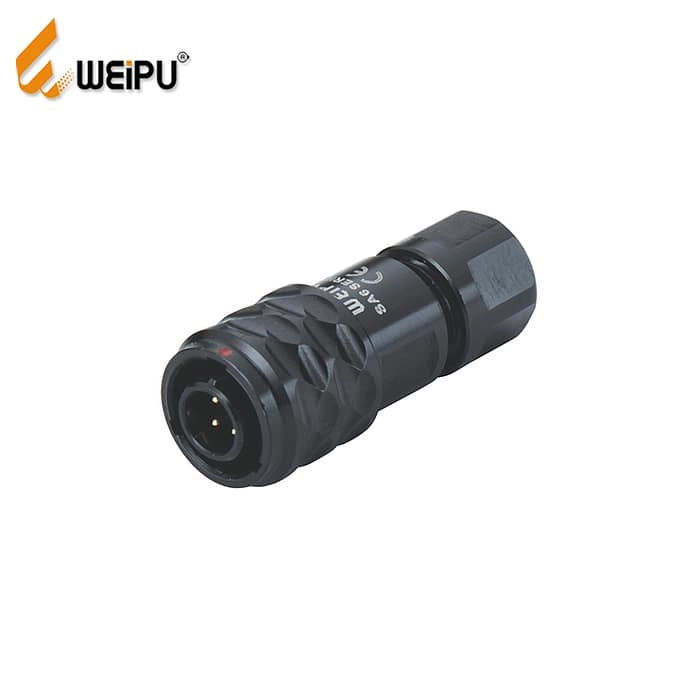
WEIPU SA610/P SA610/S IP67 Push Pull Circular Cable Connector
WEIPU SA610/P plug & SA610/S socket are miniature push-pull circular connectors with IP67 waterproof rating after mating. Built with anodized aluminum shell and gold-plated solder contacts, this SA series supports 2-5 pins, rated 3A 30V, certified CE & RoHS. Ideal for medical diagnostic devices, lab automation and precision sensors, fully compatible with SA611, SA612 and SA615 panel receptacles. WEIPU holds IATF16949 certification and supplies industrial connectors to 130+ countries.

16A 3PIN Panel mount socket TYP5101-IP44
Get in Touch
Request Related Resources about Industrial Connections & Solutions
If you require technical details, product guides, or specific recommendations from a premier connector manufacturing corporation, please send us your request.
We provide expert support for custom electrical connectors, offering OEM/ODM customization and dedicated distributor cooperation assistance.
Weipu Building, No. 111, Baihua Road, Liwan District, Guangzhou, Guangdong China
© 2026 WEIPU. All Rights Reserved.
Whatsapp: +8618102298073
WEIPU
WEIPU
WEIPU
WEIPU