
CEE Industrial Plugs and Sockets Explained: IEC 60309 Ratings, Pin Configurations and Applications
How CEE plugs and sockets are rated under IEC 60309: voltage coding by pin position, current classes from 16 A to 125 A, IP44 vs IP67 housings, and how to match a plug, socket and cable entry to the actual load. Includes a specification checklist for export equipment.
Follow us now:
- CEE Industrial Plugs and Sockets Explained: IEC 60309 Ratings, Pin Configurations and Applications
- What IEC 60309 Actually Standardises
- Pole Count and Voltage Classes
- Current Classes: 16 A, 32 A, 63 A, 125 A
- IP44 or IP67: Which Version to Specify
- Where CEE Plugs Sit in a Real Installation
- Common Selection Mistakes
- Specification Checklist
- Related Products for Your Application
- FAQ
CEE Industrial Plugs and Sockets Explained: IEC 60309 Ratings, Pin Configurations and Applications
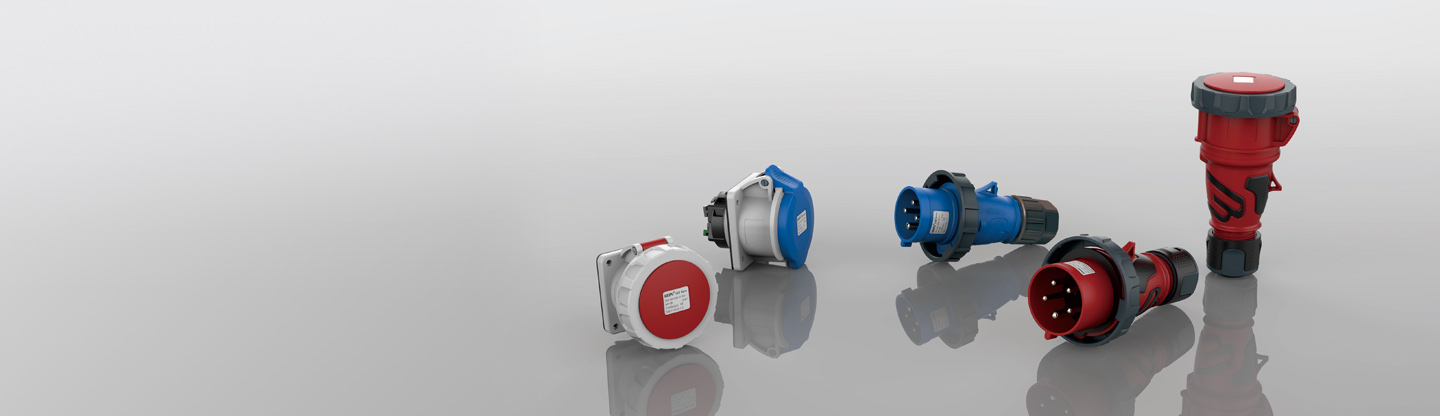
A CEE plug is the blue or red industrial plug most people recognise from construction sites, event rigs and factory walls. The name comes from the historical European committee that first standardised the format, but the format itself is now defined by IEC 60309 — the international standard for plugs, socket-outlets and couplers for industrial purposes. Equipment exported to Europe, the Middle East and much of Asia is expected to mate with these plugs, which is why panel builders and machine manufacturers keep asking the same questions: which pin configuration, which current class, which ingress rating?
This article walks through the parts of IEC 60309 that actually drive a purchase decision, and where common selection mistakes happen.
What IEC 60309 Actually Standardises
IEC 60309 does not simply define a plug shape. It defines the whole interconnection: plug, connector, socket-outlet and appliance inlet, in two families — the standard family (16 A to 125 A) and the smaller compact family (16 A to 32 A in a reduced body). What makes the system work is a deliberate design rule:
The position of the earth contact is the voltage coding.
Clock positions such as 4 h, 6 h, 9 h and 12 h encode the voltage and frequency class of the circuit. A 3P+PE 400 V 50/60 Hz plug has its earth pin at 6 h; a different voltage class with the same pole count lands at a different clock position. Two plugs that carry different voltages therefore cannot be mated by accident. This is worth explaining to customers who ask why "a 5-pin plug" is not just a 5-pin plug — the earth position is the safety mechanism.
Voltage class is only half of the identification story. The industrial plug colour code guide explains how blue, red and yellow housings map to 200-250 V, 380-415 V and 110-130 V, and what the 6h clock position on the label adds to the check.
Pole Count and Voltage Classes
Most real-world selections come down to three formats:
- 2P+PE (3 pin) — single-phase 230 V circuits, small tools, site distribution spurs.
- 3P+PE (4 pin) — three-phase loads without neutral, typically 400 V motor circuits where the machine does not need a neutral conductor.
- 3P+N+PE (5 pin) — three-phase with neutral, used where control circuits, lighting or electronics run at 230 V phase-to-neutral inside the equipment.
The recurring mistake is choosing 4 pin for a machine that internally needs the neutral, then retrofitting a small transformer instead. For export equipment, matching the destination country's practice matters: Gulf markets and Europe use 400/230 V 50 Hz systems where 5 pin is the default for mixed loads; some 60 Hz regions follow different voltage codings, which is exactly what the clock system exists to handle.
Current Classes: 16 A, 32 A, 63 A, 125 A
The standard families step through 16 A, 32 A, 63 A and 125 A, and the plug body size grows with each step. Two practical notes from field experience:
Cable size, not the moulding, is the real constraint. A 32 A plug accepts a defined cable diameter range. If the installed cable is undersized for the gland range, the sealing and strain relief both suffer — a common failure point on site-built cables.
Continuous load is not the rating. As with any connector system, sustained service at 100% of rated current in an enclosed or sun-exposed location leaves little thermal margin. Panel builders commonly size continuous loads at 70–80% of the rating, then verify temperature rise on the finished assembly.
Choosing between the two builds is easier once the test behind each digit is clear. The IP44 vs IP67 socket guide walks through the splash test, the 30-minute immersion test, and how the mated pair decides the final rating on site.
IP44 or IP67: Which Version to Specify
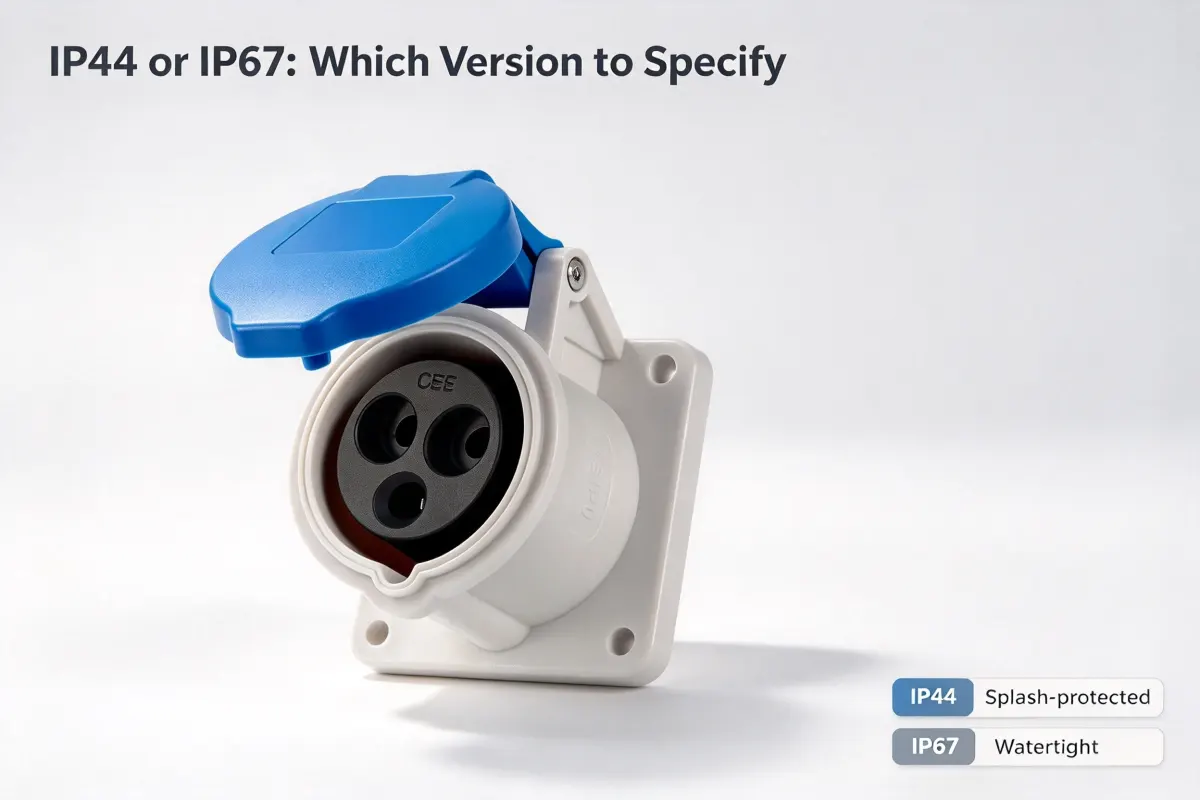
IEC 60309 plugs exist in both splash-protected and watertight versions, and the difference shows up in two places: the coupling face and the cable entry.
- IP44 versions protect against splashing water and are the standard choice for indoor walls, covered distribution boards and equipment used under a canopy. They are lighter, cheaper and quicker to mate.
- IP67 versions — including fully sealed constructions such as WEIPU's TYP and TYPR surface-mount sockets — are specified where the coupling point can be washed down, exposed to rain, or buried in a wet environment: food plants, marinas, outdoor event power, car washes, irrigation and cold-chain facilities.
One detail that separates good IP67 designs from mediocre ones is the behaviour of the unused socket position. A wall socket that is not mated is still an ingress path; covers and shutter designs determine whether the installed base stays sealed between uses.
Where CEE Plugs Sit in a Real Installation
A typical power chain looks like this:
Fixed supply → distribution box (IP44–IP68) → CEE wall socket → CEE plug on flexible cable → machine inlet.
This is also where WEIPU's product families meet: combined distribution boxes distribute the supply, TYP/TYPR plugs and sockets handle the field coupling, and the machine side terminates in matching inlets. Specifying the chain as a system — rather than as isolated components — is what keeps ingress ratings consistent end to end, because the weakest rating in the chain defines the whole installation. Technicians who terminate their own leads can follow this step-by-step guide to wiring a 16 A industrial plug, covering strip length, terminal torque and the insulation test that follows.
The rating classes above are easier to apply when both halves are specified together. The matching rules for a 3 pin industrial plug and socket condense frame, hour position and IP class into one pre-order check.
Single-phase blue bodies are only half the family. Where a machine draws 400 V for its motor and 230 V for its controls from one cord, the 5 pin industrial plug carries 3P+N+E in the same frame sizes and clock keying as the pairs above.
Common Selection Mistakes
- Choosing the pole count for today's load and ignoring the neutral that the control system will need later.
- Installing an IP44 socket where hoses and washdowns reach it, because the wall looked "mostly dry".
- Mixing compact-family and standard-family components at the same current class — they do not mate, and site improvisation with adapters defeats the voltage-coding protection.
- Ignoring the clock position when exporting to 60 Hz markets with different voltage classes.
- Over-torquing screw terminals on fine-stranded cable, which works loose under vibration; crimp terminations avoid this entirely.
Current class and clock position decide what mates; the milliohm budget decides how the circuit runs. This guide to the contact resistance budget of a socket connector chain shows where those milliohms go and how to measure them four-wire.
Ratings and pin configurations decide whether a pair fits; paperwork decides whether the fit has been proven. The guide to industrial plug test reports sets out which IEC 60309-1 clauses a buyer should see evidence for.
Specification Checklist
Before ordering, confirm:
- Voltage / frequency class of the destination supply → determines earth pin clock position
- Poles: 2P+PE, 3P+PE or 3P+N+PE
- Current class: 16 / 32 / 63 / 125 A, against continuous load at 70–80% margin
- Ingress rating: IP44 (splash) or IP67 (washdown / outdoor / buried)
- Cable diameter range of the gland vs the installed cable
- Termination type: screw vs crimp, against vibration exposure
- Housing material: plastic (light, corrosion-free) vs metal where impact and heat dissipation matter
Related Products for Your Application
Browse the full range of industrial connectors to find the right plug or socket for your project.
For terminal-side applications such as reefer racks and quay distribution, the duty requirements are expanded in this guide to industrial plugs for ports.
FAQ
Is a CEE plug the same as an IEC 60309 plug?
In practice, yes. "CEE" refers to the standardisation history; the current standard is IEC 60309. Reputable suppliers label products with both terms.
Can I use a 4-pin CEE plug on a machine that needs a neutral?
Not directly — 4-pin (3P+PE) circuits carry no neutral. Either run a 5-pin circuit or add a step-down transformer inside the machine. The transformer approach is common but adds cost and heat.
What IP rating do outdoor event power connections need?
Rain-exposed couplings should be IP67 when mated, and the installation should still be safe when unmated — which is why socket covers and shutter design matter as much as the plug rating.
Are CEE plugs usable in North America?
IEC 60309 products are sold in North America, but NEMA-style wiring devices dominate there. Equipment exported to both markets typically offers a NEMA inlet option or ships with an adapter strategy defined by the OEM.
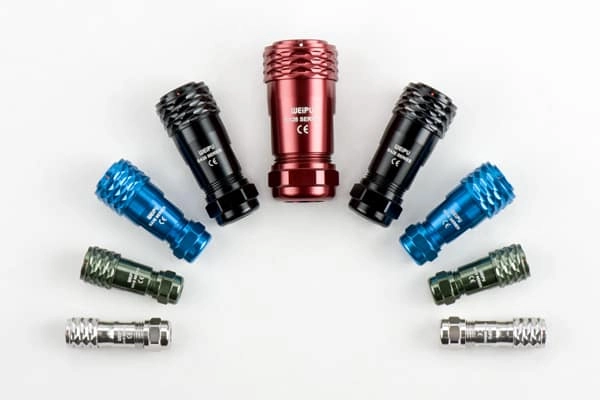
What is a connector?
Mining Connectors: Surviving Abrasion, Impact and Washdown

Circular Connectors Manufacturers: A 10-Point Factory Audit
IP65 to IP69K: Evaluating Heavy Duty Housing Protection for Harsh Environments
Contacts
Sofia
WhatsApp/Phone
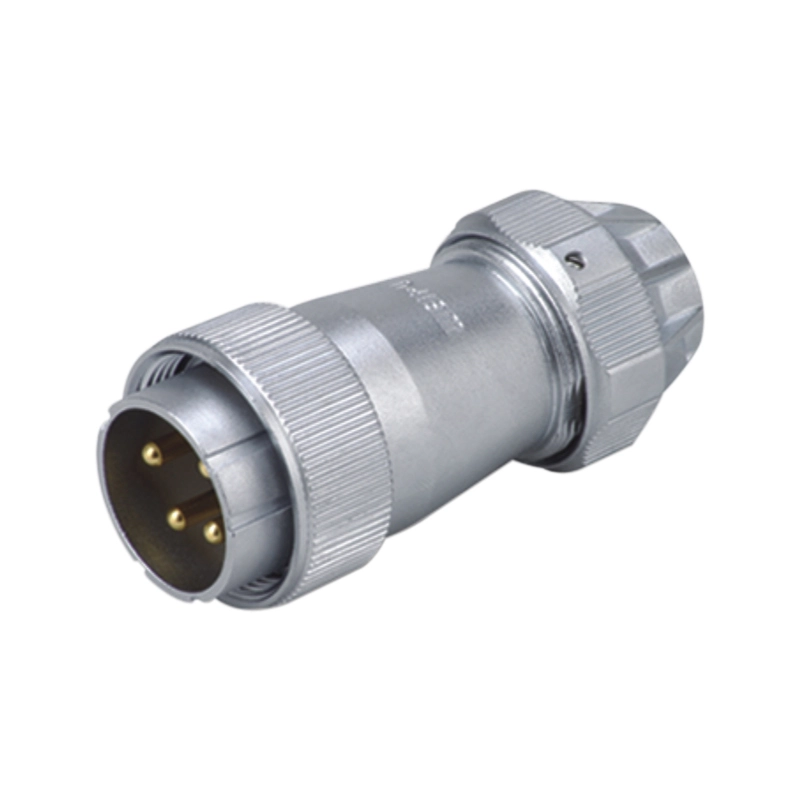
Weipu WF Series Industrial Threaded Connectors with IP67 Protection
WEIPU WF Series Industrial Threaded Connectors offer robust IP67 protection, ensuring reliable performance in harsh environments. Designed for secure, waterproof connections, these IP67 connectors are ideal for industrial applications requiring durability and stability. Trust WEIPU for quality and safety.
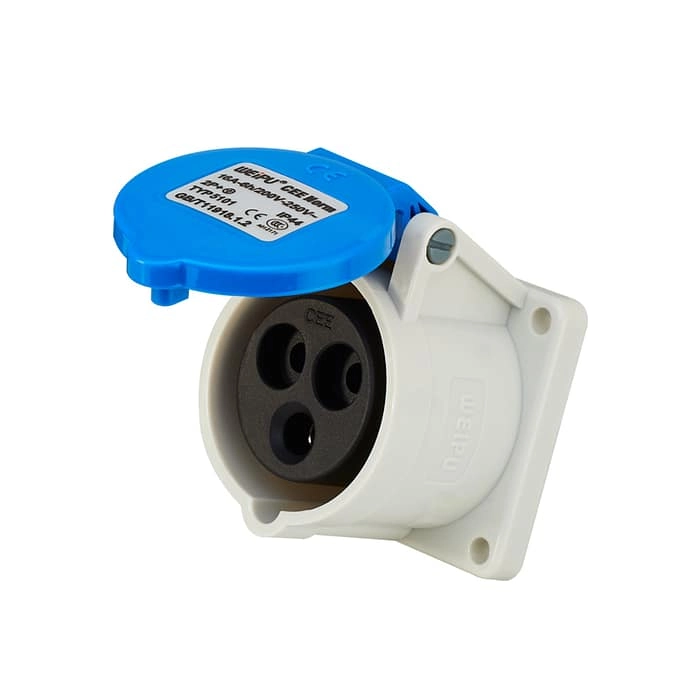
16A 3PIN Panel mount socket TYP5101-IP44
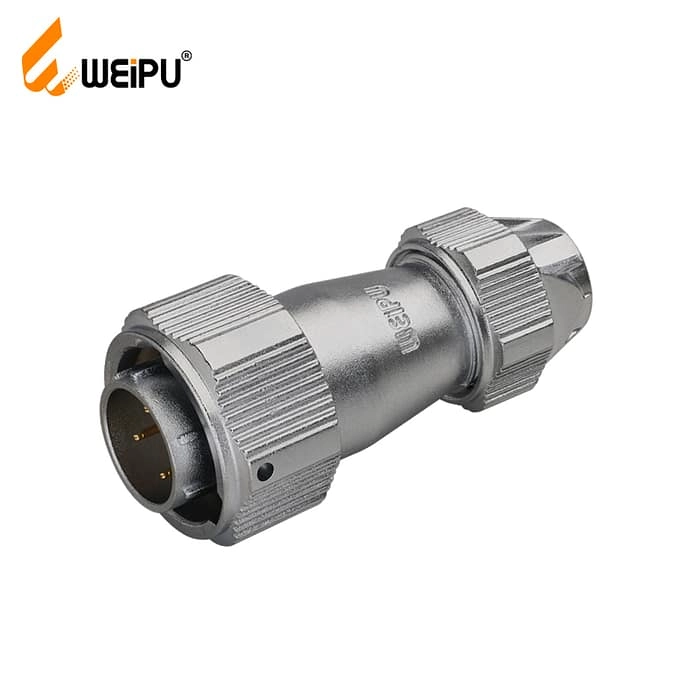
WEIPU WY-TE Series Waterproof Electrical Plug
With metal clamping-nut IP67, Threaded, Zinc alloy with chrome plating, PPS
WEIPU WY-TE IP67 circular connectors are waterproof electrical plugs with metal clamping-nut, which are durable, safe and easy to assemble with your all devices.With the metal clamping-nut and threaded design, these waterproof electrical plugs ensure high security and super stable connection. It’s an ideal waterproof connector for your applications.
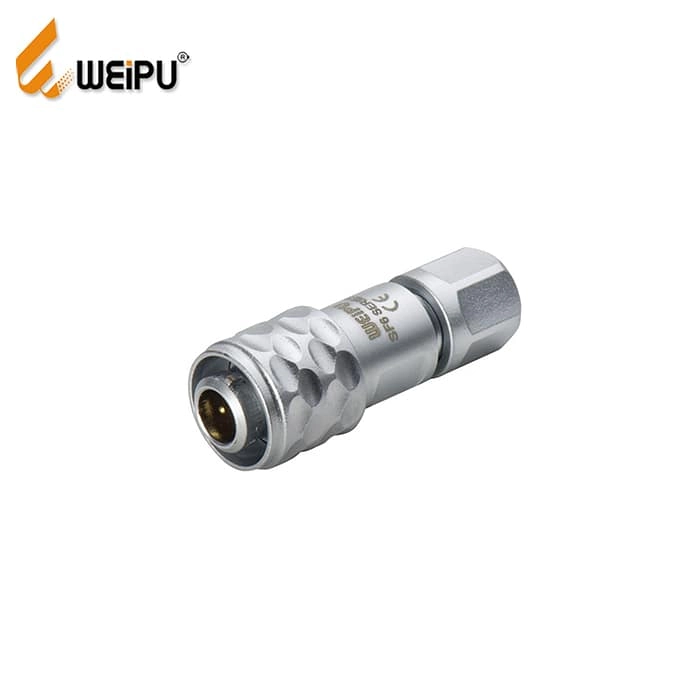
SF610B/P SF610B/S Cable connector IP67
Mate with SF611B, SF612B, SF615B
Get in Touch
Request Related Resources about Industrial Connections & Solutions
If you require technical details, product guides, or specific recommendations from a premier connector manufacturing corporation, please send us your request. We provide expert support for custom electrical connectors, offering OEM/ODM customization and dedicated distributor cooperation assistance.
Weipu Building, No. 111, Baihua Road, Liwan District, Guangzhou, Guangdong China
© 2026 WEIPU. All Rights Reserved.
Whatsapp: +8618102298073
WEIPU
WEIPU
WEIPU
WEIPU