

How Industrial Connectors Affect Signal Integrity and Data Reliability
Learn how contact quality, shielding, grounding, cable termination, vibration, and environmental conditions affect industrial communication reliability.
Follow us now:
- How Can a Connector Affect Industrial Communication Reliability?
- 1. Contact Resistance and Contact Quality
- 2. Connector Structure and Mating Quality
- 3. Shielding and Grounding
- 4. Cable Termination Is Part of Connector Reliability
- 5. Vibration Can Cause Intermittent Communication
- 6. Environmental Conditions Can Affect Signal Performance
- 7. Data Reliability Is a System-Level Result
- 8. How Engineers Should Evaluate Signal Connector Performance
- 1. What type of signal is being transmitted?
- 2. What environment will it operate in?
- 3. How will the connector be installed?
- 4. How often will it be serviced?
- 5. What happens if the connection becomes intermittent?
- WEIPU Solutions for Industrial Signal and Data Applications
- SA Series
- SF Series
- M23 Series
- Signal Reliability Checklist
- Conclusion
- FAQ
How Can a Connector Affect Industrial Communication Reliability?
Industrial communication systems rely on controllers, sensors, switches, cables, and communication devices. But there is another component that is easy to overlook: the connector between them.
A connector sits directly in the electrical path. If its contacts become unstable, its locking mechanism loosens, shielding is interrupted, or the cable termination is poorly installed, communication problems can appear—even when the electronic devices and communication protocol are working correctly.
These problems may appear as:
- Intermittent signals
- Data transmission errors
- Sensor communication failures
- Network dropouts
- Unstable machine operation
- Difficult-to-reproduce faults
This is why signal performance is not only about advanced electronics or high-speed transmission theory.
Reliable industrial communication starts with a stable physical connection.
1. Contact Resistance and Contact Quality
One of the most basic factors affecting signal performance is contact resistance.
When two connector contacts mate, they create the electrical path between the cable and equipment. A reliable connection should maintain stable electrical contact throughout its service life.
Contact resistance can become less stable because of:
- Contact wear
- Corrosion
- Contamination
- Insufficient contact force
- Poor contact alignment
- Mechanical movement
For power applications, increased resistance can contribute to voltage drop and heat. For signal and data applications, unstable contact conditions may contribute to intermittent signals and communication errors.
However, low contact resistance alone does not guarantee reliable performance.
Contact quality also matters.
Contact material, surface plating, contact force, dimensional accuracy, and wear resistance all influence how consistently the connection performs over time.
This is particularly important in industrial equipment that is frequently connected, disconnected, moved, or exposed to vibration.
2. Connector Structure and Mating Quality
The electrical contact depends on the connector's mechanical structure.
Housing design, contact arrangement, alignment, insulation, locking mechanism, sealing, and cable entry all help maintain a stable connection.
A connector that is not fully mated or properly locked can create an intermittent electrical connection even if the contacts themselves are well designed.
Common installation problems include:
- Incomplete insertion
- Incorrect alignment
- Insufficient locking
- Damaged contacts
- Excessive cable stress
- Improper cable routing
For this reason, engineers should consider not only how a connector performs when new, but also how consistently it can be installed and maintained in the field.
The locking mechanism is especially important in applications exposed to movement or vibration.
Push-pull, threaded, bayonet, and lever locking mechanisms provide different approaches to maintaining mechanical stability.
3. Shielding and Grounding
Industrial equipment often operates close to motors, drives, switching power supplies, and other sources of electromagnetic interference.
Sensitive signals and communication lines can be affected when unwanted electrical noise enters the signal path.
Shielding helps reduce this risk by providing a barrier around the signal conductors. But effective shielding requires more than a shielded cable.
The complete path matters:
Cable Shield → Connector → Connector Shell → Equipment Ground
If the shielding path is interrupted at the connector, the effectiveness of the overall system can be reduced.
Grounding is therefore closely connected to shielding performance. Engineers should consider how the cable shield terminates, how the connector interfaces with the equipment, and whether the grounding strategy matches the overall system design.
The practical principle is simple:
- A shield is only effective when its continuity is maintained across the connection.
4. Cable Termination Is Part of Connector Reliability
The connector-to-cable interface can become a weak point if termination is poorly designed or installed.
Depending on the connector, termination may involve crimping, soldering, or other connection methods. Each method requires the correct cable size, contact, tooling, and installation procedure.
Poor termination can lead to:
- Unstable electrical contact
- Increased resistance
- Signal interruption
- Shielding discontinuity
- Cable pull-out
- Mechanical stress on contacts
- Strain relief is also important.
If cable movement is transferred directly to the contacts, repeated bending or pulling can gradually weaken the connection.
Therefore, engineers should evaluate the connector, cable, termination, and strain relief as one system rather than treating them as independent components.
5. Vibration Can Cause Intermittent Communication
Vibration is a common challenge in robotics, AGVs, servo systems, industrial machinery, and automated production equipment.
A connector may operate normally during initial testing but develop intermittent problems after extended exposure to vibration.
Mechanical movement can contribute to:
- Connector loosening
- Contact movement
- Contact wear
- Cable termination stress
- Intermittent electrical continuity
The problem is particularly difficult to diagnose because the connection may appear normal when the equipment is stationary.
For dynamic applications, connector selection should therefore consider:
Locking mechanism + contact stability + strain relief + mounting + vibration conditions
The connector should be selected according to the actual movement and mechanical stress of the equipment.
6. Environmental Conditions Can Affect Signal Performance
Industrial connectors rarely operate in ideal laboratory conditions.
Depending on the application, they may be exposed to:
- Moisture
- Dust
- Oil
- Chemicals
- Temperature changes
- Outdoor conditions
- Corrosive environments
These conditions can gradually affect contact surfaces, insulation, seals, and cable interfaces.
For example, moisture or contamination around the mating interface can contribute to corrosion or unstable electrical performance.
This is why environmental protection is part of signal reliability.
An appropriate IP rating helps protect the connection from environmental exposure, but the correct rating should be selected according to the actual application conditions, not simply because a higher number appears better.
7. Data Reliability Is a System-Level Result
A communication path can be simplified as:
Controller → Cable → Connector → Cable → Connector → Device
Every connector introduces another physical interface.
This means data reliability depends not only on the controller, cable, or communication protocol, but also on whether each physical connection remains stable.
| Connector Factor | Impact on Reliability |
|---|---|
| Contact resistance | Helps maintain stable electrical continuity |
| Contact quality | Supports consistent signal transmission |
| Connector structure | Maintains alignment and mechanical stability |
| Shielding | Helps reduce electromagnetic interference |
| Grounding | Maintains the intended electrical reference and shield path |
| Cable termination | Prevents weak points at the cable interface |
| Mating quality | Ensures consistent contact |
| Vibration resistance | Reduces intermittent connection risk |
| Environmental protection | Protects contacts and insulation over time |
This is the key engineering takeaway:
- Signal integrity is not isolated from connector design.
A connector does not need to perform signal processing. Its job is to maintain the physical and electrical conditions required for the signal to travel reliably.
8. How Engineers Should Evaluate Signal Connector Performance
Instead of starting with complex signal theory, engineers can begin with practical application questions.
1. What type of signal is being transmitted?
Identify whether the connector carries:
- Sensor signals
- Control signals
- Encoder feedback
- Industrial communication
- Ethernet/data
- Power and signal together
2. What environment will it operate in?
Consider:
- Vibration
- Moisture
- Dust
- Temperature
- Chemicals
- EMI
- Outdoor exposure
3. How will the connector be installed?
Check:
- Termination method
- Cable size
- Shield termination
- Strain relief
- Locking mechanism
- Available installation space
4. How often will it be serviced?
A connector used once during factory assembly has different requirements from one that technicians disconnect regularly.
Mating frequency, accessibility, locking method, and serviceability should all be considered.
5. What happens if the connection becomes intermittent?
For critical automation systems, even a short communication interruption may stop a machine, interrupt sensor feedback, or trigger a system fault.
Reliability should therefore be evaluated across the entire expected service life, not just during initial testing.
WEIPU Solutions for Industrial Signal and Data Applications
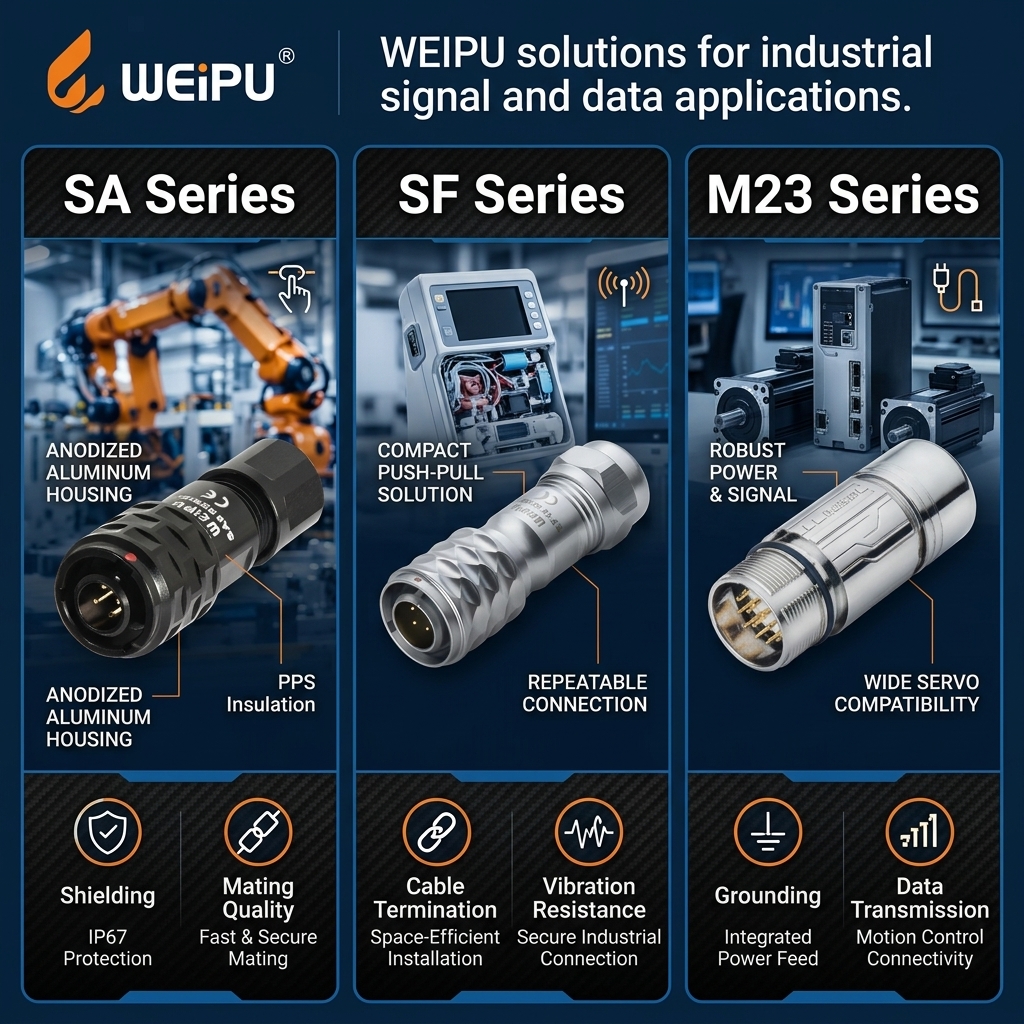
WEIPU provides different connector designs for industrial automation, machinery, robotics, and communication applications.
SA Series
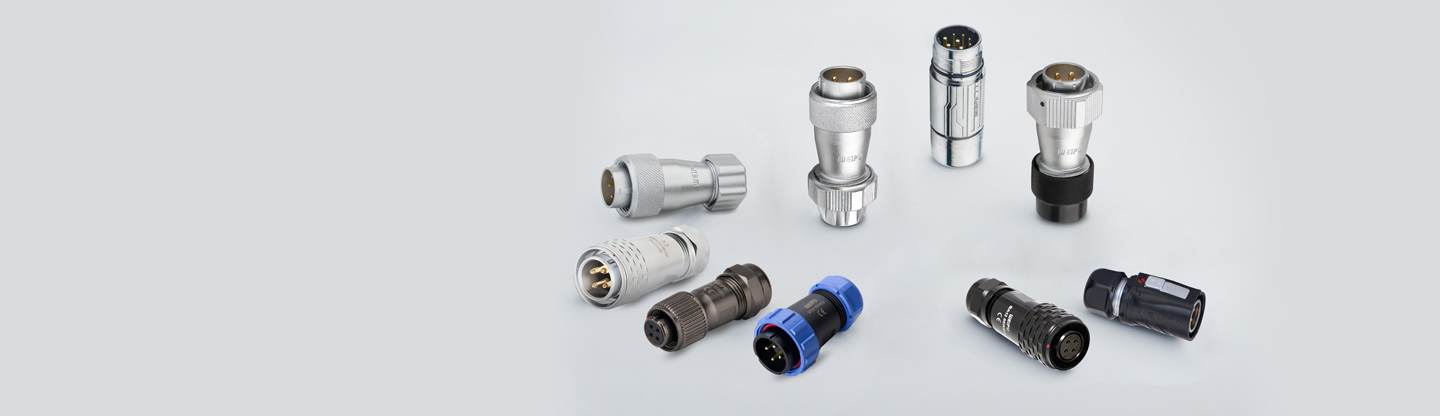
The SA Series uses a push-pull locking structure and is designed for compact industrial applications where fast mating, secure connection, and environmental protection are important.
With anodized aluminum housing, PPS insulation, gold-plated brass contacts, and IP67 protection on listed configurations, the series can be considered for automation equipment, instrumentation, sensors, and compact industrial systems.
SF Series
The SF Series provides a compact push-pull connection solution for applications where installation space, connection convenience, and environmental protection are important.
Its design is suitable for industrial equipment requiring a secure and repeatable connection.
M23 Series
The M23 Series is widely suited to industrial automation applications where robust signal and power connectivity is required.
Depending on configuration, M23 solutions can support applications involving servo systems, motion control, robotics, machinery, and industrial equipment.
Signal Reliability Checklist
Before selecting an industrial connector for signal or communication applications, engineers should ask:
- Is the contact quality stable?
- Is contact resistance controlled?
- Is the connector securely locked?
- Is the mating process repeatable?
- Is the cable termination appropriate?
- Is strain relief adequate?
- Is shielding required?
- How is the shield terminated?
- Is the grounding strategy appropriate?
- Can the connector withstand application vibration?
- Is the IP rating suitable for the environment?
- How frequently will the connector be mated?
- Can the connection maintain performance throughout the expected service life?
These questions can help identify potential connection problems before they become system-level communication failures.
Conclusion
Reliable data transmission starts with a reliable physical connection.
Industrial connectors can affect signal and communication reliability through contact resistance, contact quality, connector structure, shielding, grounding, cable termination, mating quality, vibration, and environmental conditions.
The important point is not to make connector selection unnecessarily complicated.
Instead, engineers should evaluate the complete connection:
Contact → Structure → Termination → Shielding → Grounding → Environment → Application
When these elements work together, the connector provides a stable physical foundation for industrial communication.
Good communication reliability starts with a stable connection.
FAQ
Can an industrial connector affect data transmission?
Yes. Contact instability, poor mating, cable termination problems, vibration, shielding issues, and environmental exposure can all affect communication reliability.
Does contact resistance affect signal reliability?
Yes. Stable contact resistance helps maintain a consistent electrical connection. However, contact resistance is only one part of overall connector performance.
Why does vibration cause intermittent communication?
Continuous vibration can cause connector loosening, contact movement, wear, or cable stress, potentially resulting in intermittent electrical continuity.
Does shielding improve industrial communication reliability?
Proper shielding can help reduce electromagnetic interference, especially around motors, drives, and other industrial equipment that generates electrical noise.
What is the most important factor when selecting a signal connector?
There is no single factor. Engineers should consider contact quality, connector structure, termination, locking, shielding, grounding, vibration, environmental conditions, and application requirements together.

Ultimate Guide to Circular Connectors (2026): Types, Standards, Selection & OEM Solutions

What is an IP rating?

Connector Application in Industrial 5G

Beyond the Assembly Line: What Makes a Top-Tier Industrial Connector Factory [2026 Expert Insights]
Contacts
Sofia
WhatsApp/Phone

WEIPU Receptacle with LC adapter SA2411/SLC
The LC Adapter Connector by WEIPU ensures precision fiber optic connectivity. Engineered for optimal alignment and minimal signal loss, this connector guarantees high-speed data transmission and clear signals. Versatile and durable, it thrives in diverse environments. Perfect for data centers, telecommunications, and industrial setups, the LC Adapter Connector establishes unwavering communication pathways.
Plug with LC adapter:SA2410/PLC>more>
Receptacle with LC adapter:SA2411/SLC>more>
Rear-nut mount receptacle with LC adapter:SA2412/SLC>more>
Square flange receptacle with LC adapter:SA2413/SLC>more>

M23SK_TK Female contact cable connector IP67
Mate with M23SJ_TK,M23SJ_Z,M23SJ_TL,M23SJ_ZL

WEIPU SP1711P/S In-line cable connector IP68
Mate with SP1710
Get in Touch
Request Related Resources about Industrial Connections & Solutions
If you require technical details, product guides, or specific recommendations from a premier connector manufacturing corporation, please send us your request. We provide expert support for custom electrical connectors, offering OEM/ODM customization and dedicated distributor cooperation assistance.
Weipu Building, No. 111, Baihua Road, Liwan District, Guangzhou, Guangdong China
© 2026 WEIPU. All Rights Reserved.
Whatsapp: +8618102298073
WEIPU
WEIPU
WEIPU
WEIPU