





Hybrid Industrial Connectors: When Power, Signal and Data Share One Connection
Follow us now:
- What Is a Hybrid Industrial Connector?
- Why Are Hybrid Connectors Becoming More Important?
- More functions, but less available space.
- Separate Connectors vs. Hybrid Industrial Connectors
- How Do Hybrid Industrial Connectors Work?
- 1. Power Contacts
- 2. Signal Contacts
- 3. Data Contacts
- Where Are Hybrid Industrial Connectors Used?
- 1. Industrial Automation
- Typical example
- 2. Robotics
- 3. Smart Manufacturing
- 4. Energy Storage and Power Equipment
- 5. Compact Industrial Equipment
- Machine A
- Machine B
- What Are the Main Benefits of Hybrid Industrial Connectors?
- Reduced Connection Complexity
- Better Space Utilization
- Simplified Cable Routing
- Faster Installation
- Easier Maintenance
- When Should You Choose a Hybrid Industrial Connector?
- Choose hybrid connectivity when:
- Consider separate connectors when:
- How to Select a Hybrid Industrial Connector
- 1. Define Power Requirements
- 2. Define Signal Requirements
- 3. Define Data Requirements
- 4. Check Environmental Protection
- 5. Evaluate the Locking Mechanism
- 6. Consider Materials
- WEIPU Hybrid Connectivity Solutions
- WEIPU WA22: Integrated Power and Signal Connectivity
- Recommended application scenarios
- WEIPU WK16: Compact Power and Signal Connectivity
- M23: When Power and Signal Need a More Specialized Industrial Connection
- M23 is particularly relevant for:
- Hybrid Connectors vs. Dedicated Connector Systems
- What About EMI and Signal Integrity?
- A Practical Hybrid Connector Selection Checklist
- Electrical
- Mechanical
- Environmental
- Maintenance
- System Integration
- Conclusion: Integration Should Follow the Application
- FAQ
Hybrid Industrial Connectors: When Power, Signal and Data Share One Connection
Modern industrial equipment is becoming more compact, more automated, and more connected. A single machine may need power for motors and actuators, signal connections for sensors and control systems, and data interfaces for Ethernet or other communication networks.
Traditionally, these functions are handled through separate connectors and cable routes. That approach can work, but as equipment becomes more complex, it can also create crowded panels, complicated cable routing, longer installation time, and more connection points to maintain.
This is where hybrid industrial connectors become valuable.
A hybrid industrial connector combines two or more transmission functions—such as power, signal, and data—within one connector system. Instead of designing three separate connection points, engineers can integrate multiple functions into a more compact interface.
But hybrid does not automatically mean better.
The right choice depends on current and voltage requirements, signal integrity, data transmission, environmental protection, locking method, available installation space, and maintenance requirements.
This article explains when hybrid industrial connectors make sense, where they are used, and how engineers can select the right solution, including WEIPU WA22, WK16, and M23 connector solutions.
What Is a Hybrid Industrial Connector?
A hybrid industrial connector is designed to combine different electrical transmission functions within one connection system.
Depending on the connector architecture, this can include:
- Power transmission
- Control signals
- Sensor signals
- Communication or data transmission
- Grounding or shielding functions
The basic idea is simple:
One mating interface can replace multiple separate connection points.
For example, an automated machine may require:
Power → Motor
Signal → Sensor
Data → Controller
Instead of routing three independent connector systems into the machine, a hybrid architecture can consolidate selected functions into a single connection.
However, engineers should distinguish between a connector that combines power and signal and a true power + signal + data solution. The actual contact configuration and electrical specifications must always be checked against the application.
WEIPU's circular connector portfolio includes solutions for power, signal, and data connectivity, while its M23X series is specifically positioned for power and signal applications.
Why Are Hybrid Connectors Becoming More Important?
The demand for hybrid connectivity is closely connected to the evolution of industrial machinery.
Modern automation equipment typically contains more:
- Sensors
- Servo motors
- Controllers
- I/O modules
- Communication interfaces
- Monitoring systems
- Smart devices
At the same time, machine builders want equipment that is:
- Smaller
- Faster to install
- Easier to maintain
- More modular
- Easier to integrate
This creates a basic engineering problem:
More functions, but less available space.
A traditional connection architecture may require separate connectors for power, control, and communication.
That can result in:
More connectors → more cables → more panel space → more routing → more potential maintenance points
Hybrid connectivity takes a different approach:
Multiple functions → one integrated connection → simplified cable architecture
This does not eliminate all engineering challenges, but it can significantly simplify the physical connection between machine modules.
Separate Connectors vs. Hybrid Industrial Connectors
The decision should not be based simply on whether a hybrid connector is more compact.
Engineers should compare the complete connection architecture.
| Requirement | Separate Connectors | Hybrid Connector |
|---|---|---|
| Power transmission | Independent | Integrated with other functions |
| Signal transmission | Independent | Integrated |
| Data transmission | Independent | Integrated where supported |
| Panel space | Usually higher | Potentially lower |
| Cable routing | More complex | Simplified |
| Installation | Multiple mating operations | Fewer mating interfaces |
| Maintenance | Multiple connection points | More centralized |
| EMI/EMC design | Easier to physically separate | Requires careful design |
| Flexibility | High | Depends on connector configuration |
| Application complexity | Can increase with more interfaces | Can reduce connection complexity |
The important point is that hybrid connectors are an architectural choice, not simply a product category.
If a machine has limited space and several functions must enter the same equipment module, hybrid connectivity can be highly attractive.
If power, signal, and data need to remain physically separated for electrical, thermal, service, or system-design reasons, separate connectors may still be the better solution.
How Do Hybrid Industrial Connectors Work?
A hybrid connector does not simply put unrelated contacts together.
The connector must manage several engineering requirements simultaneously.
1. Power Contacts
Power contacts generally require larger conductive paths and appropriate current-carrying capacity.
Engineers should evaluate:
- Rated current
- Rated voltage
- Contact resistance
- Wire size
- Temperature rise
- Duty cycle
The power section must be sized according to the actual electrical load.
2. Signal Contacts
Signal contacts may be used for:
- Sensors
- Control signals
- Feedback
- I/O
- Low-voltage communication
Signal integrity can become particularly important when sensitive circuits are located close to higher-current power contacts.
Connector architecture, contact arrangement, grounding, shielding, and cable design should therefore be considered together.
3. Data Contacts
When data transmission is included, the requirements become more demanding.
Depending on the application, engineers may need to evaluate:
- Transmission speed
- Impedance
- Shielding
- Crosstalk
- EMI/EMC performance
- Cable construction
- Connector termination
A connector should not be considered a high-speed data solution simply because it physically contains multiple contact types. The complete connector and cable system must support the required communication performance.
Where Are Hybrid Industrial Connectors Used?
Hybrid connectivity becomes particularly useful when equipment needs multiple electrical functions but space, installation time, or cable management is limited.
1. Industrial Automation
Automation equipment is one of the most obvious applications.
A production machine may contain:
- Motors
- Sensors
- PLCs
- I/O modules
- Actuators
- Frequency converters
- Communication systems
These components often need to exchange power and signals through compact interfaces.
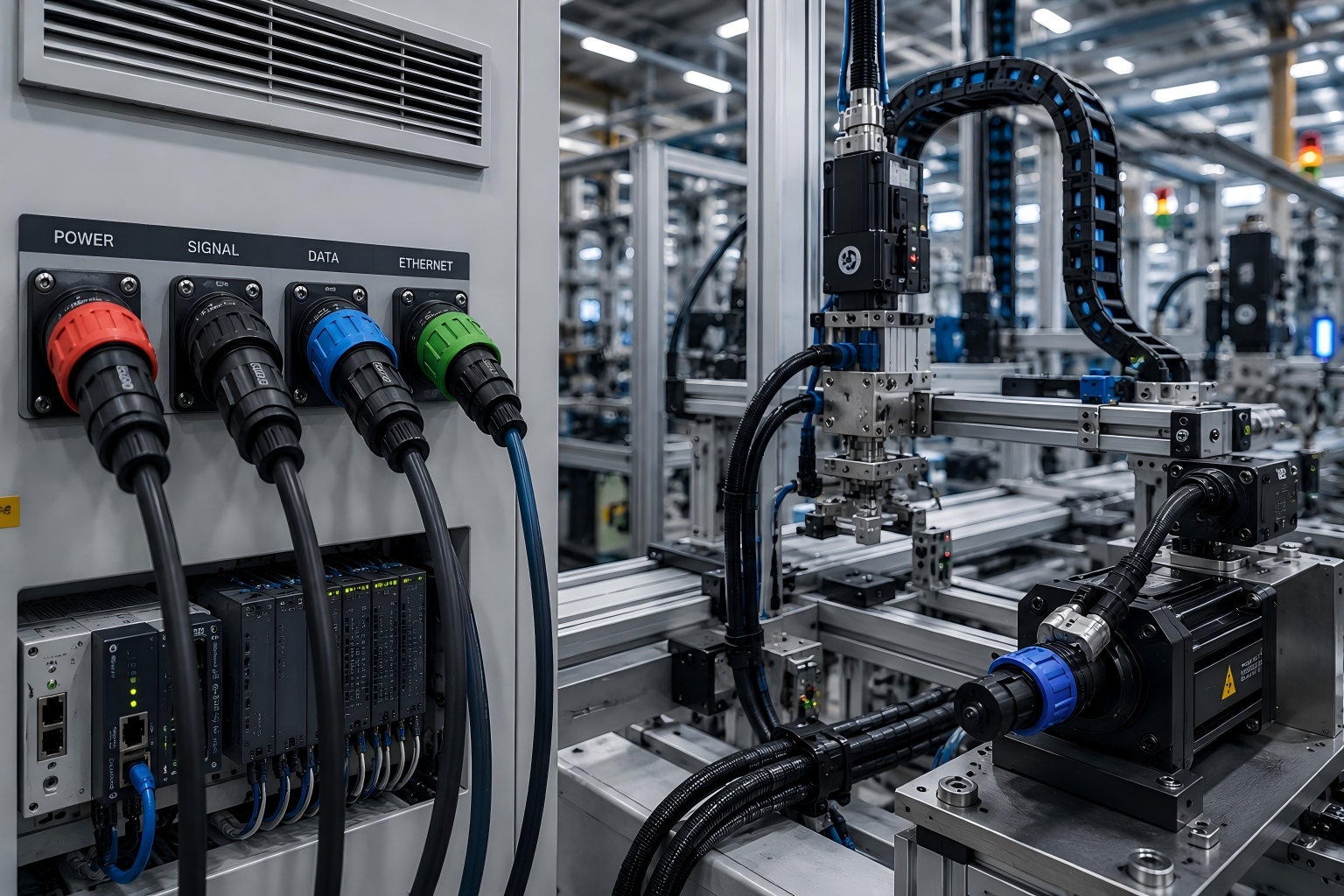
A hybrid connector can help simplify the connection between machine modules and reduce the number of separate cable interfaces.
Typical example
Control cabinet → Hybrid connector → Machine module
Instead of routing several independent connection systems, selected power and signal functions can be consolidated.
2. Robotics
Robotic systems place particularly strong demands on connectivity.
Robots need:
- Motor power
- Feedback signals
- Sensors
- Communication
- Compact cable routing
Space around robotic joints and moving assemblies is limited, while vibration and repeated movement can put mechanical stress on connectors and cables.
A properly selected hybrid connector can reduce the number of connection interfaces and simplify routing.
However, connector selection must also consider:
- Vibration
- Mating cycles
- Cable flexibility
- Strain relief
- Locking reliability
- Environmental protection
The goal is not simply to use fewer connectors.
The goal is to create a more reliable connection architecture.
3. Smart Manufacturing
Smart manufacturing increases the amount of information flowing through industrial equipment.
A machine may simultaneously need:
Power
for motors and actuators.
Signal
for sensors and control.
Data
for monitoring, diagnostics, and network communication.
This makes hybrid connectivity increasingly relevant to modular production equipment.
For machine builders, reducing the number of connection interfaces can also make machine assembly and field installation easier.
4. Energy Storage and Power Equipment
Energy storage systems and related power equipment can contain high-power circuits alongside monitoring and control systems.
A typical system may require:
- Power transmission
- Monitoring signals
- Control circuits
- Communication
However, high-power applications require careful evaluation of current, thermal performance, insulation, creepage and clearance, and connector architecture.
Therefore, hybrid connectors should only be used when their electrical configuration matches the application's actual requirements.
5. Compact Industrial Equipment
Space is often the biggest reason engineers investigate hybrid connectivity.
Consider two machines with identical electrical functions.
Machine A
Three separate interfaces:
Power connector
Signal connector
Data connector
Machine B
One integrated hybrid interface:
Power + Signal + Data
Machine B may require less panel space and fewer cable entry points.
For compact equipment, this can simplify mechanical design significantly.
What Are the Main Benefits of Hybrid Industrial Connectors?
Reduced Connection Complexity
One integrated interface can reduce the number of separate connectors required.
This can make the overall wiring architecture easier to understand and maintain.
Better Space Utilization
Industrial control cabinets and machine panels often have limited space.
Combining selected functions can reduce the physical footprint of connection points.
This is particularly valuable for:
- Robotics
- Compact automation equipment
- Modular machines
- Smart instruments
Simplified Cable Routing
Fewer connection points can mean fewer cable routes.
This may help reduce:
- Cable congestion
- Crossing cables
- Installation errors
Difficult access during maintenance
Faster Installation
When multiple functions can be connected through one interface, installation and commissioning may become more efficient.
This is especially useful for modular equipment that is repeatedly assembled, disassembled, or transported.
Easier Maintenance
A well-designed hybrid architecture can make machine modules easier to disconnect and replace.
Instead of disconnecting multiple interfaces individually, an integrated connection can simplify service procedures.
However, maintenance requirements should be considered during the initial connector selection—not after installation.
When Should You Choose a Hybrid Industrial Connector?
A hybrid connector is worth considering when several of the following conditions apply:
Choose hybrid connectivity when:
- Power and signal need to enter the same machine module
- Equipment has limited panel space
- Cable routing is becoming complicated
- Modular machine design is important
- Frequent installation or replacement is expected
- Multiple functions need to be connected simultaneously
- Reducing connection interfaces can simplify maintenance
But hybrid is not always the correct solution.
Consider separate connectors when:
- Power requirements are particularly high
- Power and sensitive data need substantial physical separation
- EMI/EMC requirements are demanding
- Different circuits require independent maintenance
- The system needs maximum connector configuration flexibility
- The hybrid connector cannot meet the required electrical performance
The correct question is therefore not:
"Are hybrid connectors better?"
It is:
"Does an integrated connection architecture better match the electrical and mechanical requirements of this machine?"
How to Select a Hybrid Industrial Connector
Before choosing a hybrid industrial connector, engineers should work through several key parameters.
1. Define Power Requirements
Start with the power circuit.
Check:
- Voltage
- Current
- AC or DC
- Wire size
- Peak load
- Continuous load
- Temperature rise
Do not select a connector based only on nominal current.
The actual operating environment and duty cycle matter.
Vibration
Mating frequency
Available installation space
Service requirements
Operator access
2. Define Signal Requirements
Determine what signals the connector will carry.
Examples include:
- Sensor signals
- Control signals
- Feedback
- I/O
- Low-voltage circuits
The number and type of contacts should match the system architecture.
3. Define Data Requirements
If data transmission is required, specify:
- Communication protocol
- Data rate
- Shielding requirements
- Cable type
- EMC environment
This is particularly important for modern automated equipment where communication reliability is critical.
4. Check Environmental Protection
Industrial connectors may be exposed to:
- Dust
- Water
- Oil
- Vibration
- Temperature changes
- Cleaning processes
Choose the appropriate IP rating and environmental construction for the actual installation.
WEIPU's circular connector portfolio includes IP67 and IP68 solutions, with different coupling and material configurations across product families.
5. Evaluate the Locking Mechanism
A hybrid connector may carry several critical circuits through one interface.
That makes mechanical locking particularly important.
Depending on the application, engineers may consider:
- Threaded locking
- Push-pull locking
- Bayonet locking
- Lever locking
The selection should consider:
- Vibration
- Mating frequency
- Available installation space
- Service requirements
- Operator access
6. Consider Materials
Connector housing materials influence:
- Mechanical durability
- Corrosion resistance
- Weight
- Temperature performance
- Environmental resistance
For harsh environments, metal housings may provide advantages in mechanical robustness and shielding.
For weight-sensitive or cost-sensitive equipment, engineered plastics may be appropriate.
WEIPU Hybrid Connectivity Solutions
WEIPU's connector portfolio includes solutions for different combinations of power, signal, and data requirements. Rather than forcing every application into one connector family, engineers can select the appropriate series according to electrical function, environment, space, and mechanical requirements.
WEIPU WA22: Integrated Power and Signal Connectivity
The WA22 Series is a practical solution for applications where power and signal functions need to be integrated into a compact circular connector architecture.
WEIPU's current WA22 product information includes configurations with 3+PE contacts, gold-plated brass contacts, a Nylon 66 housing, and applications including industrial automation, electrical control systems, mechanical equipment, power distribution equipment, and new-energy auxiliary equipment.
Recommended application scenarios
Industrial automation
Control cabinets
Servo and control equipment
Mechanical equipment
Power distribution
Compact machine modules
WEIPU WK16: Compact Power and Signal Connectivity
The WK Series provides another option when engineers need compact industrial power and signal connectivity.
WEIPU describes the WK family as power and signal connectors designed for high-reliability industrial applications.
This makes the series relevant to equipment where:
- Space is limited
- Multiple circuits must be integrated
- Quick connection is valuable
- Industrial durability is required
M23: When Power and Signal Need a More Specialized Industrial Connection
Not every application needs a hybrid connector in the strictest sense.
For automation equipment, servo systems, motors, and machinery, engineers may instead need a dedicated M23 connector system that provides robust power or signal connectivity in a standardized industrial form factor.
This is where the WEIPU M23 Series becomes relevant.
WEIPU's M23 family includes power and signal configurations. Its published specifications include threaded coupling and IP67 protection, while specific M23 signal configurations use zinc-alloy housings, gold-plated brass contacts, PA66 inserts, crimp termination, and a rated mating cycle of 1,000 cycles.
M23 is particularly relevant for:
- Servo motors
- Automation machinery
- Robotics
- Motion control
- Frequency converters
- Industrial sensors and signal systems
The M23X series is also positioned by WEIPU for Power & Signal applications with IP67 protection.
This creates an important distinction:
Hybrid connectivity is about integrating functions. M23 is about providing a robust industrial connection architecture for specific power or signal requirements.
In a complete machine, both approaches can coexist.
Hybrid Connectors vs. Dedicated Connector Systems
A modern machine does not necessarily need one connector type everywhere.
A more practical architecture might look like this:
Main Power Input
↓
Industrial Power Connector
Servo Motor
↓
M23 Power Connector
Sensor Network
↓
M23 Signal / Circular Connector
Compact Power + Signal Module
↓
WA22 / WK16
High-Speed Communication
↓
Dedicated Data Connector
This is often more realistic than trying to make one connector handle every function.
WEIPU's broader portfolio includes circular, industrial, heavy-duty, M23X, signal/data, and power-oriented connector solutions, allowing engineers to build a connection system around the machine architecture rather than around a single product family.
What About EMI and Signal Integrity?
One of the most important engineering considerations for hybrid connectors is electromagnetic compatibility.
When power and sensitive signal or data circuits share one connector system, engineers need to consider:
- Contact arrangement
- Physical separation
- Shielding
- Grounding
- Cable construction
- Crosstalk
- Connector termination
- System-level EMC design
A hybrid connector should therefore be evaluated as part of the complete cable and equipment system.
Simply combining power and data contacts does not automatically guarantee high-speed data performance.
For applications involving sensitive communication signals, the connector, cable, shielding, grounding, and equipment design should all be evaluated together.
A Practical Hybrid Connector Selection Checklist
Before specifying a hybrid industrial connector, ask:
Electrical
- What voltage is required?
- What continuous and peak current is required?
- How many power contacts are needed?
- How many signal contacts are needed?
- Is high-speed data required?
Mechanical
- How much installation space is available?
- What locking mechanism is appropriate?
- How much vibration will the connector experience?
- How frequently will it be mated and unmated?
- Is strain relief required?
Environmental
- What IP rating is required?
- Will the connector be exposed to water or dust?
- Is oil or chemical exposure expected?
- What temperature range is required?
- Is corrosion resistance important?
Maintenance
- Will the equipment require frequent service?
- Can the connector be easily accessed?
- Can a complete machine module be disconnected through one interface?
- Is field replacement important?
System Integration
Can power and signal safely share the connector architecture?
Are EMI/EMC requirements satisfied?
Does the connector fit the cable architecture?
Is customization required?
Conclusion: Integration Should Follow the Application
Hybrid industrial connectors are becoming increasingly relevant as industrial machines become more compact, connected, and modular.
The main advantage is not simply that one connector replaces several connectors.
The real advantage is connection architecture optimization.
By combining selected power, signal, and data functions, engineers can potentially reduce:
- Connector count
- Cable congestion
- Panel space
- Installation complexity
- Maintenance interfaces
But hybrid connectivity should always be selected according to the actual electrical, mechanical, environmental, and communication requirements of the application.
For integrated power and signal applications, WEIPU WA22 and WK16 provide practical solutions. For dedicated industrial power and signal connections in automation and motion-control systems, WEIPU M23/M23X solutions provide another important option.
The best connector is therefore not necessarily the one that combines the most functions.
It is the one that provides the right combination of power, signal, data, protection, reliability, and serviceability for the machine.
FAQ
What is a hybrid industrial connector?
A hybrid industrial connector combines multiple electrical functions, such as power, signal, or data, within one connector system. The exact combination depends on the connector design and contact configuration.
Can hybrid connectors carry power and data at the same time?
Some hybrid connector systems are specifically designed to combine power and data. However, engineers should verify the connector's electrical specifications, contact arrangement, shielding, impedance, and supported communication requirements before selecting it for a data application.
Are hybrid connectors better than separate connectors?
Not always. Hybrid connectors can reduce space requirements, cable complexity, and the number of mating interfaces. Separate connectors may be preferable when power, signal, and data need greater physical separation or independent maintenance.
Where are hybrid industrial connectors commonly used?
Typical applications include industrial automation, robotics, smart manufacturing, compact machinery, modular equipment, and selected energy-storage or power-control systems where multiple connection functions need to be integrated.

Application of Connectors in Road Monitoring
Industrial Connector Types: Power, Signal, Data and Hybrid Connectors Explained

Weipu Connector Solutions: Bridging Gaps and Enhancing B2B Networks

Locking Lever Types for Rectangular Connector Housings: Single vs. Double
Contacts
Sofia
WhatsApp/Phone

Weipu WK16 Series Industrial Lock Hook Connectors with IP67 Protection

M23DK-TK Female contact cable connector IP67
Mate with M23DJ_TK,M23DK_Z,M23DK_TL,M23DK_ZL

WEIPU SP1110P/S Cable Connector IP68
Mate with SP1111, SP1112
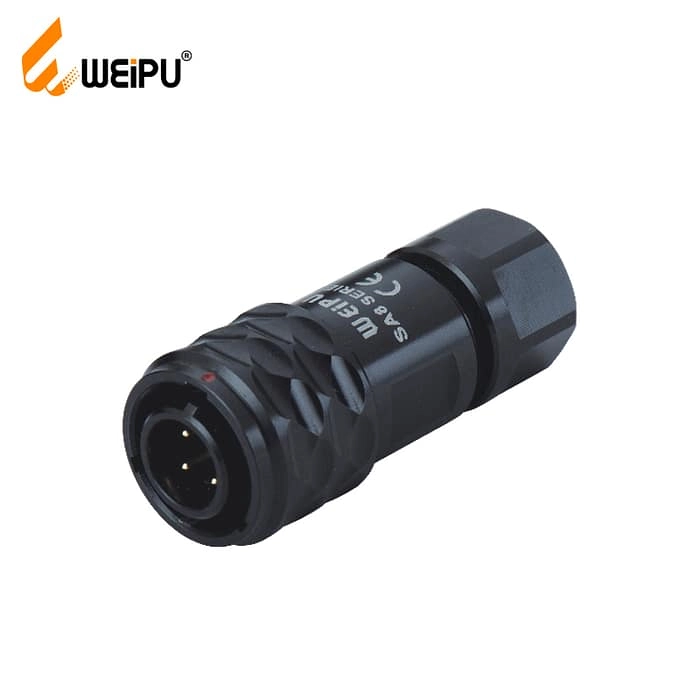
SA810/P SA810/S Cable connector IP67
The Weipu SA series connectors are high-quality, versatile connectors known for their ruggedness and reliability. Designed to meet various industrial and outdoor requirements, these connectors offer excellent environmental protection and are resistant to moisture, dust, and vibrations. The SA series connectors come in different sizes and configurations, making them suitable for a wide range of applications, including LED lighting, industrial automation, and outdoor equipment. With their robust construction and secure locking mechanisms, the Weipu SA series connectors ensure seamless and dependable connections for critical operations
Get in Touch
Request Related Resources about Industrial Connections & Solutions
If you require technical details, product guides, or specific recommendations from a premier connector manufacturing corporation, please send us your request. We provide expert support for custom electrical connectors, offering OEM/ODM customization and dedicated distributor cooperation assistance.
Weipu Building, No. 111, Baihua Road, Liwan District, Guangzhou, Guangdong China
© 2026 WEIPU. All Rights Reserved.
Whatsapp: +8618102298073
WEIPU
WEIPU
WEIPU
WEIPU