


Application-Based Industrial Connector Selection: A Practical Decision Matrix
Follow us now:
- Application-Based Industrial Connector Selection: A Practical Decision Matrix
- 1. Why Industrial Connector Selection Depends on the Application
- 2. Identify the Most Important Requirement Before Selecting a Connector
- 2.1 Electrical Load and Connection Function
- 2.2 Environmental Exposure
- 2.3 Mechanical Stress and Cable Movement
- 2.4 Installation Space and Maintenance
- 3. How Connector Selection Changes Across Industrial Applications
- 3.1 Control Cabinets and Fixed Automation Equipment
- 3.2 Sensors and Field Devices
- 3.3 Machine Vision and Data Connections
- 3.4 Robotics and Moving Machinery
- 3.5 Outdoor and Moisture-Exposed Equipment
- 3.6 High-Power Equipment and Heavy Machinery
- 4. Application-Based Industrial Connector Selection Matrix
- 5. How to Compare Connector Options for the Same Application
- 5.1 When a Circular Connector May Be Appropriate
- 5.2 When a Hybrid Connector May Be Worth Evaluating
- 5.3 When to Consider Heavy-Duty Connectors
- 5.4 When Separate Connection Interfaces Make More Sense
- 6. From Application Requirements to WEIPU Connector Families
- 6.1 Matching Requirements to Candidate Product Families
- 6.2 Verify the Exact Model and Configuration
- 7. A Practical Application-Based Selection Workflow
- Conclusion
- FAQ
Application-Based Industrial Connector Selection: A Practical Decision Matrix
Industrial connector selection is not simply a matter of matching a connector to a cable or choosing a product with the required current rating. The right solution depends on how the equipment operates, what the connection carries, where it is installed, and how it will be maintained throughout its service life.
A connector used inside a fixed control cabinet may need to prioritize wiring density, accessibility, and straightforward maintenance. A connector on a moving robot must also accommodate dynamic cable movement and mechanical stress. Outdoor equipment introduces different concerns, including moisture, temperature changes, and exposure to environmental conditions.
These differences mean that a connector suitable for one application may not be the best choice for another, even when both connections carry similar electrical loads.
This article compares common industrial applications, explains which connector requirements deserve the most attention in each scenario, and provides a practical decision matrix to help engineers narrow down suitable connector solutions.
1. Why Industrial Connector Selection Depends on the Application
Industrial connectors serve different functions across automation equipment, field devices, machine vision systems, robotics, outdoor installations, and heavy machinery. Their selection should reflect the actual operating conditions rather than rely on a single specification.
Three questions provide a useful starting point:
- What does the connection need to carry? Power, control signals, sensor signals, communication data, or a combination of these.
- What conditions will the connection experience? Temperature changes, moisture, vibration, repeated movement, limited installation space, or frequent maintenance.
- What must the connection achieve over time? Stable electrical performance, secure mating, convenient replacement, or reliable operation within a larger system.
A connector's rated current, ingress protection rating, contact arrangement, locking mechanism, and mechanical design all contribute to suitability. However, no single specification determines whether a connector is appropriate for every application.
2. Identify the Most Important Requirement Before Selecting a Connector
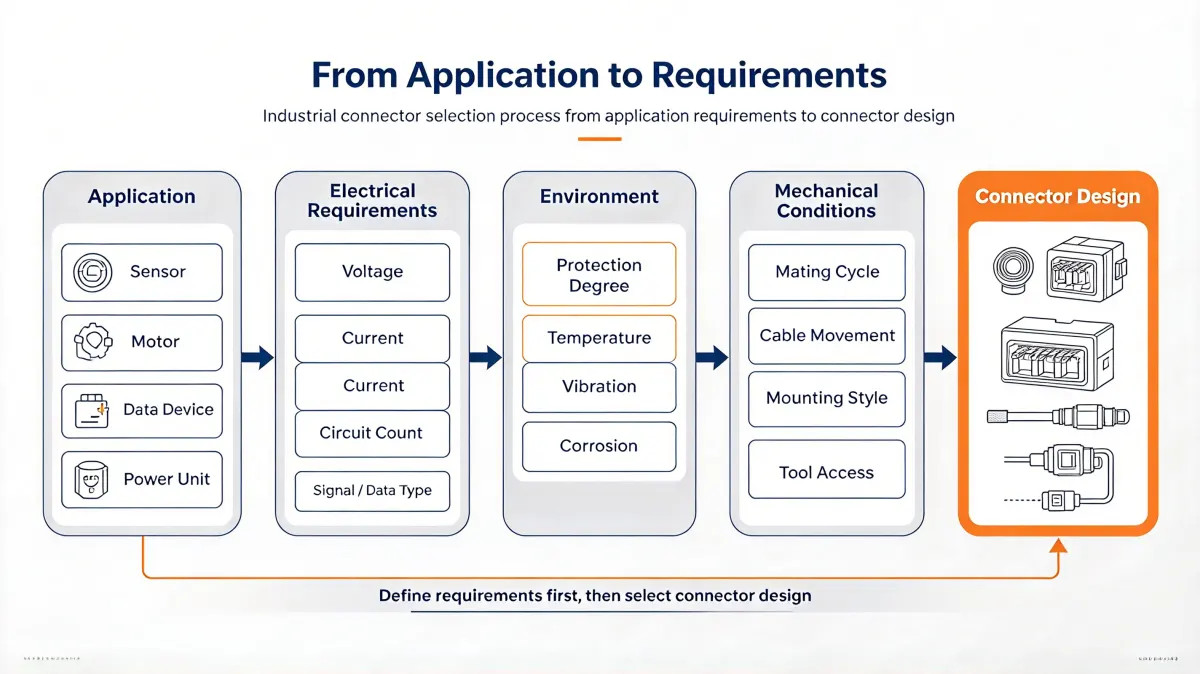
Before comparing connector families, engineers should identify the requirements that have the greatest influence on the application.
2.1 Electrical Load and Connection Function
Start by identifying whether the connection carries power, signals, data, or multiple functions.
Power connections require appropriate current and voltage ratings, compatible contacts, and suitable cable termination. Signal connections require attention to contact quality, wiring configuration, and the possibility of electrical interference. Data connections may require a specified interface, compatible cable characteristics, and suitable shielding or grounding arrangements.
If several functions must pass through one connection, a hybrid connector may be worth evaluating. However, combining functions is not automatically better than using separate connectors. The decision depends on the required circuits, electrical separation, installation constraints, and maintenance strategy.
2.2 Environmental Exposure
The installation environment determines which protection characteristics matter.
For outdoor or moisture-exposed equipment, engineers should assess ingress protection, sealing arrangements, temperature range, and material compatibility. An IP rating should be evaluated against the actual installation conditions, including whether the connector is fully mated and whether its specified protection applies to the complete assembly.
For applications involving dust, washdown, or changing weather conditions, verify the exact product's documented protection level rather than assuming that every connector in a family offers the same performance.
2.3 Mechanical Stress and Cable Movement
A fixed connection and a connection on moving equipment have different mechanical requirements.
Robotics and moving machinery may introduce repeated bending, twisting, vibration, and cable pulling. In these situations, the locking mechanism, cable routing, strain relief, and cable flexibility all contribute to connection reliability.
A connector with an appropriate electrical rating can still be unsuitable if the installed cable assembly is not designed for the actual movement profile.
2.4 Installation Space and Maintenance
Space constraints influence connector size, orientation, mating access, and cable routing. Maintenance requirements also matter.
For equipment that needs frequent replacement or inspection, engineers should consider whether the connector can be accessed easily, whether the connection can be identified clearly, and whether technicians can reconnect it correctly without extensive disassembly.
The best selection balances electrical performance, mechanical suitability, installation requirements, and lifecycle maintenance.
3. How Connector Selection Changes Across Industrial Applications
The following scenarios illustrate how different operating conditions change connector selection priorities.
3.1 Control Cabinets and Fixed Automation Equipment
Control cabinets bring together PLCs, power supplies, I/O modules, relays, communication interfaces, and field wiring. Connector selection often focuses on circuit organization, wiring space, secure termination, and maintenance accessibility.
Key considerations include:
- The number and function of required electrical circuits.
- Available mounting space and connector orientation.
- Cable entry and termination requirements.
- Secure mating and clear circuit identification.
- Access for troubleshooting and replacement.
A compact connector may be appropriate where space is limited and the circuit requirements are relatively straightforward. More complex equipment may require connectors that accommodate multiple circuits or support a structured interface between cabinet sections and external machinery.
The objective is not simply to minimize connector size. It is to create a connection layout that remains practical to install, inspect, and maintain.
3.2 Sensors and Field Devices
Sensors and actuators connect the physical process to the control system. These devices may measure position, pressure, temperature, or other operating parameters, while actuators carry out control commands.
Connector selection depends on the device's power and signal requirements, the number of contacts, cable configuration, environmental exposure, and frequency of replacement.
Engineers should check:
- Required power and signal circuits.
- Contact arrangement and pin assignment.
- Compatibility with the device and cable assembly.
- Environmental protection at the installed connection.
- Mating access and replacement requirements.
Compact circular connectors can be candidates for suitable field-device interfaces, but the exact connector must match the electrical configuration and environmental requirements.
For additional context, see Industrial Connectors for Field Devices: Connecting Sensors, Actuators and Control Systems.
3.3 Machine Vision and Data Connections
Machine vision systems use cameras, lighting, triggering signals, processing equipment, and control interfaces to support automated inspection and measurement.
In these applications, connector selection must reflect the function of each connection. Camera data, lighting power, trigger signals, and machine-control signals may have different electrical and interface requirements.
Important considerations include:
- Compatibility with the required data interface and cable.
- Signal integrity and connection stability.
- Shielding and grounding where required by the system design.
- Cable routing around cameras, lighting units, and moving machine components.
- Environmental and mechanical conditions at the installation point.
A connector's physical compatibility alone does not guarantee that it is suitable for the required data transmission. The complete connection, including the cable and termination, must support the system's performance requirements.
See How Industrial Connectors Support Machine Vision Systems for more on connectivity in machine vision applications.
3.4 Robotics and Moving Machinery
Robotic equipment introduces mechanical conditions that are less significant in many fixed installations. Cables may move continuously, change direction, or experience vibration and pulling forces during operation.
Connector selection should therefore consider the complete dynamic connection rather than the connector alone.
Priorities include:
- Secure locking under the expected mechanical conditions.
- Compatibility with the cable and termination method.
- Appropriate strain relief and cable routing.
- Resistance to the vibration and movement expected in service.
- Electrical performance throughout the intended operating cycle.
A bayonet, threaded, push-pull, or other locking mechanism should be evaluated according to the application, not selected based on the mechanism's name alone. The actual mating requirements, retention characteristics, and manufacturer's specifications must be checked.
Engineers should also distinguish between a connector's rated mating cycles and the service life of a moving cable assembly. These are related but different considerations.
3.5 Outdoor and Moisture-Exposed Equipment
Outdoor equipment, renewable energy systems, and installations in damp industrial environments may expose connections to rain, dust, temperature changes, or other environmental conditions.
The main priorities are protection, material compatibility, secure mating, and suitability for the complete installation.
Before selecting a connector, verify:
- The required IP rating for the actual application.
- Whether the rating applies when mated, unmated, or under specific test conditions.
- Seal compatibility and correct cable-entry arrangements.
- The operating temperature range.
- Housing and contact materials appropriate to the environment.
- Installation and maintenance requirements.
A high IP rating should not be treated as a guarantee against every environmental risk. Correct installation, compatible cable assemblies, and the condition of seals are also important.
Where the equipment is exposed to more demanding conditions, engineers should confirm the complete product configuration and installation instructions before making a final selection.
3.6 High-Power Equipment and Heavy Machinery
Industrial motors, machinery, power distribution equipment, and other high-power applications place greater emphasis on electrical loading and the physical demands of the installation.
Connector selection should consider more than the nominal current shown on the equipment label.
Relevant factors include:
- Normal operating current and maximum expected load.
- Peak or inrush current, where applicable.
- Continuous versus intermittent operation.
- Number of contacts carrying current simultaneously.
- Ambient temperature and installation conditions.
- Cable size, contact configuration, and termination method.
- Required voltage rating and electrical clearances.
- Mechanical protection and service access.
Heavy-duty connectors may be candidates where an interface must accommodate multiple power and control circuits or provide a suitable machine-level connection. However, a heavy-duty connector is not automatically the best solution for every high-current application. The required current, voltage, configuration, cable, and operating conditions must be checked against the exact product specifications.
For a more focused explanation of current-rating decisions, see How to Select the Right Current Rating for Industrial Connectors.
4. Application-Based Industrial Connector Selection Matrix
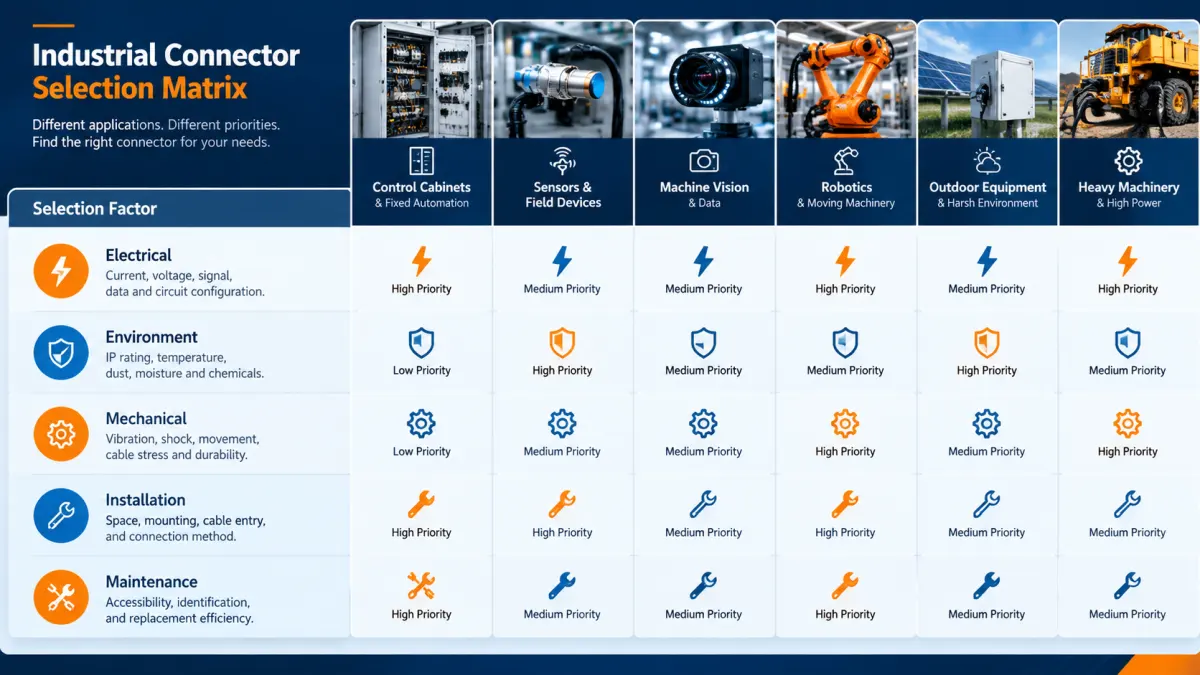
The following matrix summarizes the main priorities across common industrial applications. It is intended to guide the initial evaluation, not to replace product datasheets or application-specific engineering checks.
| Application | Primary selection priorities | Additional checks |
|---|---|---|
| Control cabinets and fixed automation | Circuit configuration, wiring density, termination, maintenance access | Mounting space, pin assignment, cable entry |
| Sensors and field devices | Power and signal requirements, contact layout, environmental protection | Device compatibility, cable configuration, replacement access |
| Machine vision and data connections | Interface compatibility, signal integrity, data cable performance | Shielding, grounding, trigger wiring, cable routing |
| Robotics and moving machinery | Locking, cable flexibility, strain relief, mechanical stability | Bending and twisting profile, vibration, movement cycle |
| Outdoor and moisture-exposed equipment | Ingress protection, sealing, material compatibility | Temperature range, mated-state protection, installation method |
| High-power equipment and heavy machinery | Current and voltage ratings, contact configuration, cable compatibility | Temperature rise, peak load, termination, service access |
| Modular machinery | Repeatable interfaces, cable assemblies, connection identification | Module replacement, expansion, maintenance workflow |
The matrix highlights an important principle:
connector selection priorities change with the application, even when the same connector technology appears in multiple scenarios.
For example, a circular connector may be appropriate for a sensor connection, a data interface, or part of an industrial machine. However, the contact arrangement, cable, locking mechanism, protection rating, and electrical performance required in each case may differ substantially.
The application should determine the requirements. The connector family should be considered only after those requirements are clear.
5. How to Compare Connector Options for the Same Application
Once the requirements have been identified, engineers can compare suitable connector architectures.
5.1 When a Circular Connector May Be Appropriate
Circular connectors are candidates for many industrial interfaces where a compact, defined connection is needed. Depending on the product design, they may support power, signal, or data-related functions.
When comparing circular connectors, check the contact arrangement, rated electrical performance, coupling mechanism, cable interface, installation space, and environmental specifications.
Do not assume that all circular connectors support the same functions or protection levels. Selection must be based on the exact model and configuration.
5.2 When a Hybrid Connector May Be Worth Evaluating
A hybrid connector may be useful when power, signal, or data circuits need to share one physical connection.
Potential benefits include a more consolidated interface and fewer separate connection points. However, the required circuit arrangement, electrical separation, current capacity, data requirements, and maintenance strategy must all be considered.
A hybrid solution is not always preferable. If the circuits have very different requirements or need to be serviced independently, separate connection interfaces may be more practical.
5.3 When to Consider Heavy-Duty Connectors
Heavy-duty connectors may be suitable for machine-level interfaces that require multiple power and control circuits within a defined housing system.
The decision should reflect the number of circuits, required electrical ratings, mounting arrangement, cable entry, mechanical conditions, and maintenance needs.
Engineers should verify the exact housing, insert, contact, and accessory configuration rather than treating the entire product category as having one set of specifications.
5.4 When Separate Connection Interfaces Make More Sense
Combining circuits is not always the best approach. Separate interfaces may be preferable when power and data connections have different performance requirements, when maintenance tasks need to remain independent, or when the equipment architecture calls for distinct cable routes.
The correct approach is the one that satisfies the electrical and mechanical requirements while keeping installation, troubleshooting, and replacement manageable.
6. From Application Requirements to WEIPU Connector Families
After defining the requirements, engineers can identify candidate connector families for further evaluation. The following examples illustrate how the selection process can begin; they are not universal product recommendations.
6.1 Matching Requirements to Candidate Product Families
- Compact automation and field-device interfaces: WEIPU SA, SF, WF, and WK families may be considered where their electrical configurations, dimensions, and environmental specifications match the application.
- Power-oriented industrial connections: WEIPU SP products may be evaluated when their exact ratings, contact arrangements, and installation characteristics meet the requirements.
- Industrial automation and circular connections: M23 products may be candidates for applications that require a compatible circular interface and suitable power or signal configurations.
- Combined power and signal requirements: WEIPU hybrid connector solutions, including relevant WA22 or WK16 configurations, may be evaluated where the required circuit arrangement is supported.
- Machine-level multi-circuit connections: WEIPU heavy-duty connector solutions, including relevant HA24B configurations, may be considered when the application requires a suitable multi-circuit interface.
- Preconfigured wiring and simplified integration: WEIPU cable assemblies may be worth evaluating where a compatible connector-and-cable solution can help standardize installation.
These examples are starting points for product evaluation, not substitutes for technical verification. The same family may include different configurations, and not every model will meet every application's requirements.
6.2 Verify the Exact Model and Configuration
Before finalizing a selection, confirm the following against the relevant technical documentation:
- Rated current and voltage for the exact configuration.
- Contact number, contact arrangement, and pin assignment.
- Cable compatibility and termination method.
- Locking mechanism and mechanical requirements.
- Ingress protection and the conditions under which it applies.
- Operating temperature and other environmental limits.
- Shielding and grounding provisions, where required.
- Mating-cycle specifications and maintenance requirements.
- Applicable installation instructions and testing requirements.
Where the application has special requirements, such as continuous movement, high electrical loads, or demanding environmental exposure, request confirmation from the manufacturer before approving the final design.
7. A Practical Application-Based Selection Workflow
A repeatable process helps engineering teams compare connector options consistently across projects.
Step 1: Define the connection function.
Identify whether the connection carries power, signals, data, or multiple circuit types.
Step 2: Document the operating conditions.
Record the electrical load, environmental exposure, mechanical stress, available space, and maintenance requirements.
Step 3: Identify the dominant constraint.
Determine whether current capacity, data performance, environmental protection, movement, installation space, or another requirement is most critical.
Step 4: Establish the minimum technical requirements.
Define the necessary electrical ratings, contact arrangement, cable compatibility, locking, and protection characteristics.
Step 5: Compare suitable connector architectures.
Evaluate circular, hybrid, heavy-duty, or separate connection solutions according to the actual requirements.
Step 6: Shortlist product families.
Identify candidate families that appear to meet the requirements, then narrow the list using exact model specifications.
Step 7: Verify the complete connection.
Check the connector, cable assembly, termination, mounting arrangement, and installation method as one system.
Step 8: Confirm before implementation.
Review the manufacturer's documentation and validate the configuration through the appropriate engineering checks or application testing.
Documenting these decisions also helps teams standardize future designs, simplify purchasing, and reduce the risk of selecting a connector based on one specification alone.
Conclusion
Application-based industrial connector selection begins with understanding the connection's role and operating conditions. Control cabinets, field devices, machine vision systems, robotics, outdoor equipment, and high-power machinery may all require different priorities, even when they use similar connector technologies.
A practical selection process identifies the connection function, evaluates electrical and environmental requirements, accounts for mechanical conditions, and compares suitable connector architectures before checking the exact product configuration.
The objective is not to identify one connector that works everywhere. It is to establish a consistent method for matching connector design to application requirements.
By using an application-based decision matrix alongside detailed engineering selection criteria, teams can make more informed comparisons, develop more consistent machine interfaces, and improve the reliability and maintainability of industrial connections.
FAQ
1. What is application-based industrial connector selection?
Application-based industrial connector selection is the process of choosing a connector according to its intended function, electrical requirements, installation environment, mechanical conditions, and maintenance needs.
2. Which factors matter most when selecting an industrial connector?
The main factors include current and voltage ratings, contact arrangement, signal or data requirements, environmental protection, locking mechanism, cable compatibility, installation space, and expected mechanical stress. Their relative importance depends on the application.
3. Are circular connectors suitable for all industrial applications?
No. Circular connectors are used in many industrial applications, but their suitability depends on the exact model, electrical configuration, cable interface, environmental specifications, and mechanical requirements.
4. When should engineers consider a hybrid industrial connector?
A hybrid connector may be appropriate when multiple circuit types, such as power and signal, need to share one connection interface. Engineers should verify that the specific configuration supports all required electrical functions and that combining the circuits suits the system architecture.
5. How should connectors be selected for outdoor equipment?
Engineers should evaluate the required ingress protection, sealing arrangement, temperature range, material compatibility, cable entry, and installation conditions. The exact product configuration and the conditions under which its protection rating applies should be verified.
High Profile vs. Standard Hoods: Selecting the Right Housing for Heavy Duty Connectors
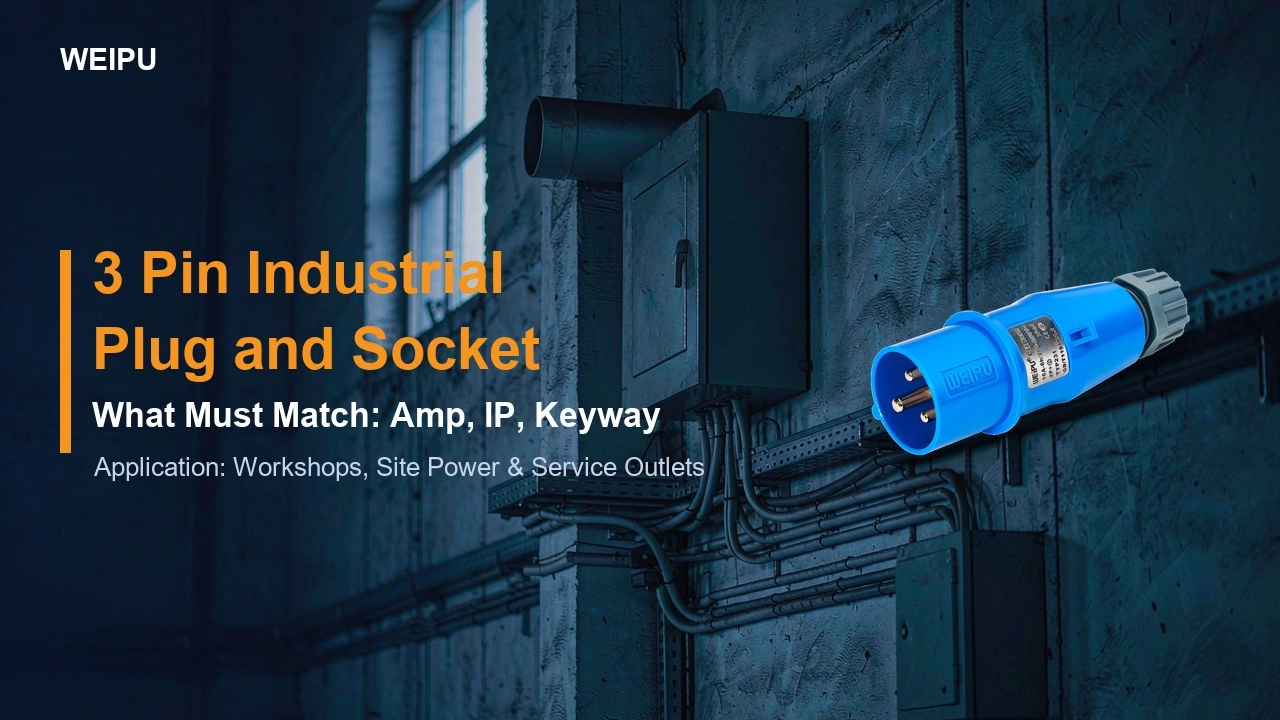
3 Pin Industrial Plug and Socket: What Must Match Before You Buy
How to Evaluate a Circular Connector Manufacturer in 2026
What is a connector?
Contacts
Sofia
WhatsApp/Phone
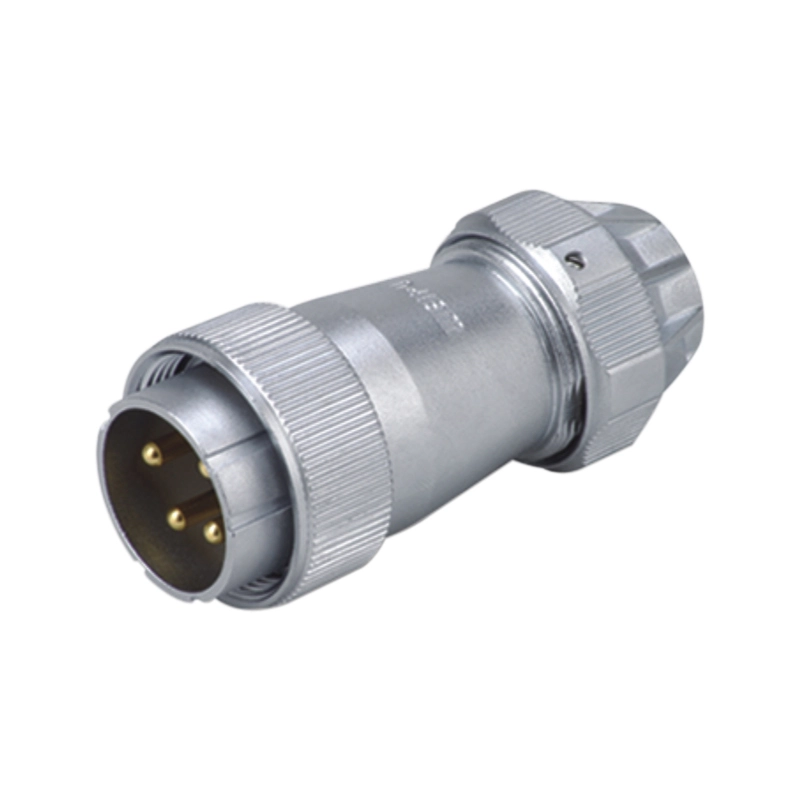
Weipu WF Series Industrial Threaded Connectors with IP67 Protection
WEIPU WF Series Industrial Threaded Connectors offer robust IP67 protection, ensuring reliable performance in harsh environments. Designed for secure, waterproof connections, these IP67 connectors are ideal for industrial applications requiring durability and stability. Trust WEIPU for quality and safety.
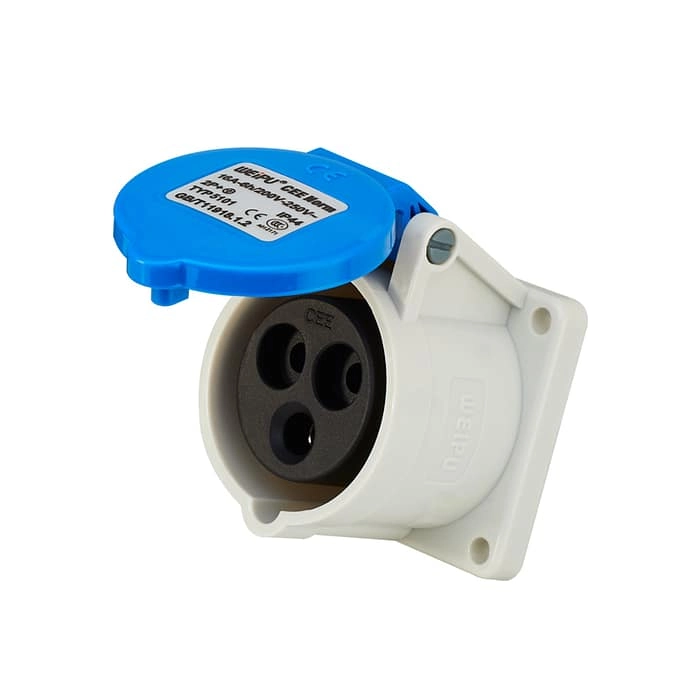
16A 3PIN Panel mount socket TYP5101-IP44
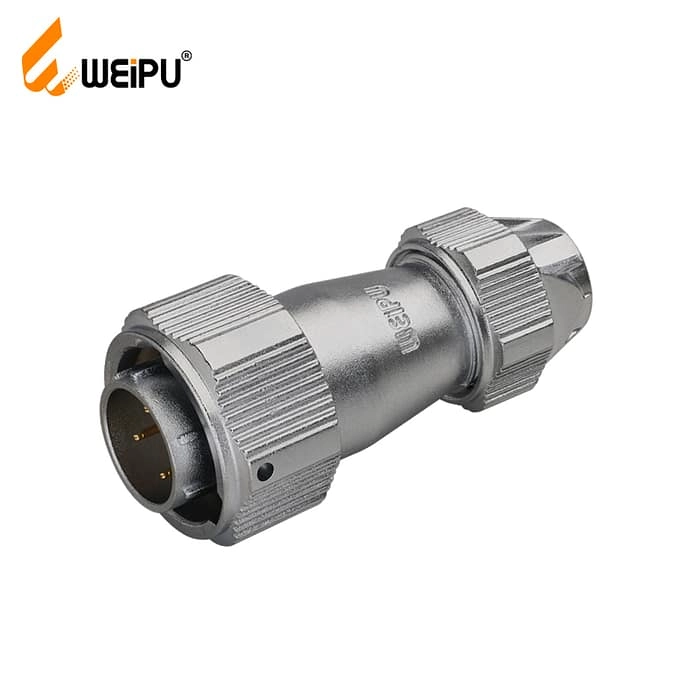
WEIPU WY-TE Series Waterproof Electrical Plug
With metal clamping-nut IP67, Threaded, Zinc alloy with chrome plating, PPS
WEIPU WY-TE IP67 circular connectors are waterproof electrical plugs with metal clamping-nut, which are durable, safe and easy to assemble with your all devices.With the metal clamping-nut and threaded design, these waterproof electrical plugs ensure high security and super stable connection. It’s an ideal waterproof connector for your applications.
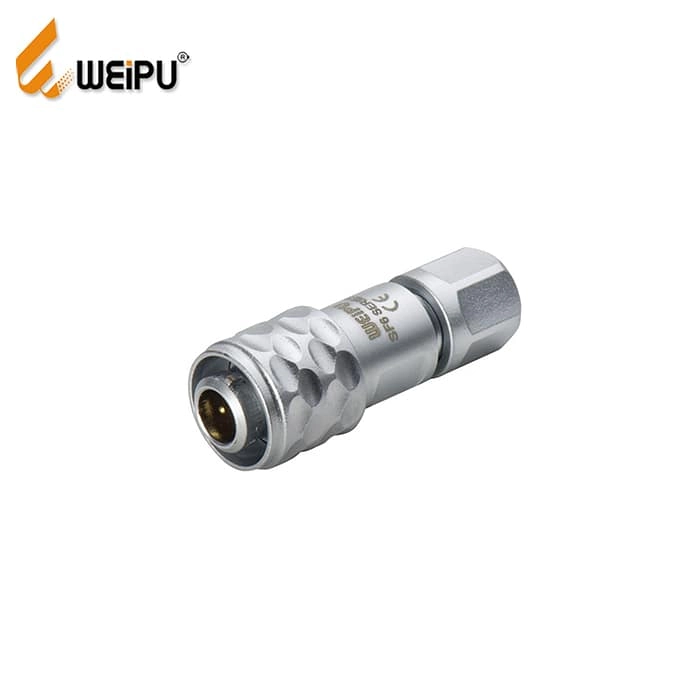
SF610B/P SF610B/S Cable connector IP67
Mate with SF611B, SF612B, SF615B
Get in Touch
Request Related Resources about Industrial Connections & Solutions
If you require technical details, product guides, or specific recommendations from a premier connector manufacturing corporation, please send us your request. We provide expert support for custom electrical connectors, offering OEM/ODM customization and dedicated distributor cooperation assistance.
Weipu Building, No. 111, Baihua Road, Liwan District, Guangzhou, Guangdong China
© 2026 WEIPU. All Rights Reserved.
Whatsapp: +8618102298073
WEIPU
WEIPU
WEIPU
WEIPU