

Data Center CEE Connectors: Specifying PDU and CDU Service Power
Follow us now:
- Quick Answer
- Where CEE Connectors Sit in an AI Facility Power Chain
- From Utility Intake to the Rack: Five Interface Points
- Why These Connections Are Specified Separately
- What Does IEC 60309 Actually Standardize?
- Size Interchange and Contact Arrangement
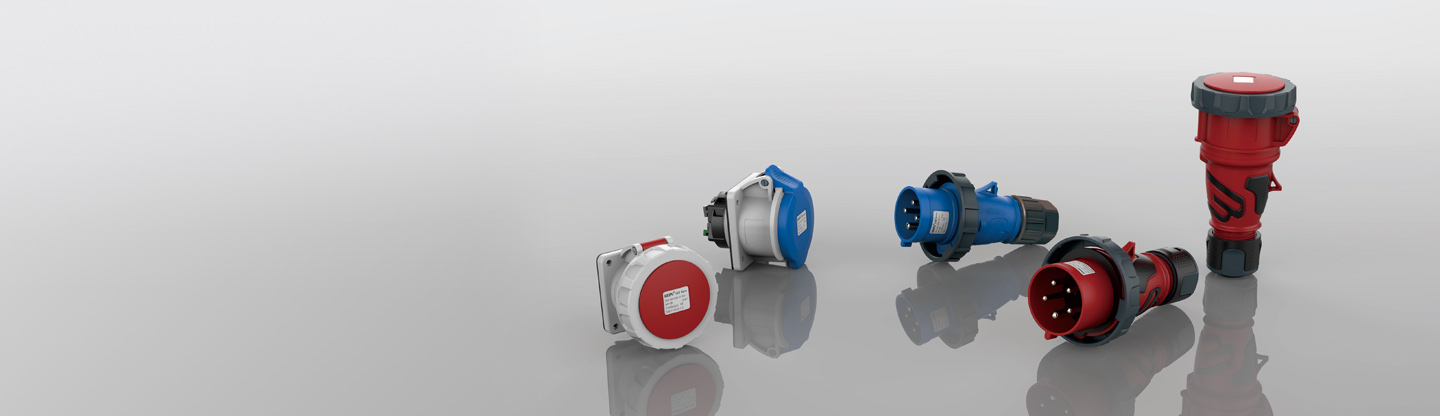
- Voltage Color Coding: Blue and Red Plugs
- Which Amperage Tier Fits Which Point of Load?
- 16 A and 32 A: Rack PDUs and Commissioning Power
- 63 A and 125 A: Distribution and Generator Interfaces
- How Should You Choose Between IP44 and IP67?
- Clean Electrical Rooms and Raised Floors
- Outdoor Yards, Containers and Wet Zones
- Why Does CDU Service Power Deserve Its Own Specification?
- Pump, Control and Heater Loops
- What Fails at the Service Power Interface?
- Beyond 125 A: Feeding High-Density White Space
- A Specification Checklist Before You Order
- How WEIPU TYP Series Fits Into This Picture
- Conclusion
- Frequently Asked Questions
Quick Answer
Data center CEE connectors are the IEC 60309 industrial plugs and sockets that carry service power — rack PDU inputs, CDU service loops, generator intake, commissioning outlets and maintenance distribution boards. They sit outside the busway and busbar systems wired permanently inside the white space.
The working specification for most AI facilities is short. Blue 32 A inputs fit rack PDUs, red 63 A feeds three-phase distribution, and 125 A belongs only where the entire cable, breaker and socket chain is rated for it. Use IP44 in clean electrical rooms, and IP67 wherever water or weather can reach the joint. The sections below explain where each tier belongs, how the standard prevents mismating, and what usually fails in the field.
Where CEE Connectors Sit in an AI Facility Power Chain
AI workloads have pushed rack power density to 40 kW and beyond, with new halls designed around 100 kW per rack according to Uptime Institute and JLL 2026 outlook data. Liquid-cooling distribution units have become standard equipment next to the IT load. The power chain that feeds all of this includes several pluggable interfaces. IEC 60309 connectors are the default choice at most of them.
From Utility Intake to the Rack: Five Interface Points
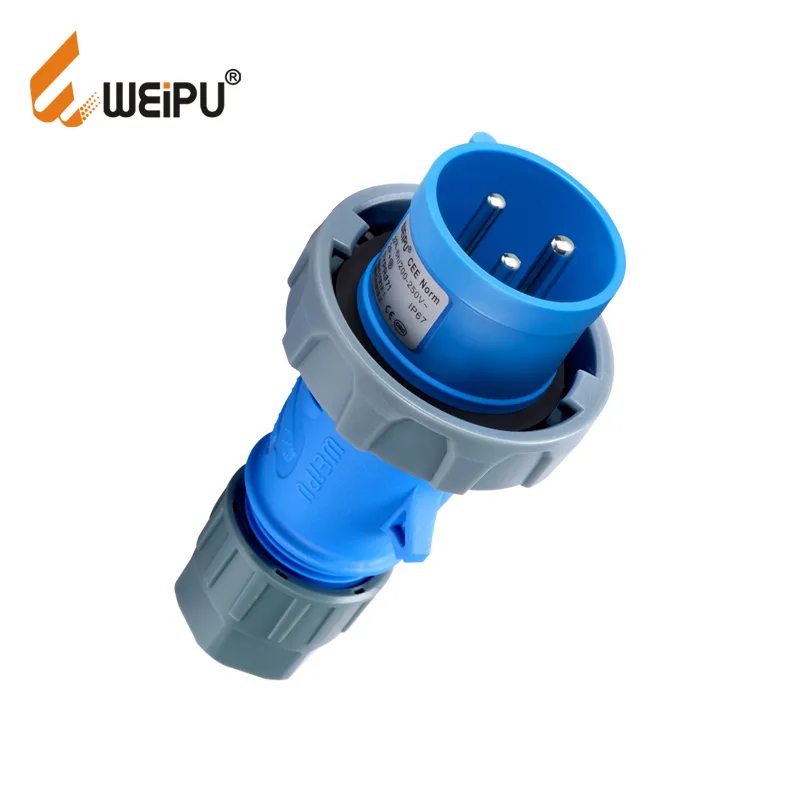
- Rack PDU inputs: a monitored rack PDU commonly terminates in a blue 32 A plug, sized so facility staff can swap or redeploy the unit without an electrician.
- CDU service power: pumps, control electronics and heaters inside liquid-cooling distribution units need a feed that can be disconnected for maintenance.
- Generator and backup intake: portable or temporary generation ties into the distribution system through high-rated inlets.
- Commissioning and temporary power: tools, test loads and temporary lighting draw from floor boxes and wall outlets before permanent circuits are energized.
- Maintenance boards and power skids: anything that gets rolled, lifted or reconnected benefits from a standardized, mis-insertion-proof interface.
These five points share one property: they are connections that people make and break by hand, sometimes weekly. That duty profile, not data rate, decides what the connector must survive.
Why These Connections Are Specified Separately
White space wiring is engineered once and touched rarely. Service power is the opposite: it is handled during every deployment, upgrade and incident, often under time pressure. A connector selected only by price tends to fail at exactly these moments.
Selection should therefore depend on amperage tier, ingress protection and mechanical duty. The logic is the same as matching connector design to application requirements in general industry, just with tighter downtime consequences when something lets go.
What Does IEC 60309 Actually Standardize?
IEC 60309, together with its parts EN 60309-1 and EN 60309-2, is the international standard family for industrial plugs, socket-outlets and couplers. It fixes dimensional interchange, contact arrangement, temperature behaviour, marking and ingress protection classes. The practical value for a data center operator is simple. Any compliant plug from any compliant maker mates with any compliant outlet of the same rating, which keeps spare parts simple across a multi-vendor facility.
Size Interchange and Contact Arrangement
Part -2 defines separate frame sizes for the 16 A, 32 A, 63 A and 125 A bands, so a 32 A plug physically cannot enter a 16 A outlet. Within each frame size, the position of the protective earth contact rotates with voltage and frequency. This is deliberate. The keying is designed to make it impossible to connect a 230 V plug to a 400 V outlet, which matters in mixed rooms where both supplies feed adjacent equipment.
Voltage Color Coding: Blue and Red Plugs
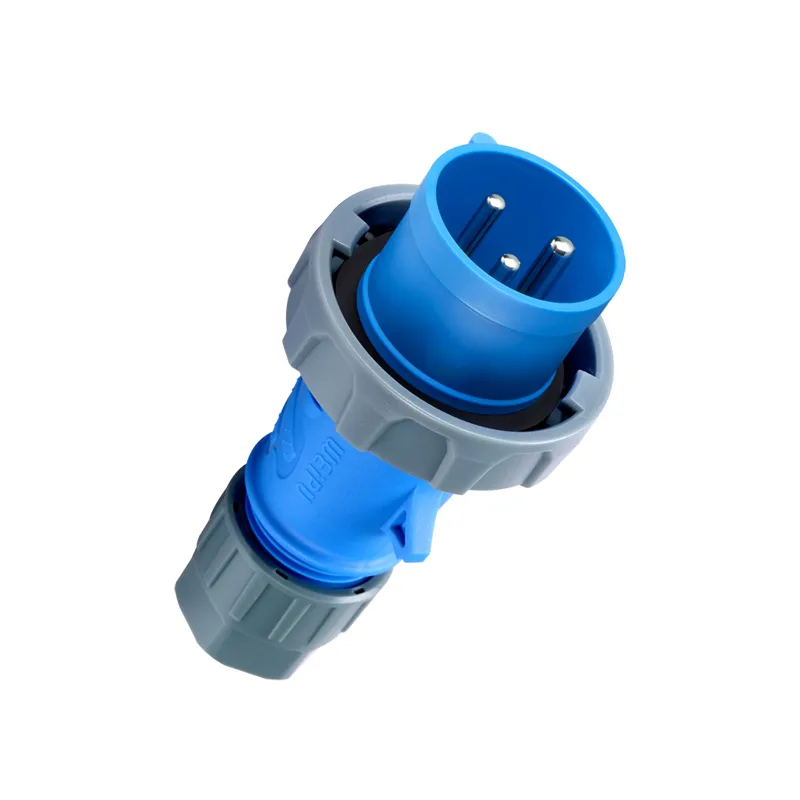
The most visible rule in the standard is housing color. Blue covers the 200-250 V band, which includes the 230 V single-phase supplies used for most rack PDU input connector circuits. Red covers 380-415 V three-phase distribution, which is where 63 A and 125 A feeds usually live. Because earth contact position also changes with voltage, a red plug cannot be mated with a blue outlet even when the frame size matches. Color gives staff an instant visual check, and geometry backstops the mistake.
Which Amperage Tier Fits Which Point of Load?
Current rating should follow the upstream protective device, not the peak draw of the equipment. The connector must equal or exceed the breaker feeding the circuit, and derating inside sealed panels still applies. For a deeper treatment of that margin, see how to select the right current rating for industrial connectors and this guide to how IP44, IP67, IP68 and IP69K ratings affect connector selection.
| Rating | Typical voltage and color | Typical AI-facility use | Environment note |
|---|---|---|---|
| 16 A | Blue, 200-250 V | Commissioning outlets, test benches, small auxiliary loads | IP44 in clean rooms; IP67 outdoors |
| 32 A | Blue, 200-250 V | Monitored rack PDU inputs, in-row CDU service power | The most common tier in white space service |
| 63 A | Red, 380-415 V | Three-phase distribution boards, larger CDUs, portable generators | Check derating inside sealed panels |
| 125 A | Red, 380-415 V | Generator intake, modular power skids | Only when the full cable, breaker and socket chain is rated 125 A |
16 A and 32 A: Rack PDUs and Commissioning Power
A 32 A, 230 V feed carries roughly 7 kW before any derating, which is why the blue 32 A plug has become the de facto rack PDU input across the industry. The 16 A tier covers the long tail of commissioning: test benches, temporary monitoring, cleaning equipment and small tools. These outlets see the most mating cycles in the building, so contact wear deserves a look during scheduled maintenance.
63 A and 125 A: Distribution and Generator Interfaces
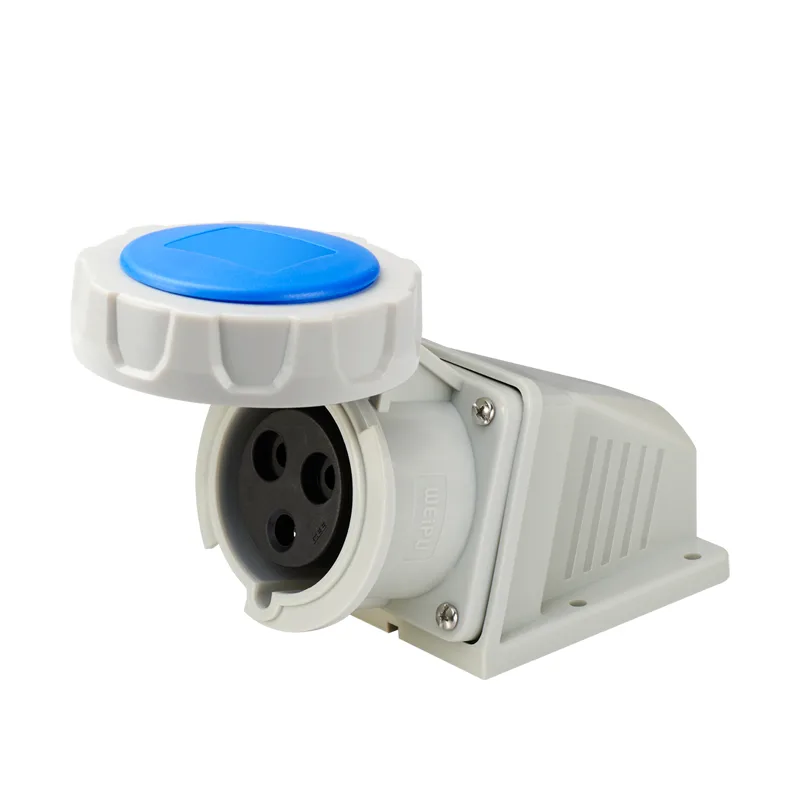
Red 63 A connectors feed three-phase distribution boards, larger CDUs and portable generators. The 125 A tier is reserved for generator intake and modular power skids, and it carries a condition: the entire chain must be rated for 125 A. That chain includes the cable cross-section, the breaker, the socket and the downstream equipment. A 125 A connector on a smaller chain does not add capacity; it just removes the visual warning that an undersized circuit exists.
How Should You Choose Between IP44 and IP67?
Ingress protection should be chosen per location, not per project. A single rating across the whole site either overspends in dry rooms or underprotects wet ones. The details of each class, including what IP69K adds for washdown, are covered in this guide to how IP44, IP67, IP68 and IP69K ratings affect application selection.
Clean Electrical Rooms and Raised Floors
IP44 is generally adequate in clean, dry electrical rooms and above raised floors with no liquid services. The class protects against solid objects larger than 1 mm and splashing water from any direction, which covers the realistic exposure in those spaces. Dust in a data hall is controlled, and washdown never happens, so paying for sealed housings buys little.
Outdoor Yards, Containers and Wet Zones
IP67 should be the default wherever the connector can see weather: outdoor generator intake, containerized modular data centers, roof plant, and any zone where leak response or floor washing is routine. An IP67 joint survives temporary immersion, but the rating holds only when the connector is mated or capped, so every unmated outlet needs a rated protective lid. This is the same discipline described for common causes of connector failure in harsh environments.
Why Does CDU Service Power Deserve Its Own Specification?
A CDU is the interface between the facility water system and the IT cooling loop. Its service feed runs pump motors, control electronics, valves and, in some designs, liquid heaters. A CDU fault can idle an entire hall, so its power connection carries three demands at once:
- Continuous current for pump motors, which draw steadily for as long as the hall is live.
- Clean, stable power for control electronics and valves that sequence the cooling loop.
- Frequent manual disconnection for maintenance, without tools and without wear on the contacts.
Treating this feed as an afterthought outlet is how facilities end up with nuisance trips during maintenance windows. Specify it as a proper service connection, with the same rigor as the rack PDU input.
Pump, Control and Heater Loops
Typical industry practice feeds in-row CDUs from a blue 32 A connection and larger in-room units from red 63 A three-phase, but the real number must come from the manufacturer's electrical drawing, because pump sizing varies widely between designs. Where heaters protect coolant in cold conditions, the load profile changes again. The service feed should also allow lockout during coolant work, which favors connectors with visible, tool-free locking.
What Fails at the Service Power Interface?
- Unrated chains: a 125 A plug installed on a circuit whose breaker or cable is smaller creates a hidden bottleneck that only appears at full load.
- Adapter workarounds: mating adapters defeat the voltage keying that IEC 60309 geometry provides, which reintroduces the mismating risk the standard was written to remove.
- Unmated joints: an IP67 outlet left open to weather is not IP67, so caps and hinged lids belong in the specification, not in a drawer.
- Gland mismatch: when the cable gland does not match the actual cable outer diameter, water wicks along the sheath into an otherwise sealed housing; drip loops matter outdoors.
- Cycle wear: commissioning outlets mated daily for years lose contact pressure, and higher contact resistance shows up as heat long before failure.
Each of these is a specification and procedure problem before it is a product problem. The mechanical side — locking styles, gland sizing, strain relief — is covered in this overview of screw, push-pull, bayonet and lever locking mechanisms. Housing choices are discussed in this piece on how material choice affects connector reliability, and the broader failure patterns appear in common causes of industrial connector failure in harsh environments. The same discipline carries over to connecting field devices, sensors and control systems across the rest of the plant. Because that work happens at the coupling itself, the field procedure for wiring a 16 A industrial plug matters as much as the part number: gland range, strip length and terminal torque decide whether the stated IP class survives the first repair.
Beyond 125 A: Feeding High-Density White Space
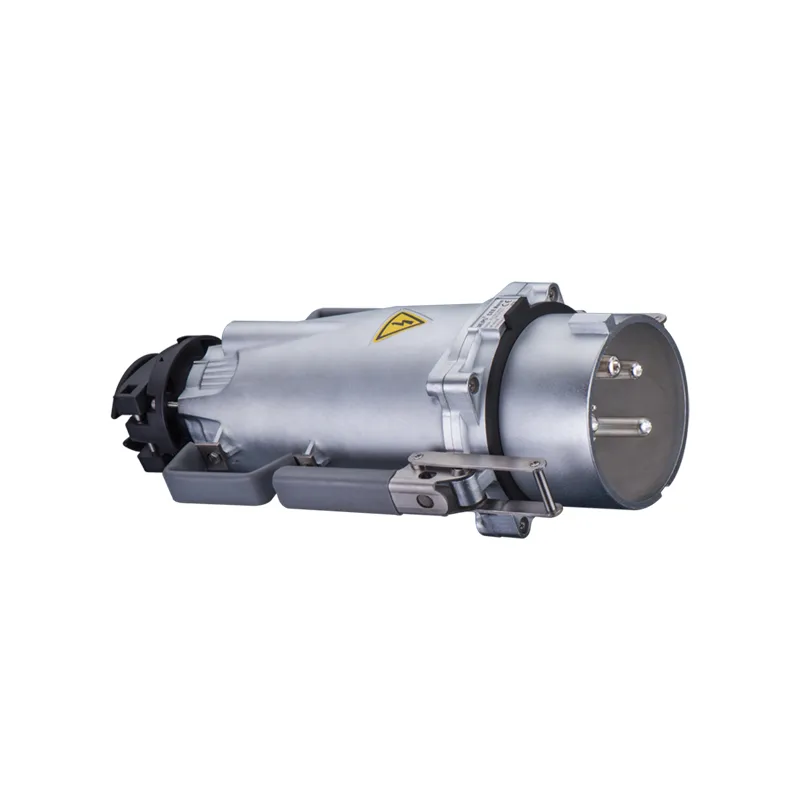
IEC 60309 stops at 125 A. Above that tier, AI facilities move to busway tap-off boxes, bolted flange interfaces, or dedicated high-current connector families outside the standard's scope. Selection criteria change accordingly: contact temperature rise, plating quality and parallel-conductor behaviour dominate, as explained in high-current industrial connectors, current rating, heat and reliability. The verification habit stays the same — the rating that matters is the one stamped on the whole chain, not the one printed on the plug.
A Specification Checklist Before You Order
- Match the connector tier to the upstream breaker: 16 A, 32 A, 63 A or 125 A, and confirm cable cross-section along the whole chain.
- Confirm the voltage band and housing color per IEC 60309-2, and document which rooms carry red versus blue circuits.
- Set ingress protection per location: IP44 in clean rooms, IP67 outdoors, with rated caps specified for every unmated outlet.
- Match each cable gland to the actual cable outer diameter and specify drip loops for outdoor runs.
- Estimate annual mating cycles per outlet and schedule contact inspection for the busiest commissioning points.
- Request ingress protection and temperature-rise test reports with the shipment, and check every part number against the current datasheet before release.
How WEIPU TYP Series Fits Into This Picture
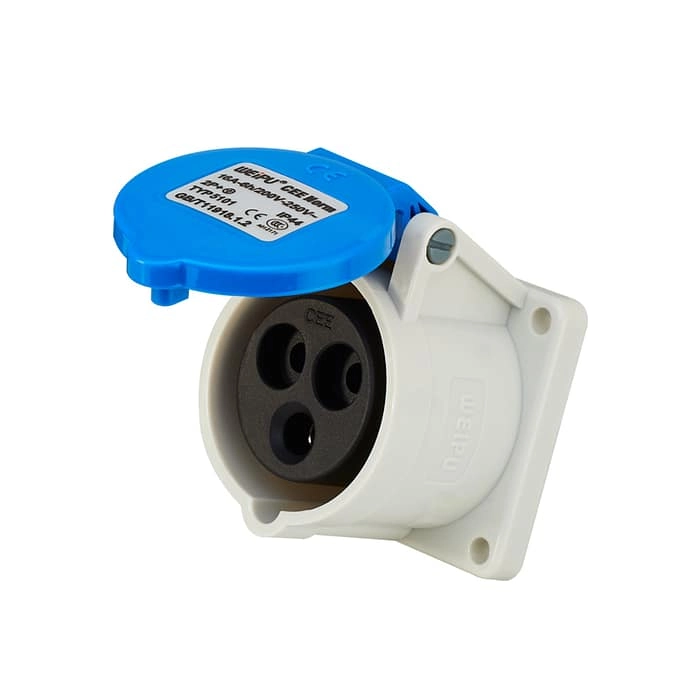
The WEIPU TYP series is a CEE-style connector family built to IEC 60309 on a tough, chemical-resistant rubber housing. It spans the 16 A, 32 A, 63 A and 125 A tiers with IP44 constructions for clean rooms and IP67 constructions for outdoor and wet locations, together with surface-mount and flush-mount sockets. For data center CEE connectors, that coverage maps directly onto the tiers described above: blue 32 A plugs and sockets for PDU and in-row CDU service, red three-phase options for distribution, and sealed housings for generator yards and modular deployments.
Whether a specific TYP part number is suitable for evaluation depends on the site's circuit design and the mounting format the panel requires. Verify the contact arrangement, current rating and ingress protection against the current datasheet before ordering, and request protection and temperature-rise test reports where the electrical design needs documented evidence. WEIPU has manufactured circular and industrial connectors since 1996, and the TYP family sits alongside its wider ranges of circular, industrial and heavy-duty rectangular systems that serve automation, renewable energy and power distribution markets.
Conclusion
Service power is the part of an AI facility that staff touch most often and think about least. The specification is not complicated: follow the breaker for current, follow the voltage table for color, follow the location for ingress protection, and treat the whole chain — cable, gland, connector, breaker — as one rated system. Do that, and the CEE layer of a data center becomes one of the most dependable interfaces in the building instead of a recurring source of maintenance calls.
Frequently Asked Questions
What is a CEE connector in a data center?
A CEE connector is an industrial plug and socket built to IEC 60309, used in data centers for service power rather than for permanent white space wiring. Typical points include rack PDU inputs, CDU service feeds, generator intake, commissioning outlets and maintenance distribution boards. The standard fixes dimensions, contact arrangement, voltage color coding and ingress protection so mismatched circuits cannot be mated.
Why do most rack PDUs use a blue 32 A input?
Blue is the IEC 60309-2 color for the 200-250 V band, and 32 A is the tier that matches the branch breakers commonly used for rack power. A 32 A, 230 V feed carries roughly 7 kW before derating, which lines up with the input capacity of a typical monitored rack PDU. The plug format also lets facility staff redeploy PDUs without special tools.
Where should IP67 CEE connectors replace IP44 versions?
Use IP67 wherever water, weather or washdown can reach the joint: outdoor generator intake, containerized modular data centers, roof plant, and any floor level where leaks or flooding are credible. IP44 is generally acceptable in clean, dry electrical rooms and above raised floors. Remember that an IP67 rating applies only when the connector is mated or fitted with a rated protective cap.
How much service power does a liquid-cooling CDU need?
It depends on the unit size. In-row CDUs serving one or two racks are commonly fed from a blue 32 A connection, while larger in-room units that pump coolant for a full row often draw three-phase power on red 63 A feeds. Because pump motors and control circuits behave differently, the CDU service feed should be specified with the manufacturer's electrical drawing rather than estimated from cooling capacity.
Can a 63 A CEE connector be used on a 32 A circuit?
No. The connector rating must match the upstream protective device and cable size. Oversizing the connector hides an underrated breaker or cable, and undersizing it creates heat. IEC 60309 geometry prevents many mismatches, but a 63 A plug can still be fitted to an undersized circuit if the installer ignores the breaker rating, so the whole chain should be checked.
What should be verified before ordering CEE connectors?
Verify the connector tier against the upstream breaker, confirm the voltage band and color per IEC 60309-2, set the ingress protection per installation location, and match the cable gland to the actual cable outer diameter. Ask the supplier for ingress protection and temperature-rise test reports, and check the exact part number, contact arrangement and current rating against the current datasheet before release.
The best waterproof connectors for landscape lighting and Outdoor AV Equipment in 2026
Weipu Connector Unveiled: Navigating the Landscape of Reliable Connectivity

How Industrial Connectors Support Modular Machine Design
Weipu Connector Solutions: Bridging Gaps and Enhancing B2B Networks
Contacts
Sofia
WhatsApp/Phone
Weipu WF Series Industrial Threaded Connectors with IP67 Protection
WEIPU WF Series Industrial Threaded Connectors offer robust IP67 protection, ensuring reliable performance in harsh environments. Designed for secure, waterproof connections, these IP67 connectors are ideal for industrial applications requiring durability and stability. Trust WEIPU for quality and safety.
16A 3PIN Panel mount socket TYP5101-IP44
WEIPU WY-TE Series Waterproof Electrical Plug
With metal clamping-nut IP67, Threaded, Zinc alloy with chrome plating, PPS
WEIPU WY-TE IP67 circular connectors are waterproof electrical plugs with metal clamping-nut, which are durable, safe and easy to assemble with your all devices.With the metal clamping-nut and threaded design, these waterproof electrical plugs ensure high security and super stable connection. It’s an ideal waterproof connector for your applications.
SF610B/P SF610B/S Cable connector IP67
Mate with SF611B, SF612B, SF615B
Get in Touch
Request Related Resources about Industrial Connections & Solutions
If you require technical details, product guides, or specific recommendations from a premier connector manufacturing corporation, please send us your request. We provide expert support for custom electrical connectors, offering OEM/ODM customization and dedicated distributor cooperation assistance.
Weipu Building, No. 111, Baihua Road, Liwan District, Guangzhou, Guangdong China
© 2026 WEIPU. All Rights Reserved.
Whatsapp: +8618102298073
WEIPU
WEIPU
WEIPU
WEIPU