



How Industrial Connectors Affect EMI and EMC Performance
Learn how industrial connectors affect EMI and EMC performance through shielding, grounding, connector design, cable termination, vibration resistance, and environmental protection.
Follow us now:
- How Industrial Connectors Affect EMI and EMC Performance
- Why Does EMI and EMC Performance Matter in Industrial Connectivity?
- Where Does the Connector Fit Into an EMC System?
- 1. Shielding Continuity Is Critical
- 2. Grounding and Bonding Affect EMC Performance
- 3. Connector Structure Can Affect Electrical Performance
- 4. Cable Termination Is Part of Connector Performance
- 5. Vibration Can Affect EMI and Signal Stability
- 6. Environmental Protection Also Supports Electrical Reliability
- Shielded vs. Unshielded Industrial Connectors
- How Should Engineers Select an Industrial Connector for EMI/EMC Applications?
- 1. What is the source of electromagnetic interference?
- 2. What type of signal is being transmitted?
- 3. Does the connector support the required shielding configuration?
- 4. How is the cable shield terminated?
- 5. How is the connector grounded or bonded?
- 6. Will vibration or movement affect the connection?
- 7. What environmental protection is required?
- 8. Does the complete system meet the required EMC performance?
- WEIPU Solutions for EMI and EMC-Sensitive Industrial Applications
- M23 Series
- SF Series
- SA Series
- An Industrial Connector Is Part of the EMC System
- Industrial EMI/EMC Connector Selection Checklist
- Conclusion
- FAQ
How Industrial Connectors Affect EMI and EMC Performance
In modern industrial systems, reliable electrical connectivity is not only about maintaining physical contact.
Industrial automation equipment, robotics, machine vision systems, servo drives, control cabinets, and industrial communication networks often operate in environments where motors, inverters, switching power supplies, and other electrical equipment can generate electromagnetic interference (EMI).
When interference reaches sensitive signal or data circuits, it can contribute to communication errors, unstable signals, unexpected system behavior, or intermittent faults.
This is where connector design becomes important.
An industrial connector is part of the electrical and mechanical path between equipment and cables. Its shielding, grounding, structure, cable termination, and mechanical stability can all influence how effectively a system controls electromagnetic interference and maintains EMC performance.
Reliable EMC performance is therefore not determined by the connector alone. It depends on how the connector works together with the cable, equipment, grounding system, and surrounding environment.
Why Does EMI and EMC Performance Matter in Industrial Connectivity?
EMI refers to unwanted electromagnetic energy that can interfere with electrical or electronic systems.
EMC, or electromagnetic compatibility, describes the ability of equipment to operate correctly in its electromagnetic environment without causing unacceptable interference to other equipment.
In industrial applications, potential sources of electromagnetic interference include:
- Motors and servo systems
- Variable frequency drives
- Switching power supplies
- High-current equipment
- Industrial Ethernet systems
- Inverters and converters
- Relay and switching equipment
- Long cable runs
- High-power electrical machinery
For example, a connector used between a machine controller and a sensor may need to transmit low-level signals while operating close to motors or power electronics.
In this situation, simply choosing a connector with the correct pin count and electrical rating may not be enough.
The connection also needs to maintain appropriate shielding, grounding, mechanical stability, and environmental protection.
Where Does the Connector Fit Into an EMC System?
It is useful to think about an industrial electrical connection as a complete system:
Noise Source → Cable → Connector → Equipment
A connector is therefore not an isolated component.
Even when a cable has effective shielding, poor connector design or incorrect cable termination can create a weak point in the overall shielding path.
Likewise, a metal connector housing does not automatically guarantee good EMC performance.
The actual result depends on factors such as:
- Shield continuity
- Grounding and bonding
- Connector construction
- Cable shield termination
- Contact and mating quality
- Mechanical stability
- Environmental conditions
This is why engineers should evaluate the connector as part of the complete connection system rather than considering EMI/EMC performance only at the component level.
1. Shielding Continuity Is Critical
One of the most important considerations for EMI control is maintaining continuity of the shielding path.
A shielded cable can help reduce electromagnetic coupling, but the protection can be weakened if the shield is interrupted at the connector interface.
A connector used in an EMI-sensitive application should therefore be evaluated for how effectively it maintains the shielding path between:
Cable Shield → Connector → Equipment Housing
A discontinuity or poorly designed transition can become a potential path for unwanted electromagnetic energy.
For industrial applications, engineers may therefore consider:
- Conductive connector shells
- Shielded connector configurations
- Appropriate cable shield termination
- Good contact between conductive components
- Proper mechanical coupling
- Low-impedance bonding where required
The goal is not simply to use a metal connector.
The goal is to maintain the intended electrical shielding structure across the connection.
A connector can only support shielding performance when its electrical and mechanical interfaces are properly designed and installed.
For deeper technical information about how shielded circular connectors can support signal integrity, see the related WEIPU technical resource:
Can EMI Shielded Circular Connectors Improve Signal Integrity?
2. Grounding and Bonding Affect EMC Performance
Shielding and grounding are closely related, but they are not the same thing.
A shield needs an appropriate electrical reference or bonding path to perform its intended function.
If conductive connector components are not properly bonded to the surrounding system, the shielding structure may not perform as expected.
In industrial equipment, engineers should consider the complete path between:
Cable Shield → Connector Shell → Equipment → Grounding Structure
Depending on the equipment architecture, grounding and bonding requirements may differ.
For this reason, connector selection should take into account:
- Connector shell construction
- Conductive interfaces
- Cable shield termination
- Equipment grounding architecture
- Mating interface
- Installation method
The connector should work with the system's overall grounding and bonding strategy rather than being treated as an independent EMC solution.
3. Connector Structure Can Affect Electrical Performance
Connector geometry and construction also influence electrical performance.
A connector contains multiple interfaces, including contacts, insulation materials, shells, seals, and mechanical locking structures.
Poor mechanical alignment or unstable mating can affect the electrical connection over time.
For example, industrial equipment may experience:
- Continuous vibration
- Mechanical shock
- Repeated mating
- Thermal cycling
- Cable movement
If the connector interface becomes unstable, electrical performance can deteriorate even when the connector initially met the required specifications.
This is particularly important in:
- Robotics
- AGVs
- Automated production lines
- Servo systems
- Industrial machinery
- Mobile equipment
For this reason, EMC performance should be considered together with connector reliability and mechanical stability.
4. Cable Termination Is Part of Connector Performance
One common mistake is to evaluate a connector without considering how the cable is terminated.
In a real industrial system, the connector and cable form one electrical connection.
A shielded connector cannot compensate for poor cable preparation or an ineffective shield termination method.
Engineers should therefore evaluate:
- Cable shield construction
- Shield termination method
- Cable gland or backshell design
- Connector assembly process
- Grounding connection
- Strain relief
- Cable routing
This becomes particularly important when using shielded cables in industrial Ethernet, machine vision, servo, sensor, and control applications.
A properly selected connector can support EMC performance, but the installation method must preserve the intended electrical structure.
5. Vibration Can Affect EMI and Signal Stability
Industrial environments are rarely mechanically static.
Robots move continuously. AGVs travel across factory floors. Motors and machines generate vibration. Cables may also experience repeated bending and movement.
Mechanical instability can eventually affect the electrical connection.
For example, vibration may contribute to:
- Intermittent contact
- Increased contact resistance
- Connector loosening
- Shield discontinuity
- Unstable signal transmission
These problems may initially appear as random communication faults rather than obvious connector failures.
A connector for a moving or high-vibration application should therefore be evaluated for both its locking mechanism and mechanical robustness.
This is another reason why EMC performance and mechanical reliability should not be evaluated separately.
6. Environmental Protection Also Supports Electrical Reliability
Industrial connectors may operate in environments exposed to:
- Dust
- Water
- Oil
- Chemicals
- Humidity
- Temperature changes
- Outdoor weather
- Mechanical contamination
Environmental exposure can affect contacts, conductive surfaces, seals, and mechanical interfaces.
Corrosion or contamination may increase contact resistance or weaken the intended electrical connection.
Ingress protection is therefore part of the broader reliability picture.
For example, depending on the application, engineers may need to evaluate whether IP67, IP68, IP69K, or another protection level is appropriate.
However, IP protection and EMC protection solve different problems.
A connector can have a high IP rating without automatically providing the required EMI shielding performance.
The two requirements should be evaluated separately and then considered together.
Shielded vs. Unshielded Industrial Connectors
Not every industrial application requires a shielded connector.
The right choice depends on the electromagnetic environment, signal type, cable construction, equipment architecture, and system-level EMC requirements.
| Application Condition | Connector Consideration |
|---|---|
| Low-noise environment | Standard connector may be sufficient |
| High motor or inverter activity | Consider shielding requirements |
| Sensitive analog signals | Evaluate shielding and grounding carefully |
| Industrial Ethernet | Evaluate cable and connector shielding together |
| Machine vision | Consider signal integrity and EMI environment |
| Servo and motion systems | Evaluate shielding, grounding and vibration |
| High-power equipment nearby | Stronger EMC considerations may be required |
| Outdoor industrial equipment | Consider EMC together with environmental protection |
The key point is that shielded does not automatically mean better for every application.
Engineers should select the connector configuration according to the actual electrical and environmental requirements.
How Should Engineers Select an Industrial Connector for EMI/EMC Applications?
When evaluating an industrial connector for an EMI-sensitive application, consider the following questions.
1. What is the source of electromagnetic interference?
Identify nearby motors, drives, switching equipment, power cables, or other potential noise sources.
2. What type of signal is being transmitted?
Sensitive analog signals and high-speed data may have different EMC requirements from simple power connections.
3. Does the connector support the required shielding configuration?
Check the actual connector construction and available shielded or unshielded configurations rather than assuming that every metal connector provides EMI protection.
4. How is the cable shield terminated?
The connector should work with the cable's shielding structure and installation method.
5. How is the connector grounded or bonded?
Consider how the connector interfaces with the equipment housing and overall grounding architecture.
6. Will vibration or movement affect the connection?
For robots, AGVs, servo systems, and mobile equipment, locking and mechanical stability are important.
7. What environmental protection is required?
Consider IP rating, temperature, moisture, dust, chemicals, and other application conditions.
8. Does the complete system meet the required EMC performance?
Ultimately, EMC is a system-level requirement.
The connector should be evaluated together with the cable, equipment, grounding, installation, and operating environment.
WEIPU Solutions for EMI and EMC-Sensitive Industrial Applications
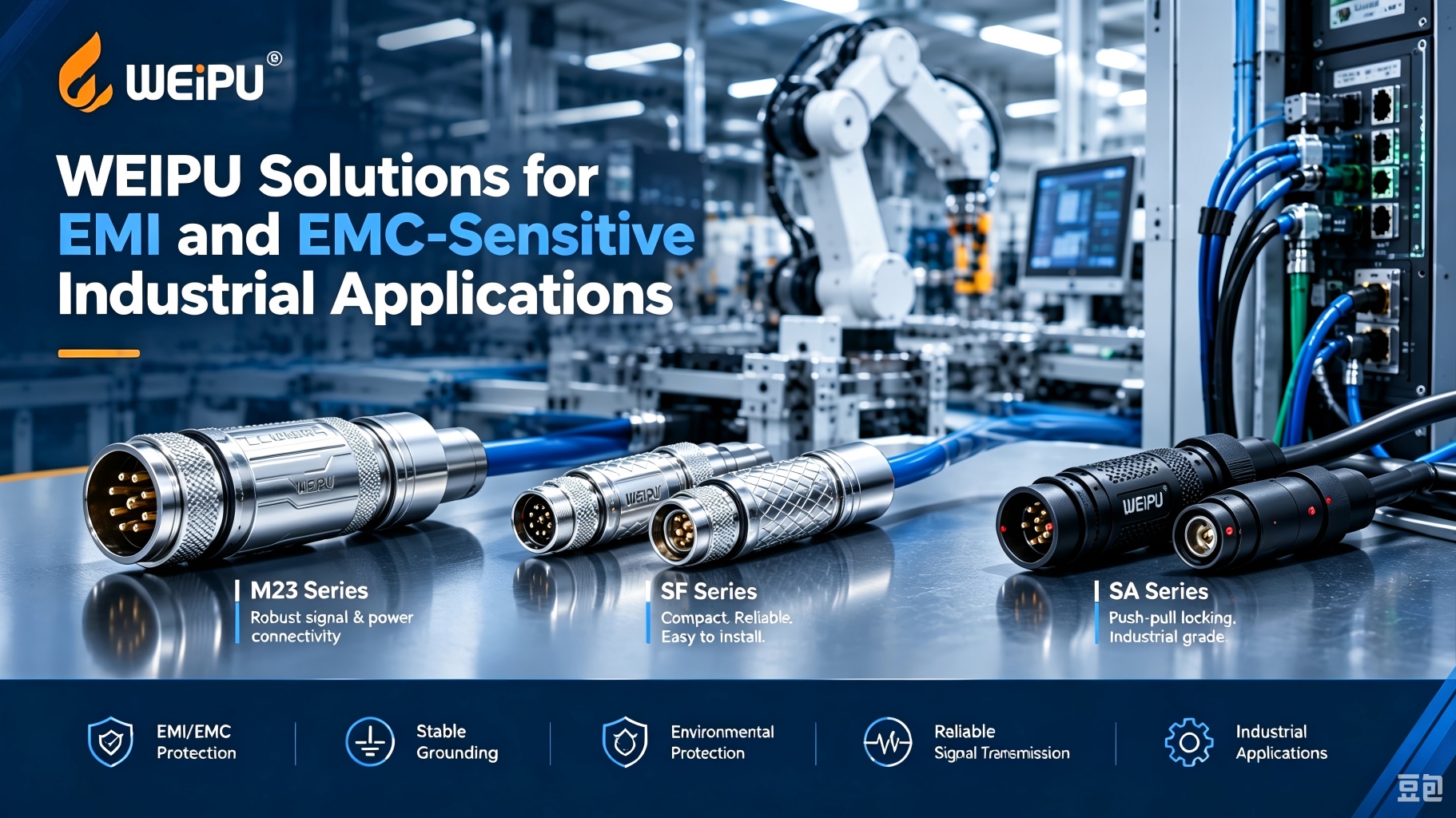
WEIPU provides a range of industrial circular connectors and connection solutions for automation, machinery, control, signal, and data applications.
Depending on the connector series and configuration, engineers can evaluate different combinations of:
- Metal connector construction
- Shielded or unshielded configurations
- Reliable contact systems
- Threaded or push-pull locking
- Waterproof protection
- Compact connector designs
- Signal and power transmission
- Cable assembly options
M23 Series
The WEIPU M23 series is particularly relevant to industrial applications requiring robust signal and power connectivity.
Selected M23 configurations provide shielded and unshielded options, allowing engineers to select the appropriate configuration according to system requirements.
SF Series
The SF Series provides a compact push-pull connection solution for industrial power and signal applications.
Its compact form factor and push-pull locking mechanism make it suitable for applications where installation space and connection convenience are important.
SA Series
The SA Series combines a compact circular design with push-pull locking and IP67 protection on applicable configurations.
It can be considered for industrial automation, control, robotics, and other applications where compact and reliable connections are required.
For applications where EMI shielding is a specific requirement, engineers should select the appropriate shielded connector configuration and verify the complete cable and equipment design rather than assuming that all metal connectors provide equivalent EMC performance.
An Industrial Connector Is Part of the EMC System
EMI and EMC performance cannot be solved by the connector alone.
However, the connector is an important part of the physical connection between the cable and equipment.
Its:
Shielding → Grounding → Structure → Cable Termination → Mechanical Stability → Environmental Protection
can all influence the reliability of the overall electrical connection.
For engineers, the better approach is therefore to evaluate the connector as part of the complete system.
Instead of asking only:
“Does this connector have EMI protection?”
a more useful question is:
“Can this connector maintain the required shielding, grounding, mechanical stability, and environmental protection within my complete system?”
That system-level approach can help reduce interference-related problems and support more reliable industrial communication and control.
Reliable EMC performance starts with a well-designed connection system.
Industrial EMI/EMC Connector Selection Checklist
Before selecting a connector for an EMI-sensitive industrial application, check:
- Electromagnetic environment identified
- Noise sources identified
- Signal or data type defined
- Shielded/unshielded configuration evaluated
- Cable shielding considered
- Shield termination method defined
- Grounding and bonding considered
- Connector mating stability evaluated
- Vibration and movement considered
- Required IP rating confirmed
- Temperature and environmental conditions checked
- Complete cable + connector + equipment system evaluated
- Required EMC tests or system-level verification identified
Conclusion
Industrial connectors play an important role in maintaining reliable electrical and communication performance in demanding environments.
Their influence on EMI and EMC performance goes beyond the connector housing itself.
- Shielding continuity, grounding, connector structure, cable termination, mechanical stability, and environmental protection all contribute to the final result.
For this reason, connector selection should be based not only on current rating, pin count, or IP protection, but also on how the connector integrates into the complete electrical and mechanical system.
For applications involving industrial automation, robotics, machine vision, industrial Ethernet, servo systems, or other electrically noisy environments, choosing the appropriate connector configuration can be an important part of building a more reliable connection system.
FAQ
Can an industrial connector reduce EMI?
A properly designed and installed connector can help maintain shielding and grounding continuity and therefore contribute to EMI control. However, connector performance must be evaluated as part of the complete cable and equipment system.
Does a metal industrial connector automatically provide EMI shielding?
No. A metal housing alone does not guarantee effective EMI shielding. Shielding performance depends on connector construction, electrical bonding, cable shield termination, mating interfaces, grounding, and the overall system design.
Which industrial applications require more attention to EMI and EMC?
Applications involving motors, variable frequency drives, servo systems, switching power supplies, industrial Ethernet, machine vision, sensitive sensors, and high-power equipment may require more careful EMI/EMC evaluation.
Are shielded connectors always better than unshielded connectors?
Not always. The appropriate choice depends on the application, signal type, electromagnetic environment, cable construction, grounding architecture, and system-level EMC requirements.

Enhancing Structural Integrity with Rectangular Connectors in Heavy Machinery (2026 Guide)

WEIPU Shines at the 2025 Shanghai International Industry Fair (SIICF)

Application of Connectors in Medical Devices

Connectivity Solutions for Solar Tracking Systems
Contacts
Sofia
WhatsApp/Phone
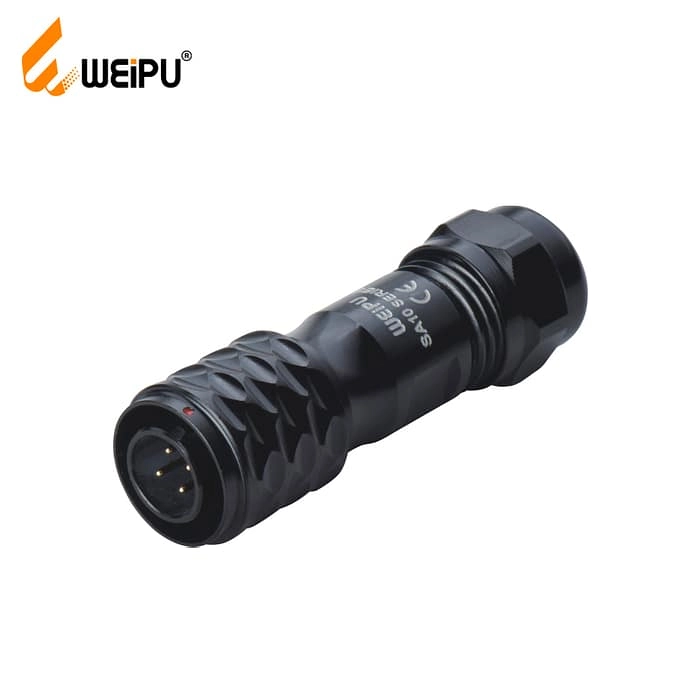
WEIPU SA1010P/S Power Cable Connector
IP67, Mate with SA1011, SA1012, SA1015

SF1010/P SF1010/S Cable connector IP67
Mate with SF1011, SF1012, SF1015

M23SK_TK Female contact cable connector IP67
Mate with M23SJ_TK,M23SJ_Z,M23SJ_TL,M23SJ_ZL

M23SJ_Z Male contact square flange receptacle IP67
Mate with M23SJ_TK,M23SJ_ZL
Get in Touch
Request Related Resources about Industrial Connections & Solutions
If you require technical details, product guides, or specific recommendations from a premier connector manufacturing corporation, please send us your request. We provide expert support for custom electrical connectors, offering OEM/ODM customization and dedicated distributor cooperation assistance.
Weipu Building, No. 111, Baihua Road, Liwan District, Guangzhou, Guangdong China
© 2026 WEIPU. All Rights Reserved.
Whatsapp: +8618102298073
WEIPU
WEIPU
WEIPU
WEIPU