




How Industrial Connectors Support Modular Machine Design
Learn how industrial connectors and cable assemblies support modular machine design, simplify equipment integration, and improve maintenance and expansion.
Follow us now:
- How Industrial Connectors Support Modular Machine Design
- 1. What Is Modular Machine Design?
- Functional Modules in Industrial Equipment
- Why Electrical Interfaces Matter in Modular Design
- 2. Why Connectivity Is Critical Between Machine Modules
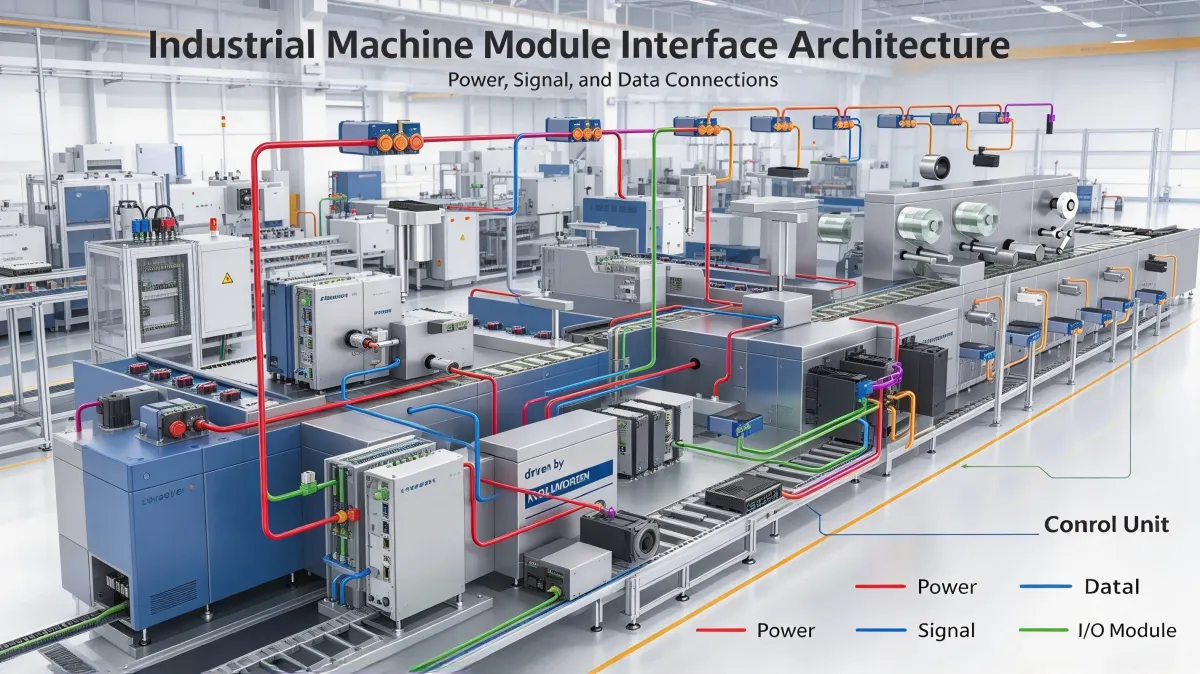
- Power Connections Between Modules
- Signal and Control Connections
- Data and Communication Interfaces
- 3. Designing a Consistent Connector Interface for Each Module
- Define the Function of Each Connection
- Standardize Contact Configuration and Cable Interfaces
- Plan for Installation Space and Accessibility
- 4. The Role of Cable Assemblies in Modular Machines
- Preassembled Cables and Repeatable Assembly
- Cable Routing, Strain Relief, and Identification
- Matching Cable Assemblies to Module Interfaces
- 5. Choosing the Right Connector Architecture for Modular Equipment
- Circular Connectors for Compact Interfaces
- Hybrid Connectors for Combined Functions
- Heavy-Duty Connectors for Multi-Circuit Interfaces
- When Separate Interfaces Are the Better Option
- 6. Supporting Machine Expansion and Maintenance
- Connecting and Disconnecting Modules
- Replacing Modules and Managing Spare Assemblies
- Planning for Future Changes
- 7. Environmental and Mechanical Requirements
- Vibration and Mechanical Stability
- Dust, Moisture, and Temperature
- Shielding and Grounding
- 8. How to Design a Reliable Modular Machine Connection System
- Step 1: Map the Machine Modules
- Step 2: Define Electrical and Communication Requirements
- Step 3: Specify Connector and Cable Interfaces
- Step 4: Verify Environmental and Mechanical Compatibility
- Step 5: Validate Assembly, Maintenance, and Expansion
- 9. WEIPU Connectivity Solutions for Modular Machine Design
- Circular Connector Options
- Hybrid Connector Options
- Heavy-Duty Connector Options
- Cable Assembly Solutions
- Conclusion
- FAQ
How Industrial Connectors Support Modular Machine Design
Modular machine design allows manufacturers to build complex equipment from individual functional units. Instead of designing and assembling an entire machine as one integrated structure, engineers can develop separate modules for processing, motion, sensing, control, and other functions.
However, modularity depends on more than mechanical design. Every module must connect reliably to the rest of the machine through clearly defined electrical and communication interfaces.
Industrial connectors and cable assemblies play a critical role in making these interfaces practical, repeatable, and easier to maintain. When connection requirements are considered early in the design process, equipment manufacturers can simplify machine integration, support future expansion, and reduce the complexity of replacing individual modules.
This article explains how industrial connectors support modular machine design, what engineers should consider when defining module interfaces, and how different connector architectures can meet the needs of industrial equipment.
1. What Is Modular Machine Design?
Modular machine design is an engineering approach in which a machine is divided into functional units that can be designed, assembled, integrated, or serviced as separate modules.
Depending on the equipment, these modules may include:
- Processing or production units
- Motion and drive assemblies
- Sensor and inspection modules
- Control and electrical enclosures
- Material-handling units
- Auxiliary equipment and peripheral devices
For machine builders, modularity can help standardize equipment platforms and simplify the configuration of different machine models. It can also make it easier to adapt an existing system when production requirements change.
Functional Modules in Industrial Equipment
Consider a packaging machine consisting of a feeding module, a filling module, a sealing module, and a control unit. Each module performs a specific function but must exchange power, control signals, or communication data with other parts of the machine.
The modules may be manufactured and tested separately before being assembled at the final installation site. Their interfaces must therefore be clearly defined before the modules are connected.
Why Electrical Interfaces Matter in Modular Design
Mechanical interfaces determine how modules fit together physically. Electrical interfaces determine how they exchange power, signals, and data.
If each module uses a different connection arrangement without a consistent interface plan, integration can become unnecessarily complicated. Engineers may need additional wiring, more installation time, or modifications during commissioning.
A well-planned connection architecture helps make the relationship between modules more predictable.
2. Why Connectivity Is Critical Between Machine Modules
A modular machine is only as practical as the interfaces connecting its individual units. These connections must match the electrical requirements, mechanical layout, and operating environment of the equipment.
Power Connections Between Modules
Some modules require dedicated power connections for motors, drives, actuators, lighting, or auxiliary equipment.
When selecting a connector for a power interface, engineers should consider the actual operating current, voltage, contact configuration, cable size, and thermal conditions. The connector's rated capacity must be evaluated against the complete operating requirements rather than a single nominal value.
For modules that contain different electrical loads, separating power connections from signal interfaces may simplify wiring and maintenance. In other designs, a suitable multi-circuit connector may provide a more compact interface.
The correct arrangement depends on the machine's power requirements and the intended module architecture.
Signal and Control Connections
Sensors, switches, actuators, and control devices exchange signals that allow different modules to coordinate their operations.
These connections may carry discrete control signals, analog measurements, feedback signals, or other low-level electrical information.
For these circuits, engineers should consider contact configuration, wiring identification, electrical compatibility, and protection against unintended disconnection. Where electrical noise is a concern, shielding and grounding must also be considered as part of the complete connection system.
Data and Communication Interfaces
Modern industrial machines often include distributed controllers, smart sensors, inspection systems, and network-connected equipment.
Communication interfaces allow these devices to exchange information across machine modules. Their requirements may differ from those of power or basic control circuits, so the connector and cable arrangement must be compatible with the intended communication system.
Not every machine needs a single connector to carry every function. In many applications, separate interfaces for power, control, and communication provide a clearer design and simplify troubleshooting.
3. Designing a Consistent Connector Interface for Each Module
A consistent interface does not mean that every module must use the same connector. It means that each connection point has defined requirements, a known function, and a repeatable arrangement.
Define the Function of Each Connection
Before selecting a connector, engineers should document what each module interface needs to carry.
A practical interface specification may include:
- Electrical function: power, signal, control, or data
- Rated voltage and required current capacity
- Number and arrangement of contacts
- Cable type, conductor size, and termination method
- Environmental protection requirements
- Mechanical space and mounting arrangement
- Required mating frequency and maintenance access
- Shielding and grounding requirements, where applicable
This information provides a technical basis for comparing connector options and helps avoid selecting components based on appearance or physical fit alone.
Standardize Contact Configuration and Cable Interfaces
Where several machine modules share similar functions, standardizing their interfaces can simplify assembly and replacement.
For example, a machine platform may use a defined connector arrangement for a particular sensor module or auxiliary unit. If the electrical configuration, cable termination, and interface identification remain consistent, technicians can more easily understand how the module connects to the wider system.
However, standardization should not be forced across interfaces with fundamentally different requirements. Power circuits, sensitive signals, and communication links may need different connector configurations.
Keying, coding, labeling, and clearly documented pin assignments can also help reduce the risk of incorrect connections.
Plan for Installation Space and Accessibility
Connector selection affects the physical layout of a modular machine.
Engineers should consider whether there is sufficient clearance for mating and unmating, access for tightening or releasing the coupling mechanism, and room for cable bending and routing.
A connector that fits within a module's housing may still be difficult to install if adjacent structures obstruct access. This is especially important when modules are positioned close together or inside compact machine enclosures.
Planning connector locations early can help prevent avoidable installation and maintenance problems.
4. The Role of Cable Assemblies in Modular Machines
Connectors define the interfaces, but cable assemblies provide the electrical pathways between them. Both should be considered during modular machine design.
Preassembled Cables and Repeatable Assembly
Preassembled cable assemblies can be useful when machine modules are manufactured repeatedly or assembled at different locations.
Depending on the application and assembly specification, a prepared cable assembly may include defined connector configurations, cable lengths, termination methods, and identification.
This can reduce the amount of field wiring required and help standardize installation procedures. It can also allow cable preparation and inspection to take place before the final machine assembly.
These benefits depend on accurate drawings, compatible components, and suitable quality-control procedures.
Cable Routing, Strain Relief, and Identification
A reliable modular interface requires more than choosing the correct connector at each end of a cable.
Engineers should consider:
- Cable routing: Keep cables away from sharp edges, moving components, and potential pinch points.
- Strain relief: Prevent cable loads from being transferred directly to electrical terminations.
- Bend radius: Follow the cable manufacturer's specified minimum bend radius.
- Identification: Label cables and interfaces to support installation and troubleshooting.
- Service access: Leave sufficient room to disconnect and replace assemblies when necessary.
These details are particularly important when modules are removed for maintenance or moved during equipment reconfiguration.
Matching Cable Assemblies to Module Interfaces
Cable assemblies should be specified against the complete interface requirements, including connector model, contact configuration, cable type, length, and environmental conditions.
A cable that physically fits may still be unsuitable if its electrical characteristics, termination, or protection level does not match the application.
For manufacturers developing repeatable machine platforms, documented cable assembly specifications can help maintain consistency between production batches and equipment installations.
5. Choosing the Right Connector Architecture for Modular Equipment
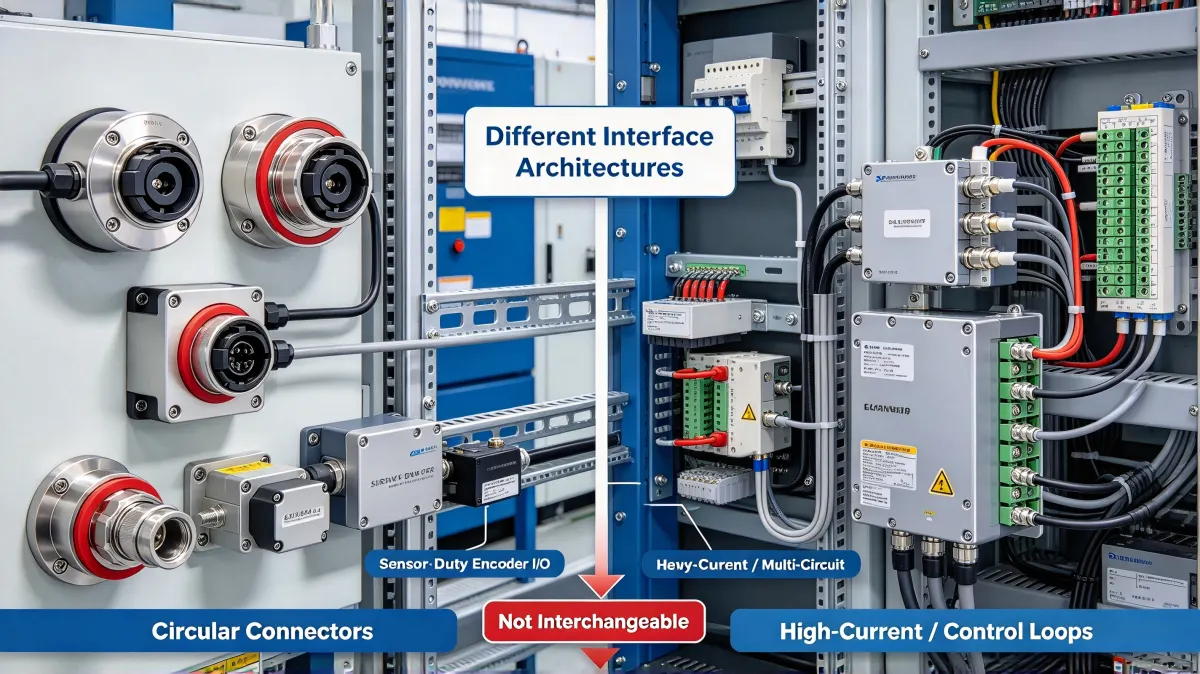
Different machine modules have different connection requirements. Circular connectors, hybrid connectors, and heavy-duty rectangular connectors can all support modular equipment, but they serve different design needs.
Circular Connectors for Compact Interfaces
Circular connectors are commonly considered for compact power, signal, and equipment interfaces. Their suitability depends on the specific series, contact arrangement, coupling mechanism, and environmental rating.
They may be appropriate for sensor modules, auxiliary equipment, compact automation units, and other connections where space and interface requirements align with the selected model.
For example, WEIPU's SA Series push-pull connectors may be considered for compatible compact industrial connections. Engineers should verify the selected model's contact configuration, current and voltage ratings, mounting arrangement, and environmental specifications before using it in a module interface.
Hybrid Connectors for Combined Functions
Some machine designs benefit from combining multiple electrical functions within a single connector interface.
Hybrid connectors can integrate selected power, signal, or data circuits in one connection, where the connector's design supports those functions. This can help reduce the number of separate connection points and simplify the physical interface between compatible modules.
However, a hybrid connector is not automatically the best choice for every modular machine. Engineers must verify the available circuits, electrical separation requirements, contact ratings, cable arrangement, and maintenance needs.
For more detail, see Hybrid Industrial Connectors: When Power, Signal and Data Share One Connection.
Heavy-Duty Connectors for Multi-Circuit Interfaces
Larger machine modules may require multiple power and control circuits within a robust equipment interface. In these cases, heavy-duty rectangular connectors may be worth evaluating.
Depending on the selected design, these connectors can accommodate multiple contacts and support structured connections between machine sections, electrical enclosures, and auxiliary assemblies.
Engineers should evaluate the housing, insert configuration, contact ratings, cable entry, mounting arrangement, and environmental protection of the exact product.
A heavy-duty connector is not necessarily the right answer simply because a machine is large. The decision should reflect the number of circuits, installation space, operating conditions, and service requirements.
When Separate Interfaces Are the Better Option
Combining circuits can reduce the number of physical interfaces, but it may also increase connector complexity.
Separate connectors may be preferable when power and communication circuits have different shielding requirements, when different modules need independent replacement, or when electrical safety and maintenance procedures call for distinct interfaces.
The goal is not to minimize connector count at all costs. It is to create an interface architecture that is safe, maintainable, and suitable for the machine's actual operating requirements.
6. Supporting Machine Expansion and Maintenance
One of the potential advantages of modular machine design is the ability to service or reconfigure individual units without rebuilding the entire system. Connector interfaces should support this objective.
Connecting and Disconnecting Modules
If a module is expected to be removed during maintenance, the connection arrangement should allow technicians to identify, access, disconnect, and reconnect the relevant interfaces efficiently.
The coupling mechanism should match the expected mating frequency, installation space, vibration exposure, and operating environment.
Engineers should also consider whether connectors could be accidentally disconnected and whether additional retention or protection measures are needed.
A disconnectable connector does not automatically make a module safe to remove while energized. Electrical isolation and the equipment manufacturer's approved maintenance procedures must be followed unless the complete system is specifically designed and approved for live disconnection.
Replacing Modules and Managing Spare Assemblies
A standardized interface can make replacement more straightforward when the replacement module and its electrical connections are fully compatible.
For example, an OEM may define a consistent cable assembly and connector configuration for a particular module type. A replacement can then follow the documented interface specification instead of requiring technicians to redesign the wiring connection each time.
Compatibility must still be verified. Changes to pin assignments, cable characteristics, electrical ratings, or connector models can prevent an otherwise similar module from being interchangeable.
Planning for Future Changes
Machine requirements can evolve as production capacity, process functions, or automation levels change.
When planning modular equipment, engineers may consider whether the interface architecture can accommodate additional signals, auxiliary functions, or replacement modules.
This does not mean every connector should have unused contacts or excess capacity without justification. Instead, future requirements should be assessed against cost, space, electrical performance, and the expected equipment lifecycle.
7. Environmental and Mechanical Requirements
Modular machine interfaces must perform within the actual conditions in which the equipment operates. Environmental and mechanical factors should therefore be part of connector selection from the beginning.
Vibration and Mechanical Stability
Machine vibration, repeated movement, and cable loads can affect connection stability.
The coupling mechanism, connector mounting, cable fixation, and strain relief should be evaluated together. A suitable locking mechanism helps maintain the intended connection, but it cannot compensate for poor cable routing or an inadequately supported assembly.
For further information, see Industrial Connector Locking Mechanisms Explained.
Dust, Moisture, and Temperature
Some machine modules operate inside protected enclosures, while others are installed near production processes, cleaning areas, or outdoor equipment.
The required protection depends on the module's location and exposure. Engineers should check the specified IP rating, operating temperature range, material compatibility, and installation requirements of the complete connection system.
An IP rating should not be treated as a blanket guarantee for every operating condition. Correct mating, sealing components, cable entry, and installation are also important.
See Industrial Connector IP Ratings: How IP67, IP68 and IP69K Affect Application Selection for more information.
Shielding and Grounding
Where modules exchange sensitive signals or communication data in electrically noisy environments, shielding and grounding may become important parts of the connection design.
Engineers should verify whether the selected connector and cable support the required shielding arrangement and how the shield is terminated and bonded within the equipment.
Metal connector housings alone do not establish that a connection will meet the system's electromagnetic compatibility requirements. The complete cable, connector, termination, grounding, and equipment arrangement must be evaluated together.
8. How to Design a Reliable Modular Machine Connection System
A structured workflow helps translate a machine's modular architecture into practical connector and cable specifications.
Step 1: Map the Machine Modules
Identify each functional unit and document which other modules it needs to connect to. Include power distribution, sensors, actuators, control equipment, and communication interfaces as applicable.
Step 2: Define Electrical and Communication Requirements
For every interface, identify the circuit functions, operating voltage, current, contact configuration, cable requirements, and communication needs.
Keep power, control, and data requirements distinct where their design constraints differ.
Step 3: Specify Connector and Cable Interfaces
Choose connector architectures and cable assemblies based on the interface requirements, installation space, mating method, termination, and service access.
Record model numbers, pin assignments, cable lengths, and other configuration details in the engineering documentation.
Step 4: Verify Environmental and Mechanical Compatibility
Check vibration exposure, cable loads, temperature, dust and moisture protection, and shielding requirements. Confirm that the complete assembly is suitable for the intended installation.
Step 5: Validate Assembly, Maintenance, and Expansion
Before finalizing the design, review how modules will be assembled, tested, disconnected, replaced, and potentially expanded.
Where appropriate, validate the interface through prototype assembly, electrical testing, mechanical checks, and application-specific environmental testing.
This process helps ensure that connector selection supports not only initial machine assembly but also the equipment's operational lifecycle.
9. WEIPU Connectivity Solutions for Modular Machine Design
WEIPU offers industrial connector families and cable assembly solutions that can be evaluated for different machine interfaces. The appropriate choice depends on the electrical, mechanical, environmental, and installation requirements of the specific application.
Circular Connector Options
WEIPU circular connector families may be considered for compatible sensor connections, compact equipment interfaces, and other industrial connections.
Potential options include the SA Series, SF Series, and M23 Series.
These product families have different designs and configurations. Engineers should compare the exact model specifications rather than assuming that every series is suitable for the same module interface.
Hybrid Connector Options
For equipment that needs to combine compatible electrical functions in a single interface, engineers can evaluate WEIPU hybrid connector solutions, including the WA22 and WK16 product families.
Selection should be based on the required circuit combination, electrical ratings, physical layout, and application conditions.
Heavy-Duty Connector Options
For machine sections requiring multi-circuit interfaces, WEIPU's industrial connector portfolio can be reviewed for suitable heavy-duty connector configurations.
The selected housing and insert arrangement must match the required circuits, cable entry, installation conditions, and protection requirements.
Cable Assembly Solutions
Connector selection and cable assembly design should be treated as parts of the same engineering task.
WEIPU's cable assembly solutions provide a starting point for evaluating cable and connector combinations for industrial equipment.
For OEM projects, a clearly defined assembly specification—including connector configuration, cable requirements, length, termination, and identification—can help support repeatable machine integration.
Conclusion
Modular machine design depends on well-defined interfaces between functional units. Industrial connectors and cable assemblies help establish these interfaces by supporting the transfer of power, signals, and data between modules.
The most effective connection architecture is not necessarily the one with the fewest connectors or the highest number of integrated functions. It is the one that matches the machine's electrical requirements, physical layout, operating environment, maintenance procedures, and future configuration needs.
By defining module interfaces early, standardizing compatible connections, and evaluating connectors and cable assemblies as a complete system, machine builders can make equipment integration more predictable and maintenance planning more practical.
For OEMs and system integrators, reliable modular machine connectivity begins with interface planning—not simply with choosing a connector.
FAQ
1. What is modular machine connectivity?
Modular machine connectivity refers to the electrical and communication interfaces that connect separate functional modules within industrial equipment. It typically involves industrial connectors, cables, cable assemblies, and defined interface specifications.
2. Why are industrial connectors important in modular machine design?
Industrial connectors provide defined connection points between modules. When correctly selected and integrated, they can simplify assembly, support repeatable wiring arrangements, and make module disconnection or replacement more manageable.
3. Are hybrid connectors suitable for modular machines?
Hybrid connectors may be suitable when a module interface needs to combine compatible power, signal, or data circuits. Engineers should verify the connector's circuit configuration, electrical ratings, cable compatibility, and application requirements before selection.
4. How do cable assemblies support modular equipment?
Cable assemblies can provide predefined connections between modules. Depending on their specification, they can help standardize cable lengths, connector configurations, and termination methods, reducing the need for ad hoc field wiring.
5. What should engineers consider when selecting connectors for modular machines?
Key considerations include electrical function, voltage and current, contact configuration, cable type, locking mechanism, installation space, environmental protection, vibration, shielding, maintenance access, and potential future changes.

WEIPU Shines at the 2025 Shanghai International Industry Fair (SIICF)

The Ultimate Guide to Heavy Duty Rectangular Connectors
Industrial Connector Types: Power, Signal, Data and Hybrid Connectors Explained

Industrial Connector IP Ratings: How IP67, IP68 and IP69K Affect Application Selection
Contacts
Sofia
WhatsApp/Phone

Weipu WF Series Industrial Threaded Connectors with IP67 Protection
WEIPU WF Series Industrial Threaded Connectors offer robust IP67 protection, ensuring reliable performance in harsh environments. Designed for secure, waterproof connections, these IP67 connectors are ideal for industrial applications requiring durability and stability. Trust WEIPU for quality and safety.

16A 3PIN Panel mount socket TYP5101-IP44

WEIPU WY-TE Series Waterproof Electrical Plug
With metal clamping-nut IP67, Threaded, Zinc alloy with chrome plating, PPS
WEIPU WY-TE IP67 circular connectors are waterproof electrical plugs with metal clamping-nut, which are durable, safe and easy to assemble with your all devices.With the metal clamping-nut and threaded design, these waterproof electrical plugs ensure high security and super stable connection. It’s an ideal waterproof connector for your applications.

SF610B/P SF610B/S Cable connector IP67
Mate with SF611B, SF612B, SF615B
Get in Touch
Request Related Resources about Industrial Connections & Solutions
If you require technical details, product guides, or specific recommendations from a premier connector manufacturing corporation, please send us your request. We provide expert support for custom electrical connectors, offering OEM/ODM customization and dedicated distributor cooperation assistance.
Weipu Building, No. 111, Baihua Road, Liwan District, Guangzhou, Guangdong China
© 2026 WEIPU. All Rights Reserved.
Whatsapp: +8618102298073
WEIPU
WEIPU
WEIPU
WEIPU