

How to Select the Right Current Rating for Industrial Connectors
Learn how to select the right current rating for industrial connectors based on actual load, duty cycle, temperature, contact configuration, cable size, and application conditions.
Follow us now:
- How to Select the Right Current Rating for Industrial Connectors
- 1. Why Connector Current Selection Is More Than Matching Amps
- 2. Start With the Actual Operating Current
- Rated Current
- Normal Operating Current
- Maximum Operating Current
- Peak or Inrush Current
- 3. Determine Whether the Load Is Continuous or Intermittent
- Machine A
- Machine B
- 4. Consider How Many Contacts Carry Current
- 5. Consider Temperature and Installation Conditions
- 6. Match the Connector With the Cable
- 7. Consider Voltage Together With Current
- 8. Allow an Appropriate Design Margin
- 9. Current Rating Should Be Evaluated With the Application Environment
- 10. Real Application Example: Industrial Sensors
- 11. Real Application Example: Solar and Outdoor Equipment
- 12. Real Application Example: Industrial Automation Equipment
- 13. Real Application Example: Higher-Power Industrial Equipment
- 14. Industrial Connector Current Selection Matrix
- 15. A Practical Industrial Connector Current Selection Workflow
- Step 1 — Identify the Actual Operating Current
- Step 2 — Determine the Duty Cycle
- Step 3 — Identify the Loaded Contacts
- Step 4 — Check the Operating Environment
- Step 5 — Match the Cable and Termination
- Step 6 — Consider Voltage and Other Electrical Requirements
- Step 7 — Consider Mechanical and Environmental Requirements
- Step 8 — Verify the Connector's Applicable Rating
- 16. From Current Requirements to WEIPU Connector Families
- 17. Current Rating Is Only One Part of Connector Selection
- Conclusion
- FAQ
How to Select the Right Current Rating for Industrial Connectors
Selecting an industrial connector is not simply a matter of matching the connector's rated current to the number shown on an equipment nameplate.
A machine may have a nominal operating current, a higher startup current, intermittent loads, multiple circuits, changing ambient temperatures, and different cable configurations.
All of these conditions can influence the appropriate connector selection.
For example, an equipment load of 20 A does not automatically mean that engineers should select a connector rated exactly at 20 A. The actual operating current, duty cycle, contact configuration, cable size, temperature, installation conditions, and applicable product specifications also need to be considered.
A more practical engineering approach is:
Actual Load → Duty Cycle → Contact Configuration → Temperature → Cable → Application Conditions → Required Current Rating → Connector Selection
This article focuses on how engineers apply current requirements to real industrial connector selection.
For an explanation of high-current connector design, heat generation, contact resistance, and thermal performance, see:
1. Why Connector Current Selection Is More Than Matching Amps
The first mistake in connector selection is often treating current rating as a single number.
For example:
Equipment rated current: 20 A
Connector rated current: 20 A
Selection complete.
In practice, the situation can be more complicated.
Engineers may need to ask:
- Is 20 A the continuous operating current?
- Is there a higher startup or inrush current?
- How long does the equipment operate at the maximum load?
- How many connector contacts are carrying current?
- What is the ambient temperature?
- What cable is connected?
- How is the connector terminated?
- Is the connector installed inside a cabinet or directly on equipment?
- Is there vibration or mechanical movement?
- What does the manufacturer's specification allow for the specific configuration?
Therefore, connector current selection should be based on the actual electrical and operating conditions, rather than one number taken from the equipment specification.
2. Start With the Actual Operating Current
The first step is to identify what current the connector will actually carry.
Several values may be relevant.
Rated Current
The equipment's nominal or rated current provides a starting point.
However, it does not always represent the current that flows continuously through the connector.
Normal Operating Current
This is the current the equipment typically draws during normal operation.
It is often more useful for understanding the connector's continuous operating requirement.
Maximum Operating Current
Some equipment can operate at different load levels.
The maximum expected operating current should be identified before selecting the connector.
Peak or Inrush Current
Motors, power supplies, capacitive loads, and other equipment can produce short-duration current peaks during startup or switching.
These conditions should be evaluated separately from continuous operating current.
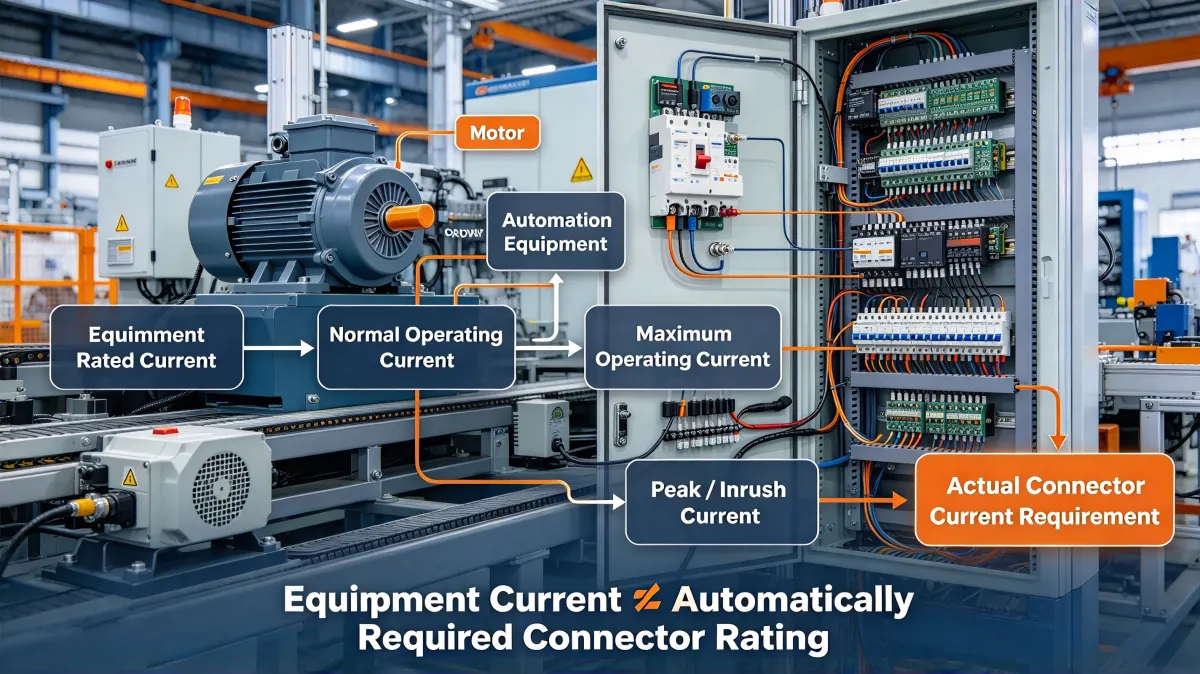
The important question is therefore:
What current will the connector experience during the actual operating cycle?
The answer may be different from the nominal value printed on the equipment nameplate.
3. Determine Whether the Load Is Continuous or Intermittent
The operating cycle can significantly affect connector selection.
Consider two machines:
Machine A
Operates at 15 A continuously for several hours.
Machine B
Operates at 15 A for 30 seconds, then remains at a much lower load for several minutes.
Both machines have a 15 A operating point, but their electrical operating conditions are different.
Engineers should therefore consider:
- Continuous load
- Intermittent load
- Short-duration peak load
- Startup current
- Duty cycle
- Frequency of load changes
This does not mean that engineers should calculate connector capacity using a universal rule.
Instead, the operating cycle should be compared with the manufacturer's specified current ratings and test conditions for the particular connector configuration.
Current selection should reflect how the connector is actually used, not only the highest number expected during operation.
4. Consider How Many Contacts Carry Current
Industrial connectors often contain multiple contacts.
Not every contact necessarily carries the same electrical load.
For example, a connector may be configured with:
- Power contacts
- Signal contacts
- Control contacts
- Ground contacts
- Data contacts
A multi-contact connector should therefore not be evaluated simply by multiplying the current rating of one contact by the total number of contacts.
Engineers need to determine:
- Which contacts carry power?
- How many contacts are simultaneously loaded?
- Are different circuits sharing the connector?
- What contact configuration does the manufacturer specify?
- Are there applicable derating conditions?
The actual current capacity can depend on the connector design and configuration.
This is particularly important when a compact connector combines power and signal functions.
5. Consider Temperature and Installation Conditions
Current capacity cannot be separated completely from the environment in which the connector operates.
Temperature can influence the operating conditions of electrical contacts and other connector components.
Engineers should therefore consider:
- Ambient temperature
- Internal equipment temperature
- Heat generated by nearby components
- Enclosure conditions
- Ventilation
- Outdoor exposure
- Installation density
A connector installed inside a densely packed control cabinet may experience different thermal conditions from the same connector installed in an open machine environment.
Similarly, connectors installed near motors, drives, power supplies, or other heat-generating components may experience elevated temperatures.
The correct approach is not simply:
Choose the highest current rating available.
Instead:
Compare the actual installation conditions with the manufacturer's specified current rating and operating conditions.
6. Match the Connector With the Cable
The connector and cable form one electrical connection system.
The connector may have a high rated current, but the cable and termination must also be appropriate for the intended application.
Engineers should check:
- Conductor size
- Cable construction
- Contact size
- Termination method
- Cable entry
- Strain relief
- Cable temperature rating
- Installation conditions
For example, a larger current requirement may require a larger conductor and an appropriate contact configuration.
At the same time, the cable must physically fit the connector and its termination system.
This creates a basic engineering relationship:
Cable → Termination → Contact → Connector
The current requirement should therefore be evaluated across the complete connection rather than focusing only on the connector housing.
7. Consider Voltage Together With Current
Current is important, but it should never be evaluated completely independently from voltage.
A connector application may have:
- Low voltage / high current
- Higher voltage / lower current
- DC power
- AC power
- Signal circuits
- Mixed power and signal
Engineers should verify the applicable voltage and current ratings for the exact connector configuration.
Other electrical factors may also matter depending on the application, including:
- Contact spacing
- Number of contacts
- Insulation system
- Creepage and clearance
- Circuit configuration
- Applicable standards
The selection process should therefore be:
Current + Voltage + Contact Configuration + Application Conditions
rather than simply:
Current = Connector Selection
8. Allow an Appropriate Design Margin
Selecting a connector with exactly the same numerical current rating as the expected operating current may leave little room for variation in the actual application.
Engineers may therefore consider an appropriate design margin between the expected operating condition and the connector's applicable rated capability.
However, there is no single percentage that should be applied to every industrial connector.
The appropriate margin depends on factors such as:
- Application requirements
- Duty cycle
- Temperature
- Contact configuration
- Product specifications
- Applicable standards
- Reliability objectives
For this reason, engineers should avoid rules such as:
“Always choose a connector rated 20% higher.”
Instead, the better approach is:
Determine the real operating conditions first, then verify that the selected connector configuration provides appropriate capacity under those conditions.
9. Current Rating Should Be Evaluated With the Application Environment
Current is only one part of connector selection.
Consider a connector used on outdoor equipment.
The application may require:
- Current
- Voltage
- Water Protection
- Dust Protection
- Temperature Resistance
- Mechanical Stability
The connector therefore needs to satisfy the combined requirements.
For harsh or outdoor environments, engineers should also consider the appropriate IP protection, housing materials, sealing system, and cable entry.
Similarly, material selection can influence connector durability under different environmental conditions.
The key principle is:
A connector with sufficient current capacity is not necessarily the right connector if its environmental or mechanical characteristics do not match the application.
10. Real Application Example: Industrial Sensors
Sensor applications demonstrate why current rating should not be considered in isolation.
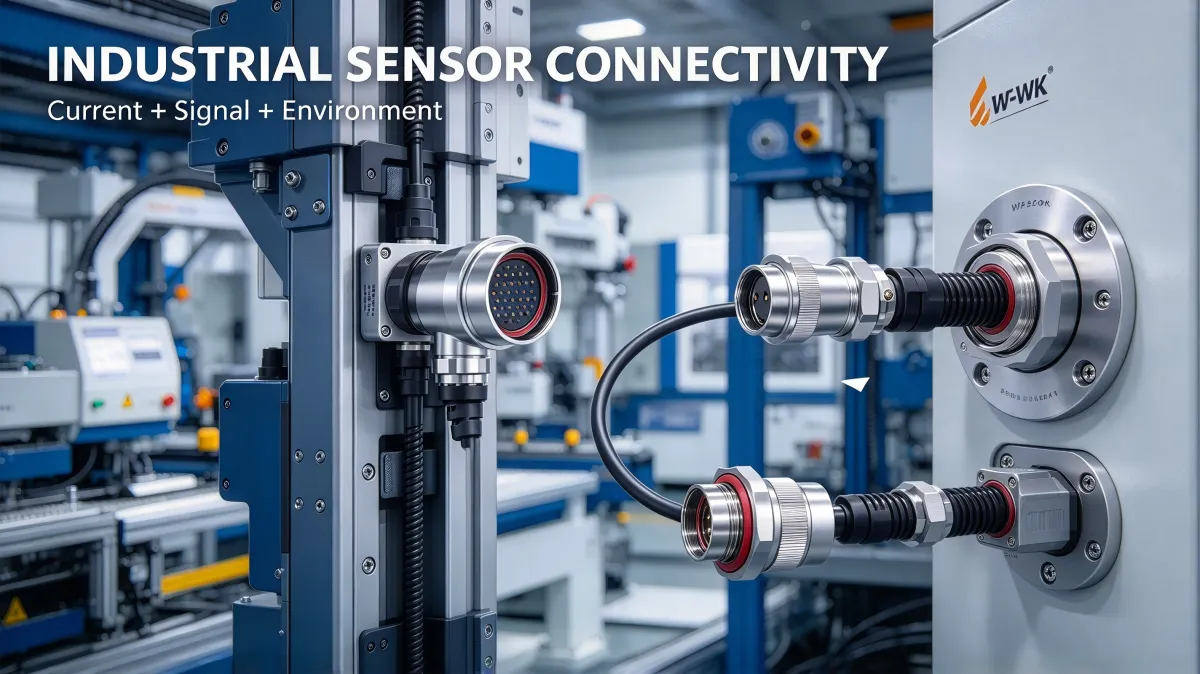
Many industrial sensors operate with relatively low power requirements, but their connectors may still need to provide:
- Reliable signal transmission
- Secure mating
- Compact installation
- Environmental protection
- Vibration resistance
- Appropriate cable connection
In these applications, selecting the highest current-rated connector may provide little benefit if the actual requirement is primarily signal reliability, compactness, and environmental protection.
For suitable sensor and compact industrial connection applications, WEIPU WF and WK series can be evaluated according to the specific electrical configuration, cable requirements, installation environment, and equipment interface.
The exact current rating and configuration should always be verified against the relevant product specification.
The engineering lesson is simple:
Low-current applications still require careful connector selection. Current capacity is a requirement, not the entire selection criteria.
11. Real Application Example: Solar and Outdoor Equipment
Solar and outdoor electrical equipment presents a different combination of requirements.
A connection may need to operate with:
- DC power
- Outdoor exposure
- Temperature changes
- Moisture
- Dust
- Long-term operation
- Cable routing requirements
Here, current capacity must be considered together with environmental protection.
For suitable sensor, solar, and related outdoor connection applications, WEIPU WF/WK series can be evaluated based on the specific application and product configuration.
Engineers should verify:
- Actual operating current
- Voltage
- Cable size
- Sealing requirements
- Environmental conditions
- Installation method
- Connector configuration
This illustrates an important selection principle:
Current rating answers only one part of the application question.
A connector needs to satisfy the electrical requirement and the environmental requirement.
12. Real Application Example: Industrial Automation Equipment
Industrial automation equipment can have significantly different electrical requirements depending on its function.
A compact control device may require relatively low current, while an actuator, motor-related system, or machine power connection may require substantially higher current.
For these applications, engineers can evaluate:
- Actual operating current
- Peak current
- Cable size
- Contact configuration
- Installation space
- Locking mechanism
- Environmental protection
Depending on the application, WEIPU SA, SF, or SP series may be considered for suitable industrial equipment connections.
However, connector selection should always be based on the exact product configuration rather than assuming that an entire connector family has one universal current capability.
13. Real Application Example: Higher-Power Industrial Equipment
Higher-power industrial equipment requires more detailed evaluation.
Typical considerations may include:
- Higher operating current
- Larger conductors
- Contact size
- Cable termination
- Temperature
- Mechanical conditions
- Equipment interface
- Maintenance requirements
For suitable applications, engineers can evaluate connector families such as WEIPU SP, M23 power configurations, and heavy-duty connector solutions according to the actual electrical and mechanical requirements.
For machine-level power and control connections, heavy-duty connector configurations can provide a different connection architecture from compact circular connectors.
Again, the correct selection depends on the exact application and product specification.
14. Industrial Connector Current Selection Matrix
A practical way to evaluate current requirements is to combine the electrical load with the actual operating conditions.
| Application Condition | What Engineers Should Check | Why It Matters |
|---|---|---|
| Continuous load | Normal operating current | Determines the long-term operating requirement |
| Peak load | Maximum or transient current | Helps avoid undersizing |
| Startup / inrush | Short-duration peak current | May create different electrical conditions |
| Multiple loaded contacts | Contact configuration | Current capability can depend on loading |
| High ambient temperature | Operating temperature | Can affect applicable current capacity |
| Large cable | Conductor and termination | Cable and contact need to be compatible |
| Outdoor installation | Environment + current | Electrical and environmental requirements must work together |
| Frequent load changes | Duty cycle | Actual operating conditions vary over time |
| Power equipment | Current + voltage | Both electrical ratings need to be verified |
| Machine installation | Vibration + cable stress | Mechanical stability also matters |
This matrix can be used as a starting point before reviewing individual connector models.
15. A Practical Industrial Connector Current Selection Workflow
The complete process can be simplified into several steps.
Step 1 — Identify the Actual Operating Current
Determine:
Normal Current + Maximum Current + Peak / Inrush Current
Step 2 — Determine the Duty Cycle
Ask:
Continuous?
Intermittent?
Short-duration peak?
Step 3 — Identify the Loaded Contacts
Determine:
- Which contacts carry power?
- How many contacts are simultaneously loaded?
- Is the connector carrying mixed power and signal?
Step 4 — Check the Operating Environment
Evaluate:
- Ambient temperature
- Enclosure
- Outdoor exposure
- Heat sources
- Ventilation
Step 5 — Match the Cable and Termination
Check:
- Conductor size
- Contact size
- Cable entry
- Termination method
Step 6 — Consider Voltage and Other Electrical Requirements
Verify:
- Rated voltage
- Current
- Contact configuration
- Insulation requirements
Step 7 — Consider Mechanical and Environmental Requirements
Check:
- IP protection
- Vibration
- Shock
- Cable movement
- Locking mechanism
Step 8 — Verify the Connector's Applicable Rating
Finally, compare the complete application requirements with the specific connector model and configuration.
This final step is critical.
A connector family may contain multiple models with different:
- Contact configurations
- Current ratings
- Termination methods
- Cable sizes
- Environmental ratings
Therefore, selection should always be made at the appropriate product configuration level.
16. From Current Requirements to WEIPU Connector Families
Once the application requirements have been established, engineers can use them to identify potential connector families.
| Application Requirement | Potential WEIPU Connector Family |
|---|---|
| Compact, lower-power industrial connections | SA / SF |
| Sensor and compact equipment connections | WF / WK |
| Solar and suitable outdoor connections | WF / WK |
| Power-oriented industrial connections | SP |
| Industrial automation and equipment connections | M23 |
| Higher-power machine-level connections | Heavy Duty Connector |
This table is intended as an engineering starting point, not a universal product recommendation.
The final connector should always be selected according to:
Current + Voltage + Contacts + Cable + Environment + Mechanical Conditions + Product Specification
This is particularly important when the same connector family is available in multiple configurations.
17. Current Rating Is Only One Part of Connector Selection
A common mistake is to treat current rating as the final selection criterion.
In reality, engineers may need to evaluate several dimensions simultaneously:
Electrical
- Current
- Voltage
- Contact configuration
- Cable
Environmental
- IP protection
- Temperature
- Water
- Dust
- Chemicals
Mechanical
- Vibration
- Shock
- Movement
- Locking
- Strain relief
Installation
- Space
- Cable routing
- Panel mounting
- Accessibility
Lifecycle
- Mating frequency
- Maintenance
- Replacement
- Long-term reliability
This means a connector with a higher current rating is not automatically a better choice.
The goal is to find a connector configuration that provides the appropriate combination of electrical, environmental, mechanical, and installation performance
Conclusion
Selecting the right current rating for an industrial connector requires more than matching the connector's rated current to the equipment's nominal current.
Engineers should consider:
- Actual operating current
- Maximum and peak current
- Duty cycle
- Number of loaded contacts
- Voltage
- Ambient temperature
- Cable size
- Termination method
- Environmental conditions
- Mechanical conditions
- Appropriate design margin
- Exact product configuration
The most important principle is:
Select the connector based on the actual operating conditions of the application, not simply the highest current number shown on a specification sheet.
For different applications, this may lead to different WEIPU connector families, including WF, WK, SA, SF, SP, M23, and heavy-duty solutions.
The right question is not:
Which connector has the highest current rating?
It is:
Which connector provides the appropriate current capacity under the actual electrical, environmental, mechanical, and installation conditions of the application?
That is the foundation of reliable industrial connector current selection.
FAQ
What is connector current rating?
Connector current rating indicates the current a connector is designed to carry under specified conditions. The applicable rating should always be evaluated according to the specific connector configuration and manufacturer's specifications.
Should connector current rating be higher than equipment current?
The connector should be selected based on the actual operating conditions and applicable specifications. Engineers should consider normal, maximum, and peak current, duty cycle, temperature, contact configuration, and other application factors rather than applying a universal margin.
Is equipment rated current the same as connector current requirement?
Not necessarily. Equipment may have different normal, maximum, startup, or peak current conditions. The connector requirement should be determined from the actual operating cycle.
Can WF and WK connectors be used for sensor applications?
Depending on the specific model and configuration, WF and WK series can be considered for suitable sensor and compact industrial connection applications. The exact electrical, mechanical, and environmental requirements should be verified before selection.
Is a higher-current connector always better?
No. A higher current rating does not automatically make a connector more suitable. Connector selection should balance electrical capacity with environmental protection, mechanical performance, installation requirements, size, cable compatibility, and lifecycle requirements.

Industrial Data Connectors: How to Choose the Right Connector for Reliable Communication
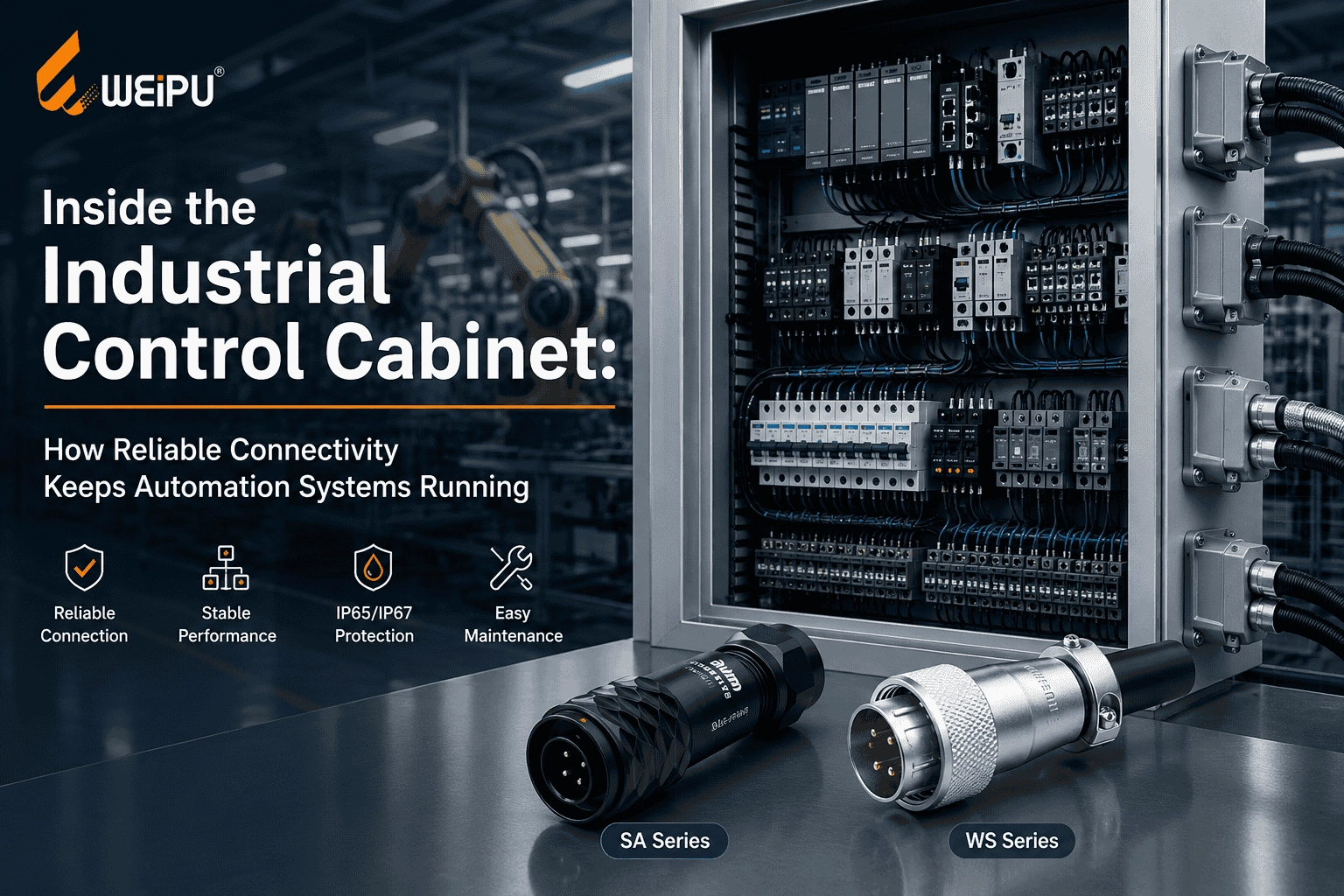
Inside the Industrial Control Cabinet: How Reliable Connectivity Keeps Automation Systems Running
Discovering Weipu: Among the World’s Largest Connector Manufacturers

Application of Heavy-Duty Connectors in Wind Power
Contacts
Sofia
WhatsApp/Phone
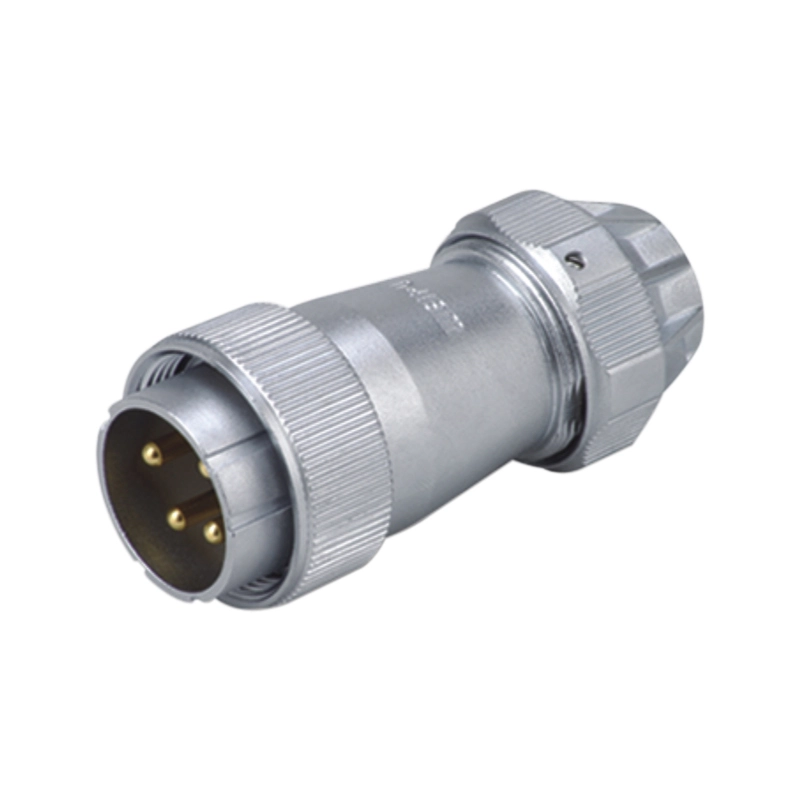
Weipu WF Series Industrial Threaded Connectors with IP67 Protection
WEIPU WF Series Industrial Threaded Connectors offer robust IP67 protection, ensuring reliable performance in harsh environments. Designed for secure, waterproof connections, these IP67 connectors are ideal for industrial applications requiring durability and stability. Trust WEIPU for quality and safety.
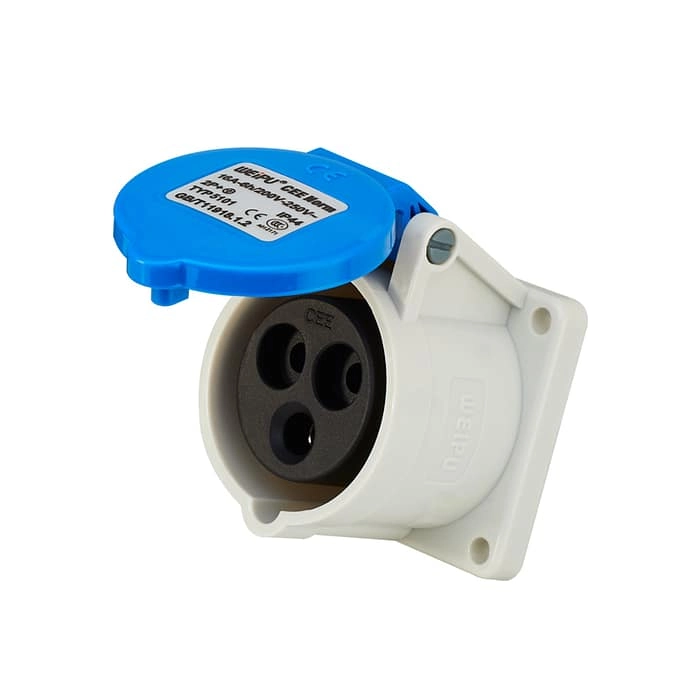
16A 3PIN Panel mount socket TYP5101-IP44
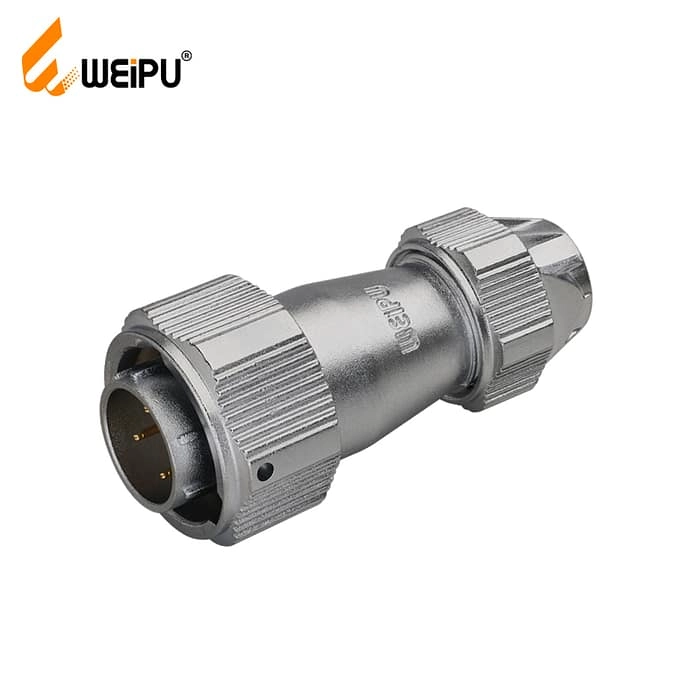
WEIPU WY-TE Series Waterproof Electrical Plug
With metal clamping-nut IP67, Threaded, Zinc alloy with chrome plating, PPS
WEIPU WY-TE IP67 circular connectors are waterproof electrical plugs with metal clamping-nut, which are durable, safe and easy to assemble with your all devices.With the metal clamping-nut and threaded design, these waterproof electrical plugs ensure high security and super stable connection. It’s an ideal waterproof connector for your applications.
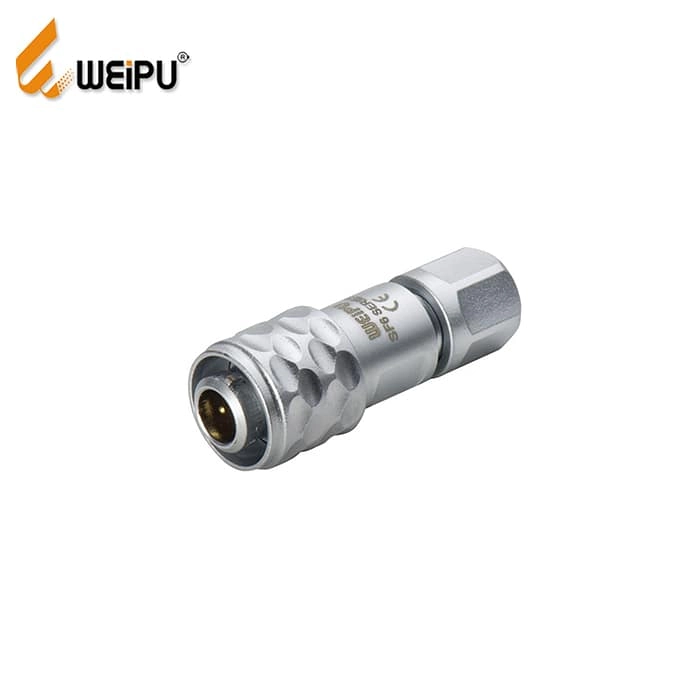
SF610B/P SF610B/S Cable connector IP67
Mate with SF611B, SF612B, SF615B
Get in Touch
Request Related Resources about Industrial Connections & Solutions
If you require technical details, product guides, or specific recommendations from a premier connector manufacturing corporation, please send us your request. We provide expert support for custom electrical connectors, offering OEM/ODM customization and dedicated distributor cooperation assistance.
Weipu Building, No. 111, Baihua Road, Liwan District, Guangzhou, Guangdong China
© 2026 WEIPU. All Rights Reserved.
Whatsapp: +8618102298073
WEIPU
WEIPU
WEIPU
WEIPU