
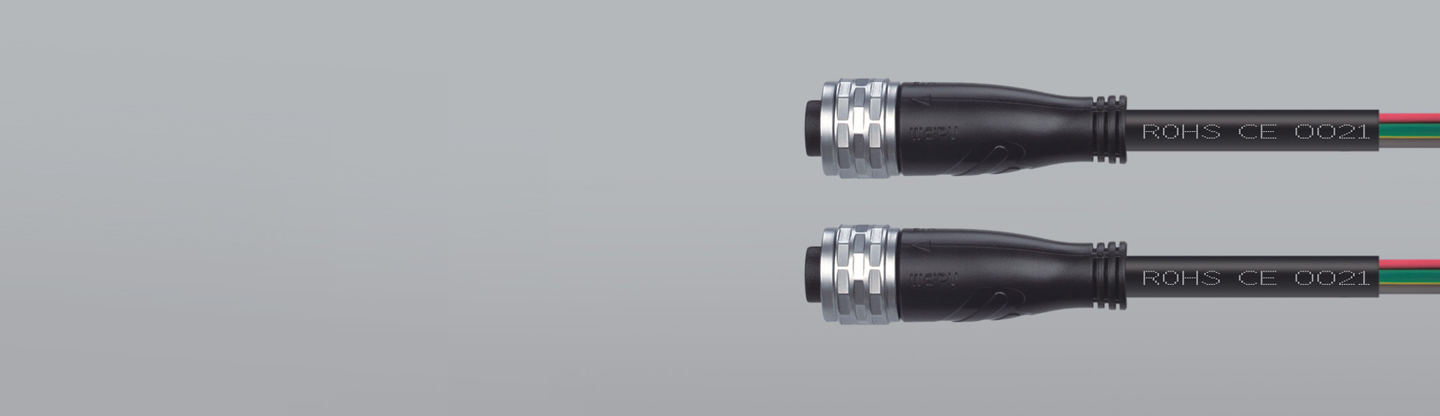
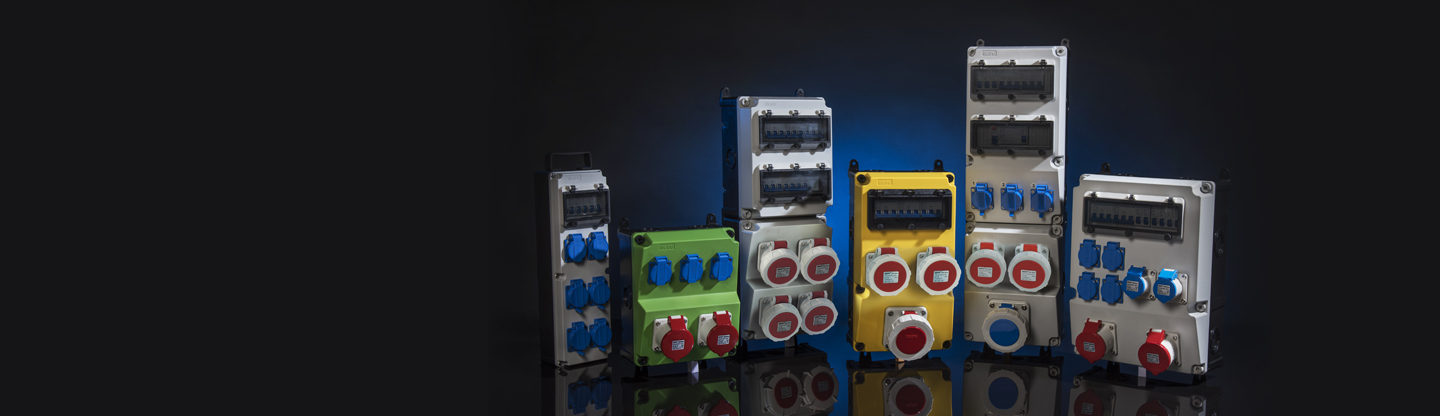

Industrial Connectors for Robotics: Power, Signal and Dynamic Connectivity
Discover how industrial connectors support power, signal and data connections in robotic systems, with key considerations for movement, locking, cable routing and reliability.
Follow us now:
- Industrial Connectors for Robotics: Power, Signal and Dynamic Connectivity
- 1. Why Robotics Requires Dynamic Connectivity
- 2. Where Do Industrial Connectors Fit in a Robotic System?
- 3. Power Connectivity for Robotic Systems
- 4. Signal Connectivity for Sensors and Feedback
- 5. Data Connectivity for Connected Robots
- 6. Why Movement Changes Connector Requirements
- 7. Locking and Mechanical Stability in Robotic Applications
- 8. Cable Routing and Strain Relief Are Part of Connector Reliability
- 9. Environmental and EMC Requirements
- Ingress Protection
- EMC and Shielding
- 10. Engineering Examples: SP, WY and Heavy-Duty Connectivity
- 10.1 SP Series: Compact Circular Connectivity
- 10.2 WY Series: Bayonet-Coupled Industrial Connectivity
- 10.3 Heavy-Duty Connectors: Machine-Level Power and Control
- 11. Robotics Connector Selection Checklist
- Electrical Requirements
- Mechanical Requirements
- Environmental Requirements
- EMC Requirements
- Maintenance Requirements
- System Integration
- 12. Connector Selection Should Follow the Robot's Connection Function
- 13. Industrial Connectivity for Robotics Is a System-Level
- Decision
- Conclusion
- FAQ
Industrial Connectors for Robotics: Power, Signal and Dynamic Connectivity
Robotic systems depend on more than motors, controllers and mechanical structures. They also depend on a network of physical connections that continuously carries power, signals, data and control information.
Unlike many stationary industrial machines, robots introduce an additional challenge: movement.
Robot arms rotate, joints move repeatedly, end-effectors change position, and cables may experience bending, twisting, vibration and mechanical stress during operation. As a result, connector selection for robotics cannot focus only on electrical compatibility.
The connection system must also consider mechanical stability, cable routing, locking, environmental protection and maintenance.
This is where industrial connectors become an important part of robotic system design.
A robotic system is not just a moving machine. It is a dynamic network of power, signal, data and control connections.
1. Why Robotics Requires Dynamic Connectivity
In a conventional control cabinet, many electrical connections remain relatively stationary after installation.
A robotic system is different.
Depending on the application, connections may be located:
- Inside the robot base
- Along the robot arm
- Near moving joints
- At the end effector
- Between the robot and controller
- Between the robot and external sensors
- Between the robot and machine vision equipment
- Between the robot cell and the control cabinet
These connection points may experience repeated mechanical movement throughout the operating cycle.
A connector therefore needs to be evaluated as part of a larger connection system:
Connector + Cable + Locking + Strain Relief + Routing + Environment
This system-level perspective is particularly important when robots operate continuously in automated production environments.
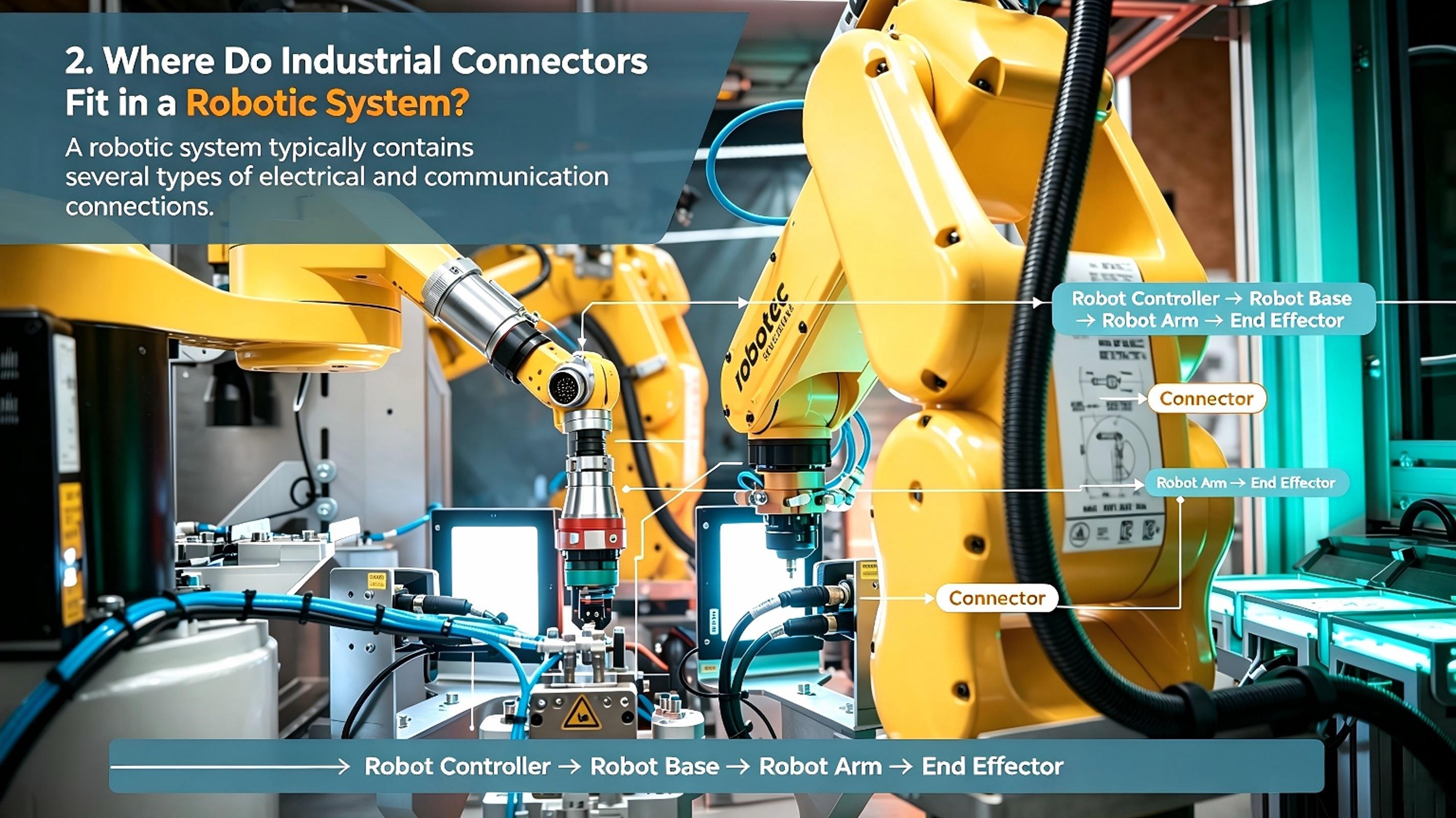
2. Where Do Industrial Connectors Fit in a Robotic System?
A robotic system typically contains several types of electrical and communication connections.
A simplified connectivity structure can be represented as:
- Robot Controller → Robot Base → Robot Arm → End Effector
At different points in this system, the connection may carry:
- Power — supplying motors, actuators, tools or auxiliary equipment
- Signal — connecting sensors, switches and feedback devices
- Data — transferring information between controllers, sensors and connected equipment
- Control — supporting communication between the robot, PLC, vision system and machine
The connector used at each point does not necessarily need to be the same.
The engineering requirement depends on the function of the connection, available space, environmental conditions, mating requirements and expected mechanical stress.
3. Power Connectivity for Robotic Systems
Robots require electrical power for motors, actuators and associated equipment.
Depending on the system architecture, power connections may exist between:
- Power supply and robot controller
- Controller and robot
- Robot and end effector
- Robot and auxiliary equipment
- Robot cell and external machinery
For these connections, engineers need to consider electrical requirements such as:
- Rated current
- Rated voltage
- Contact configuration
- Conductor size
- Contact resistance
- Termination method
- Temperature rise
- Environmental conditions
High-current requirements may require a different connector architecture from low-power sensor connections.
For example, machine-level connections may benefit from a heavy-duty connector architecture where multiple electrical circuits need to be integrated into a robust interface.
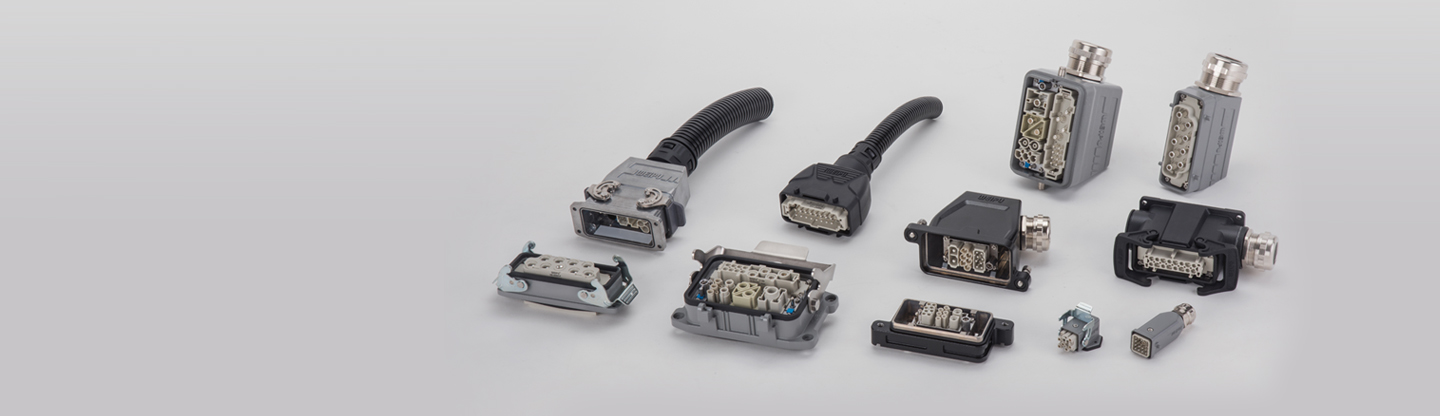
WEIPU's Heavy Duty Connector range includes rectangular industrial connectors designed for electrical or signal connections between different devices or functional units, with modular insert and housing options available for different system requirements.
4. Signal Connectivity for Sensors and Feedback
Robots rely on sensors to understand their operating conditions.
Depending on the robotic system, signals may come from:
- Position sensors
- Proximity sensors
- Limit switches
- Encoders
- End-of-arm sensors
- Force or torque sensors
- Safety devices
- Machine vision systems
These signals may be relatively low-power, but their reliability can be critical to system operation.
A poor physical connection can introduce problems such as:
- Intermittent contact
- Increased contact resistance
- Signal instability
- Unexpected communication interruptions
- Difficult-to-diagnose faults
For this reason, signal connectivity should be evaluated together with contact quality, connector structure, mating reliability, cable termination and environmental conditions.
5. Data Connectivity for Connected Robots
Modern robotic systems are increasingly connected to other industrial equipment.
A robot may communicate with:
- PLC systems
- Machine vision equipment
- Industrial computers
- Sensors
- Motion controllers
- Production management systems
- Other machines
The physical connection therefore becomes part of the overall data path.
The basic chain can be viewed as:
Device → Cable → Connector → Equipment
Even when the communication protocol is correctly configured, the physical connection still needs to maintain stable electrical performance.
Connector design factors such as contact quality, shielding, grounding, cable termination and mechanical stability can therefore contribute to overall communication reliability.
6. Why Movement Changes Connector Requirements
This is one of the most important differences between robotics and many stationary industrial applications.
A connector installed on a fixed machine may experience relatively limited mechanical movement.
A connector used around a robot may experience:
- Repeated bending
- Cable movement
- Twisting
- Vibration
- Pulling forces
- Mechanical impact
- Repeated mating and unmating during maintenance
This means that electrical performance alone is not enough.
Engineers should also consider how the connector interacts with the cable and mechanical structure.
For example:
- Robot Movement → Cable Movement → Mechanical Stress → Connector Interface
If cable routing is poorly designed, mechanical forces can eventually be transferred to the connector interface.
Therefore, connector selection and cable management should be considered together.
7. Locking and Mechanical Stability in Robotic Applications
A connector needs to remain properly mated while the equipment is operating.
Different industrial connector families use different coupling mechanisms, including:
- Screw coupling
- Push-pull locking
- Bayonet coupling
- Lever locking
Each mechanism provides a different approach to mating, locking and maintenance.
For robotic applications, the important question is not simply:
“Which locking mechanism is best?”
Instead, engineers should ask:
Which locking mechanism matches the movement, maintenance and installation requirements of the application?
For example, a bayonet coupling can provide a quick locking approach where repeated industrial mating is required. WEIPU's WY Series uses bayonet coupling and offers multiple cable-fix and panel-mount configurations.
For other installations, threaded or push-pull solutions may be more appropriate depending on the connector family and application requirements.
8. Cable Routing and Strain Relief Are Part of Connector Reliability
One common mistake in connector selection is focusing on the connector body while ignoring the cable.
In robotic systems, this can be particularly important.
A connector may have appropriate electrical specifications, but the overall connection can still experience mechanical problems if the cable is:
- Routed through an unsuitable bending path
- Excessively pulled
- Poorly supported
- Exposed to repeated twisting
- Improperly clamped
- Subjected to unnecessary mechanical stress
A more complete design approach considers:
Connector → Cable Termination → Strain Relief → Cable Routing → Robot Movement
The connector should work with the cable assembly rather than operate as an isolated component.
This is also why cable fixation and back-shell configuration can become important during connector selection.
For example, the WEIPU WY Series includes configurations with cable clamping plates, strain relief and angled back-shell options, depending on the specific model.
9. Environmental and EMC Requirements
Robotic systems are often installed directly on the factory floor.
Depending on the application, connectors may encounter:
- Dust
- Water
- Oil
- Coolant
- Vibration
- Temperature changes
- Cleaning processes
- Electromagnetic interference
The required environmental protection depends on the actual installation location.
For example, a connector installed inside a protected control cabinet may have very different requirements from one mounted directly on a robot cell or production machine.
Engineers should therefore evaluate:
Ingress Protection
Select the appropriate IP rating based on the actual environmental exposure.
EMC and Shielding
Where robots operate close to drives, motors, inverters or other sources of electromagnetic interference, shielding and grounding may become important considerations.
The connector should be evaluated as part of the complete cable and grounding system rather than considered independently.
10. Engineering Examples: SP, WY and Heavy-Duty Connectivity
Different robotic connection points may require different connector architectures.
Rather than treating one connector family as a universal robotics solution, engineers can evaluate connector families according to the function they need to perform.
10.1 SP Series: Compact Circular Connectivity
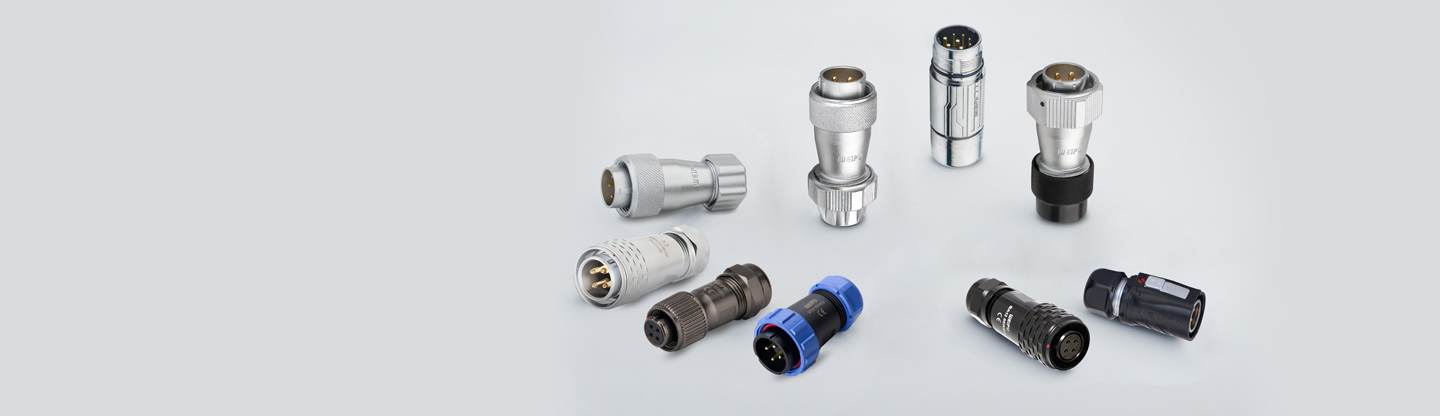
WEIPU's SP Series provides circular connector configurations for industrial applications, including cable and in-line connection options. Current WEIPU product information lists SP configurations with screw coupling and different termination options depending on the model.
For robotic equipment, an SP Series connector can serve as an engineering example where a compact circular connection is required for power or signal connectivity and environmental protection.
The exact current, pin configuration, IP rating and termination method should always be selected according to the specific SP model.
10.2 WY Series: Bayonet-Coupled Industrial Connectivity
The WY Series uses a bayonet coupling mechanism and is available in multiple configurations for cable and panel connections.
WEIPU currently lists WY configurations including metal clamping-nut, cable-clamping, strain-relief and angled back-shell versions, depending on the model.
This makes the series an engineering example for applications where designers are considering:
- Repeatable industrial mating
- Mechanical locking
- Cable fixation
- Compact equipment interfaces
- Environmental protection
The WY Series should not be considered a “robot-specific” connector. Instead, its bayonet coupling and available configurations can be evaluated when these characteristics match the requirements of a robotic system.
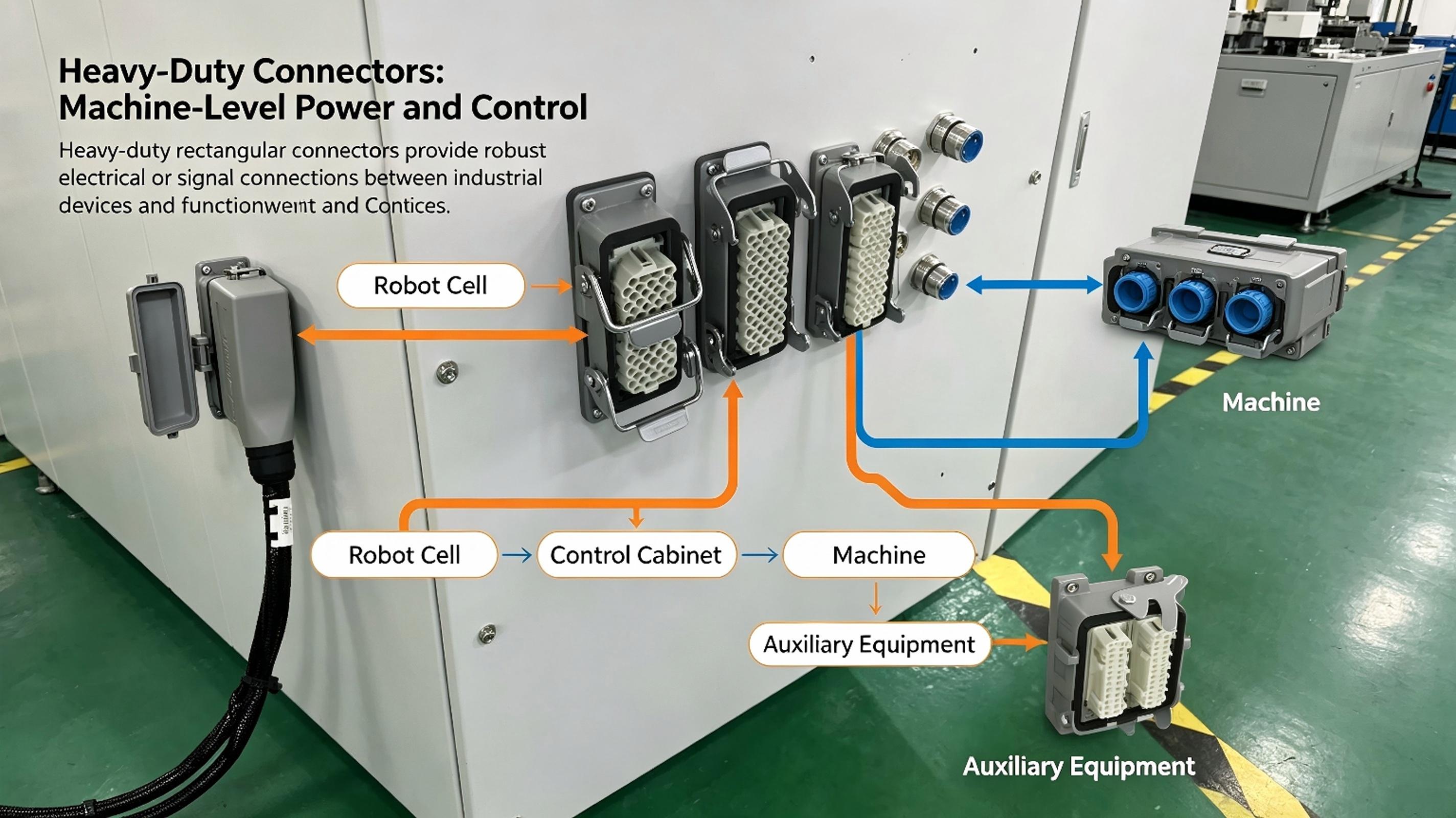
10.3 Heavy-Duty Connectors: Machine-Level Power and Control
Heavy-duty rectangular connectors provide another connection architecture for industrial machinery.
They can be used for electrical or signal connections between different devices or functional units and are particularly relevant when a robotic cell needs a robust interface between equipment such as:
Robot Cell ↔ Control Cabinet ↔ Machine ↔ Auxiliary Equipment
WEIPU's Heavy Duty Connector range includes modular inserts, housings and hoods, allowing different connection configurations to be assembled according to the application.
For a robotic production cell, this type of connector can be considered for machine-level power, signal or control interfaces, depending on the selected configuration.
11. Robotics Connector Selection Checklist
When selecting industrial connectors for robotic systems, engineers can evaluate the following factors.
Electrical Requirements
- What current and voltage does the connection carry?
- Is the connection for power, signal, data or a combination?
- What contact configuration is required?
- What termination method is appropriate?
Mechanical Requirements
- Is the connector located on a moving or stationary part?
- Will the cable experience repeated bending or twisting?
- What locking mechanism is appropriate?
- Is additional strain relief required?
Environmental Requirements
- Is the connector exposed to dust or water?
- Is an IP-rated connection required?
- Will the connector be exposed to oil, coolant or cleaning processes?
- What temperature range must it support?
EMC Requirements
- Is the connector located near motors, drives or inverters?
- Is shielding required?
- How will the cable shield be terminated?
- How is grounding implemented?
Maintenance Requirements
- How frequently will the connection be serviced?
- Is quick mating important?
- Is the connector accessible after installation?
- Will the connector need to be replaced in the field?
System Integration
- Does the connector fit the available installation space?
- Does the cable routing work with the robot's movement?
- Is the connector compatible with the cable assembly?
- Does the selected configuration match the equipment interface?
12. Connector Selection Should Follow the Robot's Connection Function
There is no single connector architecture that fits every point in a robotic system.
A better approach is to start with the function of the connection.
Robotic Connection Main Requirement Connector Considerations Power Electrical energy Current, voltage, contact configuration, temperature Sensor / Signal Reliable low-level signals Contact quality, mating, environmental protection Data Stable communication Signal integrity, shielding, grounding, termination End Effector Compact equipment interface Space, mating, cable routing, maintenance Robot Cell Machine-level connectivity Power, signal, modularity, installation Outdoor / Harsh Area Environmental protection IP rating, materials, sealing Moving Connection Dynamic mechanical conditions Locking, strain relief, cable routing, vibration This function-based approach helps engineers avoid selecting a connector only because of its nominal current or IP rating.
For robotic systems, electrical, mechanical and environmental requirements need to be evaluated together.
13. Industrial Connectivity for Robotics Is a System-Level
Decision
A reliable robotic connection is not created by the connector alone.
It depends on the interaction between:
Connector
↓
Contact
↓
Cable Termination
↓
Strain Relief
↓
Cable Routing
↓
Robot Movement
↓
Environmental Conditions
The connector is one part of this complete connection chain.
This is why robotic connectivity should be considered during system design rather than treated as a final component-selection task.
For engineers, the key question is not simply:
“Which connector should I use for a robot?”
It is:
“What type of connection does this point in the robotic system need, and what electrical, mechanical and environmental conditions will it experience?”
That question leads to a more reliable connector selection process.
Conclusion
Robotic systems create a different connectivity challenge from stationary industrial equipment.
Power, signal and data connections must continue to operate while equipment moves, vibrates and interacts with other machines.
As a result, connector selection for robotics should consider more than electrical specifications. Locking, cable routing, strain relief, environmental protection, EMC requirements and maintenance accessibility can all influence the reliability of the complete connection system.
SP, WY and Heavy-Duty connectors represent different industrial connection architectures that can be evaluated according to the requirements of each robotic application. The appropriate choice ultimately depends on the specific connection function, mechanical conditions, electrical requirements and environmental exposure.
Reliable robotics starts with reliable connections — and reliable connections start with the right engineering considerations.
FAQ
What type of connector is used in robotic systems?
Robotic systems can use different connector types depending on the connection function. Circular connectors may be used for compact power or signal connections, while heavy-duty rectangular connectors can be considered for machine-level power and control interfaces. The appropriate choice depends on the specific application.
Why is cable routing important for robotic connectors?
Robot movement can introduce bending, twisting and mechanical stress into the cable. Proper routing and strain relief help prevent unnecessary forces from being transferred to the connector interface.
Are bayonet connectors suitable for robotic applications?
A bayonet connector can be considered where the application requires a repeatable locking and mating mechanism. However, suitability depends on the specific robot, connector location, cable routing, environmental conditions and connector model.
Can heavy-duty connectors be used in robotic cells?
Yes. Heavy-duty connectors can be considered for machine-level electrical or signal interfaces between robotic cells, control cabinets and other industrial equipment. The exact connector and insert configuration should be selected according to the required electrical and mechanical specifications.
How do industrial connectors affect robot reliability?
Connectors provide the physical interface through which power, signal and data are transferred. Poor contact, inadequate locking, unsuitable cable routing or insufficient environmental protection can contribute to connection problems. Connector selection should therefore be evaluated as part of the complete robotic connection system.

Ultimate Guide to Circular Connectors (2026): Types, Standards, Selection & OEM Solutions

IP65 to IP69K: Evaluating Heavy Duty Housing Protection for Harsh Environments

Weipu Connector Marches on 5G Base Station Market

Inside Weipu Connector: Engineering Excellence for Seamless Connectivity
Contacts
Sofia
WhatsApp/Phone

WEIPU WY-ZE Series In-line Receptacle Connector
With metal clamping-nut IP67, Threaded, Zinc alloy with chrome plating
WEIPU WY-ZE series circular power connectors are mainly designed with metal clamping-nut, suitable for aviation, stage lighting, medical industry and other areas. All circular connector types can ensure transmissions efficiently and can be easily installed. Even under adverse conditions, our circular power connectors can also keep working.

WEIPU WY-Z Series Panel Receptacle
Square flange panel receptacle IP67, Threaded, Zinc alloy with chrome plating, PPS

HA6B-PS-2B standard electrical connection components for Industry 4.0
Heavy duty connector housings are made of cast aluminum or flame retardant thermoplastic materials and are powder coated to withstand impact and mechanical pressure.
SEALANT gasket between housing.
The fire rating is V-0, which the product is for IP65.
All kind of the cable joints and different shell forms are for different installation, provide a variety of different solutions.

HVE-020-MC/FC Crimp termination Connector 16A 500V 20+PE
Heavy-duty connectors are mainly used for electrical or signal connections between different devices or functional units, which provide great convenience for the installation and maintenance of complex control devices.
| Applied Range: |
| ◆ Wind Energy |
| ◆ Power Systems |
| ◆ Photovoltaic Industry |
| ◆ Engineering Equipment |
| ◆Other Industry Application |
Get in Touch
Request Related Resources about Industrial Connections & Solutions
If you require technical details, product guides, or specific recommendations from a premier connector manufacturing corporation, please send us your request. We provide expert support for custom electrical connectors, offering OEM/ODM customization and dedicated distributor cooperation assistance.
Weipu Building, No. 111, Baihua Road, Liwan District, Guangzhou, Guangdong China
© 2026 WEIPU. All Rights Reserved.
Whatsapp: +8618102298073
WEIPU
WEIPU
WEIPU
WEIPU