


Industrial Data Connectors: How to Choose the Right Connector for Reliable Communication
Learn how to choose industrial data connectors for reliable communication. Compare connector types, shielding, locking, IP protection, and applications.
Follow us now:
- Introduction: Why Data Connectivity Matters in Industrial Systems
- What Are Industrial Data Connectors?
- Why Reliable Data Connectivity Matters in Industrial Automation
- What Should You Consider When Selecting an Industrial Data Connector?
- 1. Signal and Data Requirements
- 2. Shielding and EMI Protection
- 3. Locking Mechanism and Mechanical Reliability
- Threaded locking
- Push-pull locking
- Bayonet locking
- Lever locking
- 4. Environmental Protection
- 5. Connector Materials
- Common Industrial Data Connector Applications
- Industrial Ethernet
- Machine Vision
- PLC and Control Cabinets
- Robotics and Automated Production Lines
- Choosing the Right Connector for Industrial Data Applications
- Step 1: Define the communication requirement
- Step 2: Define the environment
- Step 3: Select the connection and locking mechanism
- Step 4: Evaluate shielding and materials
- Step 5: Match the connector to the equipment
- WEIPU Industrial Connector Solutions for Data and Communication Applications
- M23 Series — Industrial Automation Connectivity
- SF Series — Compact Push-Pull Connectivity
- SA Series — Reliable Push-Pull Connections
- What About Hybrid Connectivity?
- Industrial Data Connector Selection Checklist
- Conclusion: Reliable Communication Starts with the Physical Connection
- FAQ
Introduction: Why Data Connectivity Matters in Industrial Systems
Modern industrial equipment depends on more than power.
A factory automation system may connect PLCs, I/O modules, sensors, machine vision cameras, industrial Ethernet devices, robots, and control systems across the same production environment. These devices continuously exchange data that controls machines, monitors processes, and supports real-time decision-making.
When communication is interrupted, the problem may not be the network protocol or the control software. The physical connection itself can become a weak point.
A connector used in an industrial communication system must withstand vibration, dust, moisture, temperature changes, electromagnetic interference, repeated mating, and mechanical stress while maintaining reliable electrical contact.
This makes industrial data connector selection an engineering decision rather than simply choosing a connector based on pin count or physical size.
In this article, we examine what industrial data connectors are, what factors engineers should consider, and how connector selection changes across automation, industrial Ethernet, machine vision, PLC, and robotic applications.
What Are Industrial Data Connectors?
Industrial data connectors are connectors designed to provide reliable electrical connections for signal and data transmission in industrial environments.
Unlike connectors used primarily for household or office electronics, industrial connectors must often operate under significantly more demanding conditions.
Depending on the application, they may need to provide:
- Stable signal transmission
- Reliable electrical contact
- Electromagnetic shielding
- Protection against dust and moisture
- Mechanical resistance to vibration
- Secure mating and locking
- Resistance to temperature and chemicals
- Long mating and service life
Industrial data connectivity can involve different types of signals and communication systems, including sensor signals, control signals, industrial Ethernet, machine vision data, and other equipment communication links.
The connector therefore becomes part of the overall communication infrastructure.
A useful way to think about the system is:
Device → Cable → Connector → Network → Connector → Device
Every connection point introduces another potential failure point.
For this reason, connector construction should be considered together with the cable, equipment, environment, and communication requirements.
Why Reliable Data Connectivity Matters in Industrial Automation
In an industrial environment, data transmission often happens continuously.
A sensor may send measurement information to a PLC. A PLC may communicate with an I/O system. An industrial Ethernet network may connect control equipment to machines. Machine vision cameras may transmit image data for inspection, while robots receive commands from the control system.
A simplified architecture looks like this:
PLC → I/O → Ethernet → Sensor / Machine Vision → Machine → Robot
If a connector becomes loose, contaminated, poorly shielded, or mechanically damaged, communication reliability can be affected.
This is particularly important in applications where equipment operates continuously.
For example, an intermittent connection in a production line may result in:
- Communication errors
- Sensor signal interruptions
- Machine stops
- Inspection failures
- Unplanned maintenance
- Production downtime
What Should You Consider When Selecting an Industrial Data Connector?
There is no single connector that is ideal for every industrial communication application.
Engineers should evaluate several factors together.
1. Signal and Data Requirements
The first consideration is the type of signal being transmitted.
Different applications may involve:
- Sensor signals
- Control signals
- Ethernet communication
- High-speed data
- Power and signal combinations
- Machine vision data
The connector should be compatible with the electrical characteristics of the system and the cable being used.
Important considerations may include:
- Number of contacts
- Contact arrangement
- Rated voltage
- Rated current
- Signal frequency
- Cable size
- Transmission requirements
- Required shielding
The goal is not simply to find a connector with enough contacts, but to select a connector whose electrical and mechanical characteristics match the complete system.
2. Shielding and EMI Protection
Industrial environments can contain significant electromagnetic noise.
Motors, variable-frequency drives, switching equipment, power supplies, and other machinery may generate electromagnetic interference that affects sensitive signal and communication lines.
For applications involving sensitive signals or industrial communication, connector shielding can therefore become an important part of system design.
Engineers should consider:
- Shielding construction
- Metal housing options
- Cable shielding compatibility
- Grounding strategy
- Contact arrangement
- Connector-to-cable shielding continuity
For industrial communication systems, connector shielding should be evaluated as part of the entire signal path rather than as an isolated connector specification.
3. Locking Mechanism and Mechanical Reliability
A connector can provide excellent electrical performance but still fail if the connection cannot remain mechanically secure.
Industrial equipment is often exposed to:
- Continuous vibration
- Mechanical shock
- Cable movement
- Equipment movement
- Frequent mating and unmating
- Installation and maintenance operations
Different locking mechanisms provide different advantages.
Common options include:
Threaded locking
Threaded connectors provide a secure mechanical connection and are commonly used where vibration resistance and long-term connection stability are important.
Push-pull locking
Push-pull connectors allow fast mating and unmating without requiring extensive rotation.
They can be useful where installation time and service accessibility are important.
Bayonet locking
Bayonet mechanisms provide relatively quick mating with a defined locking action.
Lever locking
Heavy-duty connectors may use lever mechanisms to provide strong mechanical retention and convenient equipment-level connection.
The right locking mechanism depends on the balance between vibration resistance, mating frequency, installation space, and maintenance requirements.
4. Environmental Protection
Industrial data connectors may be installed inside control cabinets, on machines, outdoors, or directly in harsh production environments.
Environmental conditions can include:
- Water
- Dust
- Oil
- Chemical exposure
- High humidity
- Temperature fluctuations
- Mechanical contamination
For these applications, the connector's IP rating becomes an important selection factor.
For example, IP67 and IP68 connectors can provide different levels of protection against environmental ingress depending on the specific product design and test conditions.
However, an IP rating should not be evaluated independently.
The complete connection should be considered, including:
Connector + cable + sealing + backshell + panel interface + installation method
5. Connector Materials
Housing materials also influence the reliability of industrial data connectors.
Metal housings may provide advantages in mechanical strength, durability, and shielding applications.
Engineered plastics can provide advantages in weight, corrosion resistance, electrical insulation, and application flexibility.
Material selection should therefore consider:
- Mechanical strength
- Corrosion resistance
- Temperature
- Chemical exposure
- Weight
- Electrical insulation
- EMI shielding requirements
- Expected service environment
Material selection should follow the application rather than simply choosing metal or plastic based on price.
Common Industrial Data Connector Applications
Industrial data connectors appear across many types of equipment.
Industrial Ethernet
Industrial Ethernet connects controllers, switches, I/O devices, sensors, machines, and other industrial equipment.
Connector selection should consider environmental protection, shielding, mechanical reliability, cable routing, and installation conditions.
The connector is part of the physical layer supporting the communication system.
Machine Vision
Machine vision systems rely on cameras, lighting, processing equipment, and control systems to inspect products and processes.
These systems can be sensitive to communication interruptions and electrical interference.
Connector selection should therefore consider:
- Signal integrity
- EMI protection
- Mechanical stability
- Cable routing
- Environmental conditions
- Space limitations
PLC and Control Cabinets
PLC systems often act as the central control point for industrial machinery.
Within a control architecture, connectors may be used between:
- PLC and I/O modules
- Control cabinets and machines
- Sensors and control systems
- Communication equipment
- Field devices
A reliable connection helps maintain communication between the control system and connected equipment.
Robotics and Automated Production Lines
Robotic systems introduce additional mechanical considerations.
Robot arms, AGVs, automated machinery, and production equipment may experience continuous movement and vibration.
In these environments, connector selection should consider:
- Locking reliability
- Cable movement
- Vibration resistance
- Repeated mating
- Compact installation
- Environmental protection
Choosing the Right Connector for Industrial Data Applications
The best connector depends on the actual application.
A practical selection process can follow five steps.
Step 1: Define the communication requirement
Determine whether the application involves sensor signals, industrial Ethernet, control signals, machine vision, or combined power and data.
Step 2: Define the environment
Evaluate:
- Indoor or outdoor installation
- Water and dust exposure
- Temperature
- Vibration
- Chemicals
- Mechanical stress
Step 3: Select the connection and locking mechanism
Consider whether the application requires threaded, push-pull, bayonet, or lever locking.
Frequent service applications may prioritize fast mating, while permanently installed machinery may prioritize secure mechanical retention.
Step 4: Evaluate shielding and materials
For electrically noisy environments, shielding can become critical.
Material selection should reflect mechanical, environmental, and EMI requirements.
Step 5: Match the connector to the equipment
Finally, verify:
- Contact configuration
- Cable compatibility
- Panel mounting
- Space constraints
- IP rating
- Mating requirements
- Product lifecycle and availability
This prevents the common mistake of selecting a connector based on only one specification.
WEIPU Industrial Connector Solutions for Data and Communication Applications
Different industrial systems require different connector configurations.
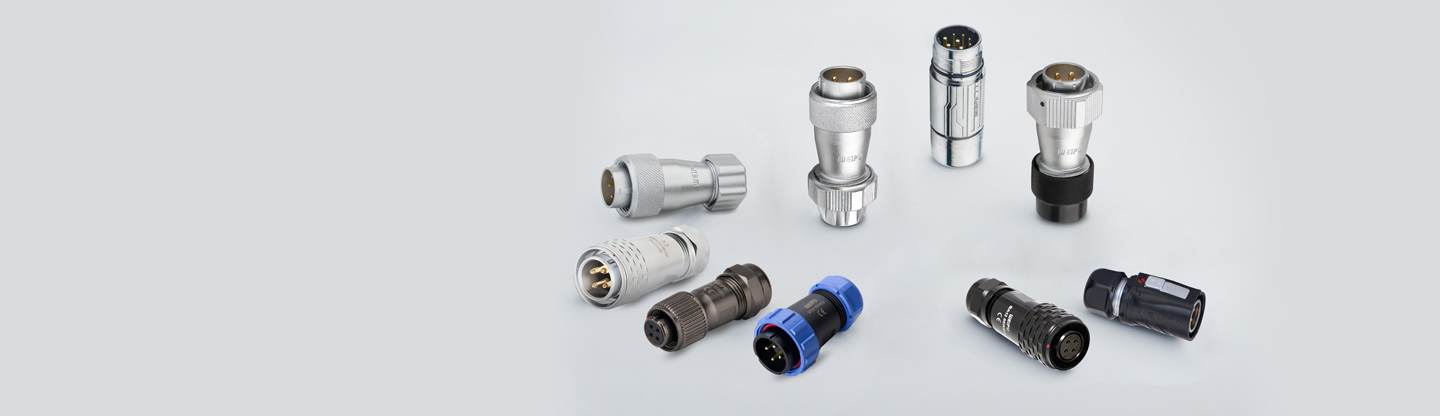
WEIPU's industrial connector portfolio includes circular and heavy-duty connector solutions that can be configured for different automation, machinery, control, and communication applications.
M23 Series — Industrial Automation Connectivity
The M23 Series can be considered for industrial automation and machinery applications where robust circular connections and secure threaded coupling are required.
It is particularly relevant to equipment architectures where connectors must withstand industrial operating conditions while maintaining stable electrical connections.
SF Series — Compact Push-Pull Connectivity
The SF Series provides a compact push-pull connection concept for industrial equipment.
Its design can be relevant where engineers need secure mating combined with convenient installation and maintenance.
SA Series — Reliable Push-Pull Connections
The SA Series is another option for industrial equipment requiring compact push-pull connectivity.
Depending on the system configuration, it can support power and signal connection requirements in automation and equipment applications.
What About Hybrid Connectivity?
Some modern machines do not treat power and data as completely separate systems.
Equipment may require different electrical functions within the same connection architecture.
This is where hybrid connector concepts become relevant.
A hybrid connector can integrate different connection functions into a more compact solution, potentially reducing the number of separate interfaces required by the equipment.
For applications requiring both power and communication, engineers should evaluate whether separate connectors or an integrated hybrid approach provides the better overall architecture.
Industrial Data Connector Selection Checklist
Before finalizing a connector, engineers can use the following checklist
Selection Factor Key Question Signal type What type of signal or data is transmitted? Contact configuration How many contacts are required? Cable Is the connector compatible with the cable? Shielding Is EMI protection required? Locking Which locking mechanism suits the application? IP rating What level of environmental protection is required? Materials Metal or engineered plastic? Vibration Will the connector experience continuous movement? Mating cycles How frequently will it be connected and disconnected? Installation Is space limited? Maintenance How easily can technicians access the connection? Product lifecycle Will the connector remain available throughout the equipment lifecycle? This approach helps engineers select a connector based on the complete application rather than a single specification.
Conclusion: Reliable Communication Starts with the Physical Connection
Industrial communication systems are becoming increasingly connected.
From PLCs and sensors to industrial Ethernet, machine vision, robots, and smart manufacturing systems, reliable data transmission depends on the entire physical connection chain.
That means connector selection should go beyond simply asking:
- “Which connector fits?”
The better engineering question is:
- “Which connector can reliably maintain the required connection under the actual electrical, mechanical, and environmental conditions?”
By evaluating signal requirements, shielding, locking mechanisms, materials, IP protection, cable compatibility, and application conditions together, engineers can build more reliable industrial communication systems.
For automation and industrial equipment manufacturers, the right industrial data connectors are not just components. They are part of the system's overall reliability strategy.
FAQ
What is an industrial data connector?
An industrial data connector is a connector designed to provide reliable electrical connections for signal and data transmission in industrial equipment and communication systems. Depending on the application, it may need to withstand vibration, moisture, dust, EMI, temperature changes, and repeated mating.
What connector is best for industrial data communication?
There is no universal best connector. The appropriate choice depends on the communication requirement, cable, environmental conditions, shielding requirements, locking mechanism, installation space, and required IP protection.
Do industrial data connectors need EMI shielding?
Not every application requires the same level of shielding. However, EMI shielding can be important in environments containing motors, drives, switching equipment, and other sources of electromagnetic interference.
What is more important: IP rating or locking mechanism?
Both address different failure risks. The IP rating concerns environmental ingress, while the locking mechanism helps maintain mechanical connection integrity. In harsh industrial environments, both should be evaluated together.

The Backbone of Smart Infrastructure: Reliable Industrial Connector Solutions for Data Centers and AI Computing Systems

Rectangular Connector Hoods: How to Choose Between Top and Side Entry

Connectivity Solutions for Solar Tracking Systems
WEIPU May 2026 Exhibition Schedule | Industrial Connector & Automation Expo China
Contacts
Sofia
WhatsApp/Phone

SF1010/P SF1010/S Cable connector IP67
Mate with SF1011, SF1012, SF1015

M23SK_TK Female contact cable connector IP67
Mate with M23SJ_TK,M23SJ_Z,M23SJ_TL,M23SJ_ZL
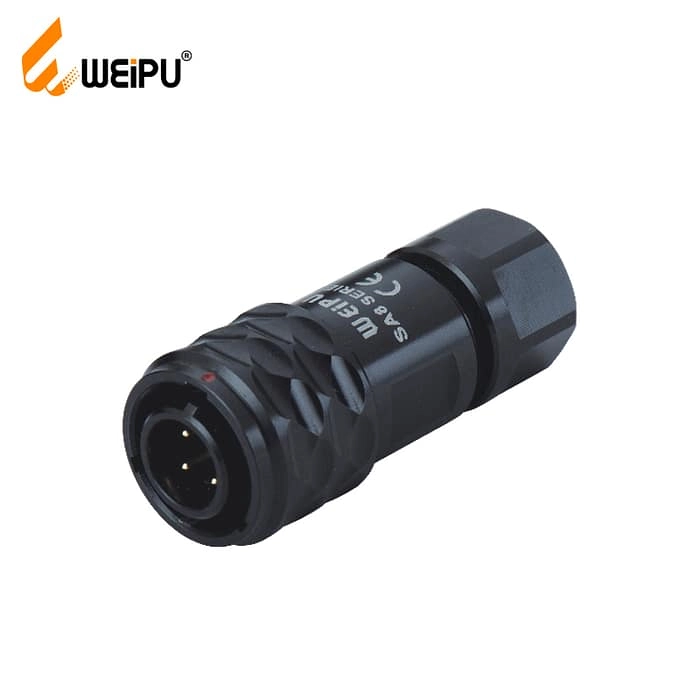
SA810/P SA810/S Cable connector IP67
The Weipu SA series connectors are high-quality, versatile connectors known for their ruggedness and reliability. Designed to meet various industrial and outdoor requirements, these connectors offer excellent environmental protection and are resistant to moisture, dust, and vibrations. The SA series connectors come in different sizes and configurations, making them suitable for a wide range of applications, including LED lighting, industrial automation, and outdoor equipment. With their robust construction and secure locking mechanisms, the Weipu SA series connectors ensure seamless and dependable connections for critical operations

SA812/P SA812/S Rear-nut mount IP67
Mate with SA810
Get in Touch
Request Related Resources about Industrial Connections & Solutions
If you require technical details, product guides, or specific recommendations from a premier connector manufacturing corporation, please send us your request. We provide expert support for custom electrical connectors, offering OEM/ODM customization and dedicated distributor cooperation assistance.
Weipu Building, No. 111, Baihua Road, Liwan District, Guangzhou, Guangdong China
© 2026 WEIPU. All Rights Reserved.
Whatsapp: +8618102298073
WEIPU
WEIPU
WEIPU
WEIPU