


Industrial Ethernet Networks: How Connectors Support Reliable Industrial Communication
Learn how connectors support Industrial Ethernet networks from control cabinets to factory-floor equipment, and why physical connectivity matters for reliable industrial communication.
Follow us now:
- Industrial Ethernet Networks: How Connectors Support Reliable Industrial Communication
- 1. What Is an Industrial Ethernet Network?
- 2. Where Do Connectors Fit Into an Industrial Ethernet Network?
- 3. From the Control Cabinet to the Factory Floor
- Inside the Control Cabinet
- Between the Control Cabinet and Machine
- At Field Devices
- 4. The Physical Connection Chain Behind Industrial Ethernet
- Device
- Interface
- Connector
- Cable
- Network Equipment
- 5. Why Physical Connectivity Matters in Industrial Networks
- 6. How Network Architecture Influences Connector Requirements
- Control-to-Control Connections
- Control-to-Machine Connections
- Machine-to-Sensor Connections
- Connections to Moving Equipment
- 7. Industrial Ethernet Protocols and Physical Connectors Are Different Layers
- 8. RJ45, M12 and Industrial Circular Interfaces
- RJ45
- M12
- Industrial Circular Connectors
- 9. The Connector Is Part of the Complete Ethernet Connection
- 10. Environmental Protection in Industrial Ethernet Connections
- 11. Mechanical Stability Matters to Network Connectivity
- 12. Industrial Ethernet Across Different Automation Systems
- PLC and Remote I/O
- Machine Vision
- Robotics
- Smart Manufacturing
- 13. How Engineers Should Evaluate an Industrial Ethernet Connection
- 1. What equipment is being connected?
- 2. Where is the connector installed?
- 3. What physical conditions exist?
- 4. What interface is required?
- 5. How will the connection be maintained?
- 14. Engineering Example: From PLC to a Field Device
- At the PLC
- At the Industrial Switch
- Along the Cable
- At the Machine Interface
- At the Remote I/O
- At the Sensor
- 15. WEIPU Industrial Connectivity Solutions
- WEIPU Industrial RJ45 Connectivity
- WEIPU Circular Connector Solutions
- 16. Industrial Ethernet Connectivity Is More Than a Protocol
- Conclusion
- FAQ
Industrial Ethernet Networks: How Connectors Support Reliable Industrial Communication
Modern factories depend on connected automation systems.
PLCs, remote I/O modules, industrial switches, sensors, machine vision systems, robots and other equipment continuously exchange information across industrial networks.
Industrial Ethernet provides an important communication infrastructure for these systems.
But a network is not only a protocol or a software configuration.
Behind every communication path is a physical connection made up of equipment interfaces, cables, connectors and network devices.
A simplified connection may look like:
PLC → Industrial Switch → Cable → Connector → Machine → Field Device
If the physical connection is poorly matched to the application, communication reliability can be affected even when the network protocol itself is correctly configured.
This leads to an important engineering principle:
Reliable Industrial Ethernet requires both reliable communication technology and reliable physical connectivity.
For connector engineers, the key question is therefore not simply which Ethernet protocol a system uses.
It is also:
How does the physical connection support reliable communication when the network moves from the control cabinet to the industrial environment?
1. What Is an Industrial Ethernet Network?
Industrial Ethernet refers to the use of Ethernet-based networking technologies in industrial automation and control environments.
A modern automation network may connect:
- PLCs
- Industrial PCs
- Industrial switches
- Remote I/O
- Sensors
- Servo drives
- Machine vision systems
- Robots
- Production equipment
These devices exchange control information, status information and production data.
A simplified architecture can be represented as:
PLC → Industrial Network → I/O → Sensors → Machines
The communication technology determines how devices exchange information.
However, the physical network still needs:
- Cables
- Equipment interfaces
- Connectors
- Network ports
- Junction points
- Proper installation
This distinction is important.
Industrial Ethernet is a communication system, while the connector is part of the physical infrastructure that allows that communication system to operate.
2. Where Do Connectors Fit Into an Industrial Ethernet Network?
The role of connectors becomes clearer when an Industrial Ethernet network is viewed as a physical system rather than only a logical network.
A typical automation system may look like:
PLC
↓
Control Cabinet
↓
Industrial Switch
↓
Network Cable
↓
Industrial Connector
↓
Machine / Remote I/O
↓
Sensor / Vision / Robot
The connector provides the physical interface between parts of this system.
Depending on its location, a connector may need to provide:
- Electrical continuity
- Mechanical connection
- Cable termination
- Environmental protection
- Secure mating
- Equipment integration
The requirements are not necessarily identical at every point in the network.
A connector inside a protected control cabinet may face very different conditions from a connector mounted directly on a machine.
That is why network architecture and physical connection requirements should be considered together.
3. From the Control Cabinet to the Factory Floor
One Industrial Ethernet network can pass through several different physical environments.
The connection requirements can change as the network moves from protected equipment to the factory floor.
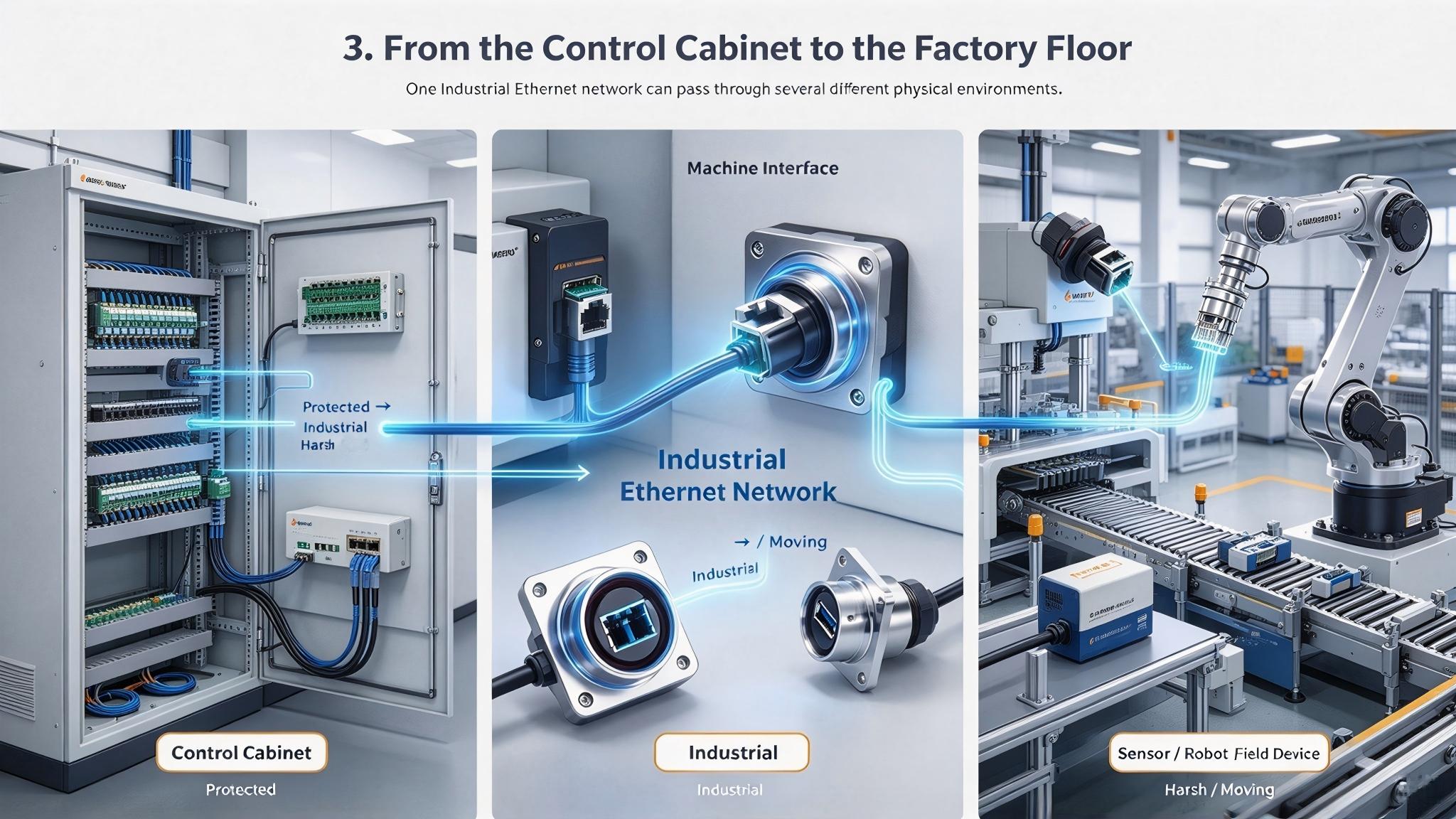
Inside the Control Cabinet
Connections inside a control cabinet are generally more protected from the surrounding environment.
Engineers may therefore focus on:
- Installation space
- Wiring density
- Panel mounting
- Equipment compatibility
- Maintenance accessibility
- Cable organization
The connector may be installed close to PLCs, switches, power supplies or other control equipment.
Between the Control Cabinet and Machine
Once the network leaves the control cabinet, the physical environment can become more demanding.
The connection may be exposed to:
- Vibration
- Dust
- Moisture
- Oil
- Mechanical stress
- Cable movement
- Temperature variation
Mechanical locking and environmental protection may therefore become more important.
At Field Devices
At the machine level, Industrial Ethernet may connect remote I/O, sensors, vision equipment, drives or other field devices.
Here, the connector may be mounted directly on equipment that operates continuously in the production environment.
The physical interface therefore needs to match the actual installation conditions.
4. The Physical Connection Chain Behind Industrial Ethernet
When engineers think about Industrial Ethernet, it is easy to focus on the network protocol.
A more complete view is:
Device → Interface → Connector → Cable → Connector → Network Equipment
Each part has a role.
Device
The PLC, industrial computer, sensor, robot or other equipment generates or receives information.
Interface
The equipment provides a physical port or connection point.
Connector
The connector creates the detachable physical connection between equipment and cable or between two connection components.
Cable
The cable provides the transmission path between devices.
Network Equipment
Industrial switches and other network devices connect different parts of the automation system.
This means that the connector should not be evaluated as an isolated component.
It is one part of the complete physical communication path.
5. Why Physical Connectivity Matters in Industrial Networks
Industrial Ethernet networks often operate in environments that are very different from office networks.
Industrial equipment may experience:
- Continuous vibration
- Mechanical shock
- Dust
- Water
- Oil and contaminants
- Temperature changes
- Repeated maintenance
- Cable movement
- Electromagnetic interference
These conditions can influence the physical connection.
For example, a connector installed on a stationary control cabinet may experience relatively little mechanical stress.
A connection installed on a moving machine or robot may experience repeated cable movement and vibration.
Similarly, a connection installed in a protected cabinet may require different environmental protection from one installed directly on factory equipment.
Therefore:
The same Industrial Ethernet network may require different physical connection strategies at different locations.
6. How Network Architecture Influences Connector Requirements
Connector requirements are closely related to where the connection sits within the network.
Control-to-Control Connections
Connections between PLCs, switches and other control equipment may emphasize:
- Interface compatibility
- Installation density
- Equipment integration
- Maintenance
Control-to-Machine Connections
Connections between a control cabinet and machine may require greater attention to:
- Environmental protection
- Mechanical stability
- Cable fixation
- Locking
- Installation conditions
Machine-to-Sensor Connections
Field-level connections may prioritize:
- Compactness
- Secure mating
- Environmental protection
- Signal requirements
- Maintenance accessibility
Connections to Moving Equipment
Robotic and moving equipment introduces additional considerations:
- Cable movement
- Bending
- Twisting
- Vibration
- Mechanical stress
- Connector locking
This is why connector selection should begin with the physical location and function of the connection, rather than simply the name of the network.
7. Industrial Ethernet Protocols and Physical Connectors Are Different Layers
Industrial Ethernet systems may use communication technologies such as:
- PROFINET
- EtherCAT
- EtherNet/IP
These technologies define how devices communicate.
However:
A communication protocol and a physical connector are not the same thing.
The protocol defines the communication method.
The physical interface defines how equipment is physically connected.
A simplified architecture is:
| Layer | Example | Main Role |
|---|---|---|
| Communication technology | PROFINET | Defines industrial communication |
| Communication technology | EtherCAT | Supports real-time industrial communication |
| Communication technology | EtherNet/IP | Ethernet-based industrial communication |
| Physical medium | Ethernet cable | Provides the transmission path |
| Physical interface | Connector | Provides the physical connection |
| Equipment | PLC / I/O / Robot | Sends or receives information |
8. RJ45, M12 and Industrial Circular Interfaces
Different Industrial Ethernet applications can use different physical interfaces.
The appropriate solution depends on the equipment and installation environment.
RJ45
RJ45 is a familiar Ethernet interface and can be found in industrial control and networking equipment.
It can be particularly relevant in:
- Control cabinets
- Industrial computers
- Network switches
- Equipment enclosures
- Protected installations
For harsher environments, industrial versions can add features such as sealing, mechanical protection and secure locking.
WEIPU currently offers dedicated RJ45 connector products for industrial Ethernet applications, including rugged circular RJ45 configurations and shielded RJ45 solutions.
M12
M12 is widely used as a compact circular interface in industrial equipment and field-level applications.
Its circular form factor and secure coupling make it relevant where equipment connections need to occupy limited space while operating in industrial environments.
However, not every M12 connector is an Ethernet connector.
The actual coding, contact configuration, cable and transmission requirements must be matched to the intended application.
This is an important selection principle:
Connector size or shape alone does not determine network capability.
Industrial Circular Connectors
Industrial automation systems do not only require data connections.
The same machine may also need connections for:
- Power
- Sensors
- Control
- Actuators
- Auxiliary equipment
- Communication
Circular connector families can therefore form part of a broader machine connectivity architecture.
However, engineers should distinguish between:
Industrial circular connector
and
Industrial Ethernet connector
They are not automatically interchangeable.
A circular connector should only be specified for Ethernet transmission when the particular product and configuration are designed and verified for that application.
9. The Connector Is Part of the Complete Ethernet Connection
A reliable network connection depends on more than the connector body.
Consider the complete path:
Equipment Interface
↓
Connector
↓
Cable Termination
↓
Cable
↓
Connector
↓
Network Equipment
Problems at any point in this chain can affect the overall connection.
For example, engineers may need to evaluate:
- Connector compatibility
- Contact configuration
- Cable compatibility
- Shielding
- Grounding
- Termination
- Mechanical stability
- Environmental protection
- Installation quality
This is why Industrial Ethernet should be considered as a system-level connectivity problem.
10. Environmental Protection in Industrial Ethernet Connections
The physical environment can determine what type of connector is required.
A connection inside a protected control cabinet may have limited exposure to water or dust.
A connector installed directly on machinery may require substantially greater protection.
Engineers should consider:
- Water exposure
- Dust
- Oil
- Cleaning processes
- Temperature
- Chemical exposure
- Installation location
- Cable entry
- Mating configuration
IP rating is therefore an application-specific consideration rather than a simple “higher is always better” specification.
The key point for Industrial Ethernet is:
Environmental protection helps maintain the physical connection on which reliable communication depends.
11. Mechanical Stability Matters to Network Connectivity
Industrial Ethernet connections can be exposed to mechanical forces that are uncommon in office networking environments.
Machines vibrate.
Robots move.
Motors accelerate and decelerate.
Production equipment operates continuously.
Cables may be pulled, bent or repositioned during maintenance.
The connector therefore needs to maintain a secure connection under the actual mechanical conditions of the application.
Depending on the application, engineers may evaluate:
- Threaded coupling
- Push-pull coupling
- Bayonet coupling
- Locking mechanisms
- Cable fixation
- Strain relief
- Housing structure
The objective is not to select one locking mechanism for every application.
The objective is to match the connector's mechanical design to the equipment and operating conditions.
12. Industrial Ethernet Across Different Automation Systems
Industrial Ethernet does not exist as an isolated technology.
It connects different industrial systems.
PLC and Remote I/O
The network can connect the central control system with distributed I/O located closer to machines and field devices.
Machine Vision
A vision system may connect cameras, controllers, lighting, PLCs and other equipment.
The physical network connection becomes part of the complete machine vision architecture.
Robotics
Robotic equipment introduces additional movement and mechanical requirements.
The network connection may need to operate while cables move and equipment vibrates.
Smart Manufacturing
As more machines become connected, Industrial Ethernet can provide communication between different parts of the production system.
The physical connection infrastructure therefore becomes increasingly important as the number of connected devices increases.
13. How Engineers Should Evaluate an Industrial Ethernet Connection
Instead of starting with a connector model, engineers can evaluate the connection using several basic questions.
1. What equipment is being connected?
Identify the devices at both ends.
For example:
- PLC
- Switch
- Remote I/O
- Sensor
- Camera
- Robot
- Industrial PC
- Machine
2. Where is the connector installed?
Is it:
- Inside a control cabinet?
- On a machine?
- At a field device?
- On a moving system?
- Outdoors?
- In a washdown area?
3. What physical conditions exist?
Consider:
- Vibration
- Shock
- Cable movement
- Temperature
- Dust
- Water
- Oil
- EMI
4. What interface is required?
Confirm:
- Equipment port
- Connector type
- Coding
- Contact configuration
- Cable type
- Data requirements
5. How will the connection be maintained?
Consider:
- Accessibility
- Mating frequency
- Installation time
- Replacement requirements
- Field service
This process keeps connector selection connected to the actual network architecture.
14. Engineering Example: From PLC to a Field Device
Consider a simplified automation system:
PLC → Industrial Switch → Ethernet Cable → Field Connector → Remote I/O → Sensor
The communication path may look simple from a software perspective.
Physically, however, several factors need to work together.
At the PLC
The connection may be inside a protected control cabinet.
At the Industrial Switch
The connection needs to match the switch interface and cable architecture.
Along the Cable
The cable must be suitable for the installation environment and network requirements.
At the Machine Interface
The connector may need greater mechanical and environmental protection.
At the Remote I/O
The interface needs to match the field device and its installation conditions.
At the Sensor
The final connection may be exposed to vibration, dust, water or repeated maintenance.
The network therefore changes physical conditions as it moves through the factory.
This is why:
Industrial Ethernet connectivity should be designed around the complete connection path, not only the communication protocol.
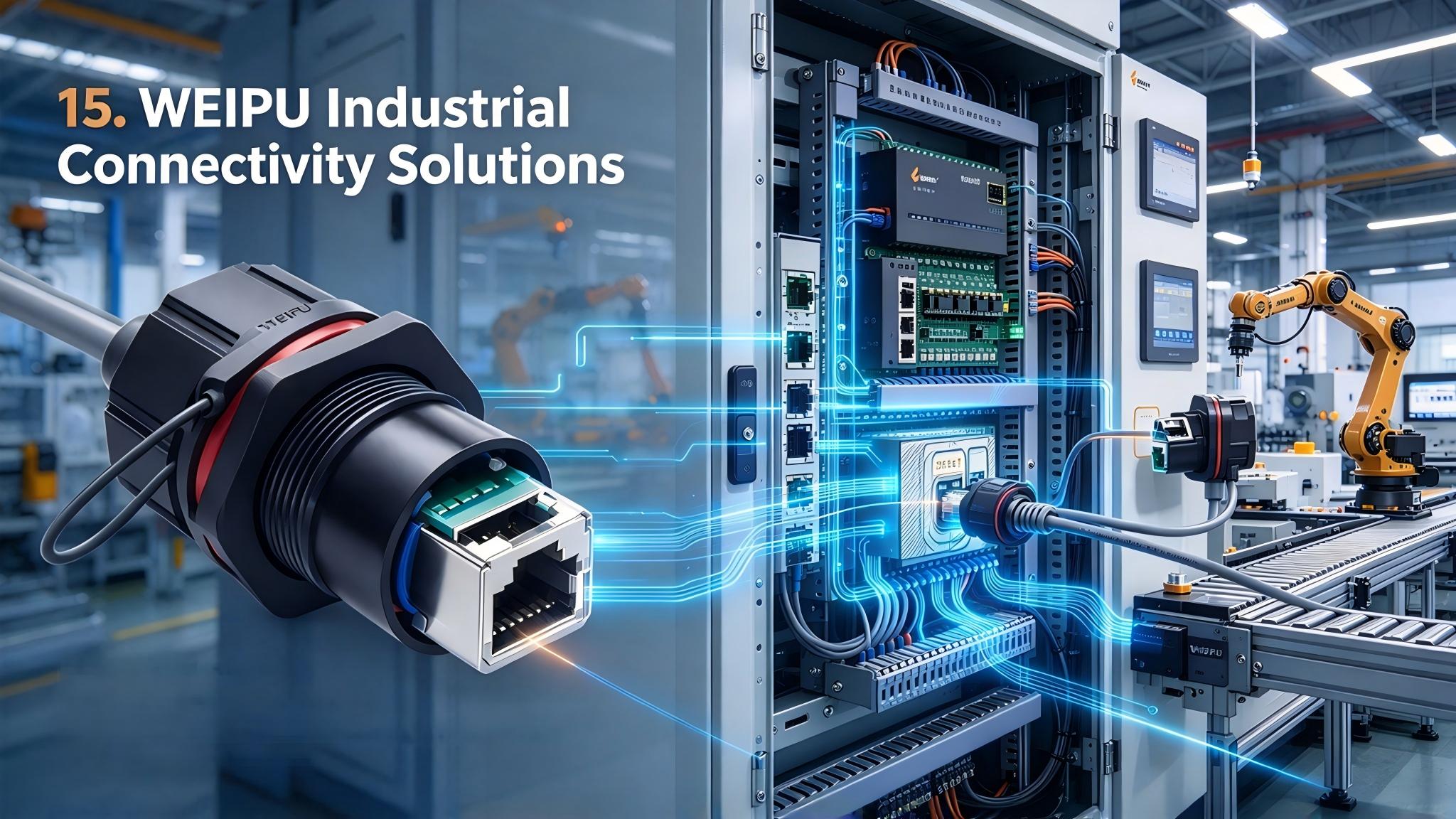
15. WEIPU Industrial Connectivity Solutions
WEIPU develops industrial connector solutions for automation, communication, power and signal applications.
Its current portfolio includes dedicated RJ45 products as well as multiple circular connector families and customized industrial connectivity solutions. WEIPU also describes customized shielding options for industrial Ethernet applications in its industrial manufacturing solutions.
For Industrial Ethernet and industrial network applications, engineers can evaluate the appropriate WEIPU solution according to:
- Network interface
- Connector configuration
- Cable requirements
- Environmental protection
- Mechanical conditions
- Shielding requirements
- Installation method
- Maintenance requirements
WEIPU Industrial RJ45 Connectivity
WEIPU's rugged RJ45 circular connector solutions are designed to integrate an RJ45 interface into an industrial circular housing.
Depending on the specific model, available configurations include different materials, coupling methods and IP protection options.
For applications requiring additional electromagnetic protection, WEIPU also offers shielded RJ45 connector solutions designed for industrial environments.
WEIPU Circular Connector Solutions
WEIPU also provides multiple circular connector families for industrial equipment.
These products can be evaluated for power, signal, control and other machine connectivity requirements according to the specific connector family and model.
However, product selection should always be based on the actual electrical, mechanical and environmental requirements rather than assuming that every circular connector is suitable for Ethernet transmission.
16. Industrial Ethernet Connectivity Is More Than a Protocol
Industrial Ethernet is an important foundation of modern automation.
But reliable Industrial Ethernet cannot be reduced to:
PROFINET
EtherCAT
or
EtherNet/IP
A complete industrial connection includes:
Device
↓
Interface
↓
Connector
↓
Cable
↓
Connector
↓
Network Equipment
↓
Industrial Environment
The protocol defines how information is communicated.
The network architecture determines how devices interact.
The cable provides the physical transmission path.
The connector creates the physical interface.
The industrial environment determines how robust that physical connection needs to be.
This is why Industrial Ethernet should be viewed as both a communication system and a physical connectivity system.
Conclusion
Industrial Ethernet connects the major systems that make modern automation possible.
From PLCs and industrial switches to remote I/O, sensors, machine vision systems and robots, these devices depend on a physical infrastructure that allows information to move reliably.
Connectors are one part of that infrastructure.
Their role extends beyond simply joining two cables.
A properly selected industrial connector needs to match:
- The equipment interface
- The cable
- The network architecture
- The installation location
- The environmental conditions
- The mechanical requirements
- The maintenance strategy
PROFINET, EtherCAT and EtherNet/IP may define how industrial devices communicate, but reliable communication also depends on the physical connection that carries that information.
The most useful question for engineers is therefore not simply:
Which Industrial Ethernet protocol does the system use?
It is:
How should the physical connection be designed so that the network remains reliable when it enters the real industrial environment?
That is where industrial connectivity engineering becomes an essential part of Industrial Ethernet system design.
FAQ
What is Industrial Ethernet connectivity?
Industrial Ethernet connectivity refers to the physical and communication infrastructure used to connect industrial devices such as PLCs, switches, remote I/O, sensors, robots and machine vision systems.
What role do connectors play in Industrial Ethernet?
Connectors provide the physical interface between equipment, cables and network components. Their mechanical, electrical and environmental characteristics can influence the reliability of the complete physical connection.
Are all industrial circular connectors suitable for Ethernet?
No. A circular connector should not automatically be considered an Ethernet connector. The specific connector, contact configuration, cable and transmission requirements need to be verified for the intended Ethernet application.
Is RJ45 suitable for industrial Ethernet?
RJ45 can be used for Industrial Ethernet, particularly in suitable equipment and control environments. Industrial versions can add features such as sealing, mechanical protection and shielding depending on the specific product. WEIPU currently offers rugged and shielded RJ45 industrial connector solutions.
What should engineers consider when selecting an Industrial Ethernet connector?
Engineers should consider the equipment interface, cable, installation location, environmental protection, mechanical conditions, shielding, connector configuration and maintenance requirements.
Customization and Beyond: Tailoring Weipu Connectors to Unique B2B Needs

Inside Weipu Connector: Engineering Excellence for Seamless Connectivity

Weipu Connector Marches on 5G Base Station Market

How to Evaluate a Circular Connector Manufacturer in 2026
Contacts
Sofia
WhatsApp/Phone

WEIPU Plug with LC adapter SA2410/PLC
The LC Adapter Connector by WEIPU ensures precision fiber optic connectivity. Engineered for optimal alignment and minimal signal loss, this connector guarantees high-speed data transmission and clear signals. Versatile and durable, it thrives in diverse environments. Perfect for data centers, telecommunications, and industrial setups, the LC Adapter Connector establishes unwavering communication pathways.
Plug with LC adapter:SA2410/PLC>more>
Receptacle with LC adapter:SA2411/SLC>more>
Rear-nut mount receptacle with LC adapter:SA2412/SLC>more>
Square flange receptacle with LC adapter:SA2413/SLC>more>

WEIPU HDMI2.0 Square flange receptacle SA2413/SHDMI2.0
In-line cable connector IP67; Mate with WEIPU SA2810
WEIPU SA2811 male and female electrical connector features a compact and precise design, making it ideal for applications where space is a limiting factor. With an advanced push-pull coupling system for quick installation, WEIPU industrial male female socket ensures positive locking and high retention. Each side of this circular connector can be male or female contact, making it very convenient for all device connection.

Weipu RJ45 Series Industrial Bayonet Connectors with IP67 Protection

Angled Receptacle RJ45F71RA Bayonet IP67
RJ45F connector is used to connect standard Ethernct Class D /Cat.5e and Class E/cat 6(10 Base T,100 basc TX, 1000 Base T net works ) in outdoor or water proof harsh working environment . no need soldering,easy to connect, it is widely use in communications,LED boards,security monitoring,automation control etc.
Get in Touch
Request Related Resources about Industrial Connections & Solutions
If you require technical details, product guides, or specific recommendations from a premier connector manufacturing corporation, please send us your request. We provide expert support for custom electrical connectors, offering OEM/ODM customization and dedicated distributor cooperation assistance.
Weipu Building, No. 111, Baihua Road, Liwan District, Guangzhou, Guangdong China
© 2026 WEIPU. All Rights Reserved.
Whatsapp: +8618102298073
WEIPU
WEIPU
WEIPU
WEIPU